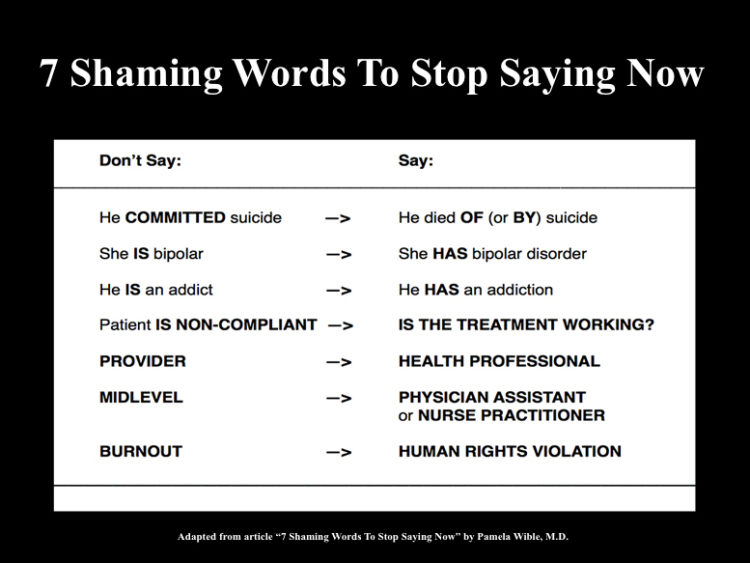
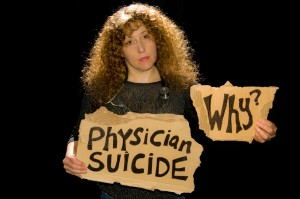
“Burnout” ~ a smokescreen for human rights abuse →

Physician burnout is human rights abuse

“Burnout” is a smokescreen for rampant human rights violations in medicine. Am I losing anyone here? Let me break it down.

“Burnout” is a complete mental and physical collapse from overwork. Psychiatrists define it as a job-related dysphoria in an individual without major psychopathy. Which means—your job sucks. You’re normal

Smokescreen is an artificial cloud of smoke that hides the perpetrator’s true intentions. This cloud of smoke may take the form of a statement or word used to obscure the truth so victims don’t understand what the heck is really going on. For example, apply the victim-blaming term “burnout” to deflect attention from oppressors who are guilty of human rights violations.

Human rights violation is the violation of a basic right to which all humans are entitled, including the right to life, liberty, equality, a fair trial, freedom from slavery and torture, and freedom of thought and expression. Common human rights violations in medicine include: 1) Sleep deprivation (24+hour shifts, 80+hour work weeks) as described by this physician whistleblower who was forced to work 168-hour shifts.  2) Not being allowed to eat, poop, pee when one needs to 3) Bullying and hazing 4) Being terminated, harassed, or threatened rather than receiving accommodations under the ADA for mental or physical health issues as described by this physician whistleblower who nearly died when her hospital obstructed her medical care.

Physician whistleblower is a physician who reveals health care’s human rights violations to the public. If you’re a physician with a whistleblower story, contact me. Doctors must stop being complicit with abuse or they will become the perpetrators (see below). Physician whistleblowers protect themselves, other health professionals, and patients from continued abuse. Silence and secrets protect the perpetrators.

Victim is a person harmed, injured, or subjected to oppression or mistreatment (may include being sacrificed or killed due to an action/inaction). Those who don’t know they are victims are at high risk of becoming perpetrators.

Perpetrator is an individual (acting alone or within a system such as a medical school, residency or hospital) who harms, injures, or subjects another to oppression or mistreatment (may include sacrificing or killing someone else due to perpetrator’s action/inaction).

Burnout is a smokescreen for rampant human rights violations in medicine. One way to end a cycle of abuse is to stop blaming the victims. Tell the truth: it’s not burnout, it’s abuse. 

___

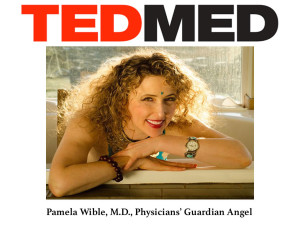
Pamela Wible, M.D., is a physician who reports on human rights violations in medicine. Have you been abused in medical training or beyond? Contact Dr. Wible. 

Tags: , , , , , , , , , , ,
5 Comments

***

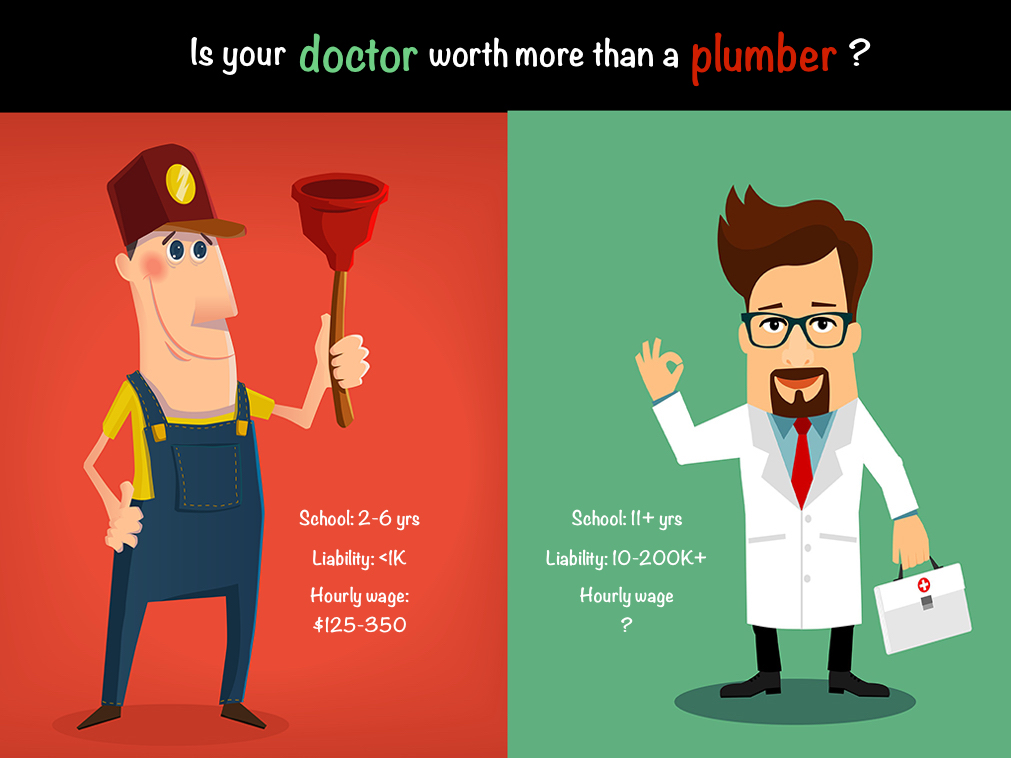
Is your doctor worth more than a plumber? →

plumberdoctor-hourly-wage-pamela-wible

I asked a group of docs I’m coaching how much they’re worth per hour. Interesting question given docs have 11+ years of specialized training beyond high school. Surgeons spend most of their 20s and 30s in school. By the time these folks graduate, they’ve got 200K+ med school debt—before kids, spouse or house. Many docs just don’t have time to develop a social life, fall in love, have children—until their 30s or later!

What’s it worth to have all that training? Where does all that delayed gratification and self-sacrifice lead? Some urgent care jobs pay docs $75/hour. Of course, patients want to see doctors for a $20 copay. Is that all we’re worth?

When I asked docs to tell me what they’re worth, many refused to respond. Why? Confusion, overwhelm, low self-worth? Maybe most doctors have been devalued for so long, they just have no idea what they’re worth. 

Those who responded were all over the map. DC Psychiatrists charge $600 per hour. A Colorado family doc is $200/hr. One in Louisiana charges $100. As a reference, a family nurse practitioner in Alaska bills at $466/hr and a med student in California claims he’s worth $600. So what’s the truth? How much are you worth per hour? (This is not an optional question. You really do need to know.)

Reality check: let’s compare doctors to plumbers. Much shorter training and tuition costs. Just a year at a community college post GED/high school. Then (depending on location) 2-5 years of paid apprenticeship before getting licensed. And what do plumbers charge? I just had a guy fix my toilet tank. Took 15 minutes. I paid $125. A gynecologist in Washington state pays her 26 year-old plumber $350/hr for emergencies.

Plumber liability insurance is usually less than $1K annually. Compare that to a family doctor at 10K+ or neurosurgeon 100-200K+ yearly. Just for professional liability insurance. Before a patient even walks in the door.

So is plumber in Washington worth 3.5 times as much as a family doc in Louisiana?

What do you think?

What would you pay for an hour with a doctor?

Addendum: As I’m publishing this (no joke), my landlord calls to tell me my office bathroom is flooding. I rush down to assess the damage. Not bad. Maybe all pricing is relative to need and urgency.

 Click here to find out how dog walkers are earning more than doctors.

Pamela Wible, M.D., is a practicing family doc in Oregon. She pioneered the first ideal clinic designed by patients. Now she helps others open ideal clinics too. Join our upcoming retreat and learn how.

Tags: , , , , , ,
78 Comments

***

Hospital obstructs medical care, nearly kills doctor →

I recently reported on Stephanie Waggel, the doctor fired by a prestigious U.S. hospital for getting cancer (story also picked up by Medscape and The Washington Post).  In her whistleblower video, Stephanie describes how she nearly died due to obstruction of medical care. 

It started during my intern year of residency.  Which, bizarrely, was the happiest year of my life. And all my friends are like, “You’re an intern, you’re not supposed to be happy, something is clearly wrong with you.” But, I’m like, “I’m out! I’m doing psychiatry. This is what I’ve always wanted to do.” I absolutely loved it. I had so much energy and I planned my outfits weeks in advance and had themes. And I had all these lectures for the medical students and it was just everything that I always wanted and it was completely delightful. I started having this pain, and it was waking me up from my sleep. And I really didn’t have time (because I was an intern) to get it worked up. But it was getting really, really bad. I was feeling really sick a lot and something had to be wrong so I really had to push to go to these appointments. 

For example, one time I went to get an MRI, but the MRI machine broke and then I had to go again the next day. And then when I told my team and my attending the MRI machine broke, they made some joke about my weight. And I was like, “No it’s actually cause there’s some helium tank in it that broke.” They were not letting me go. It was awful, and I’m like, “No, I need to find out what’s wrong with me.” So I pushed and pushed and pushed and after wrong diagnosis, and everything, they finally found out that I had renal cell carcinoma. And I said, “Well, that’s going to be a lot more doctors appointments.” 

So I went and I had a partial nephrectomy [kidney removal] and I thought that everything could be set up because there are people having babies and things like that. So I would send my schedule, like when my appointments were, and say, “Oh I have this appointment, like, three Tuesdays from now.” That Tuesday would come and everybody would be like, “Oh, we’re slammed today. You’re going to have to reschedule that appointment.” And I’d be like, “Okay.” And then, I’d reschedule it and then that day would come and they’d be like, “Oh, we’re really busy.” I would never be able to get to go to my appointments. So, eventually, I was just like, “I’m going, I need to go.” And my oncologist said that had I not gone, I would have died within at least a year or two. And, when he said that to me, I was like, “Well, I’m really glad that I went, because had I listened to everyone around me, I would be dead in a year or two.”

And I distinctly remember this attending that I had, on the day that I was diagnosed with cancer, told me to pick between being a doctor and being a patient. And up until that point, I never really thought about, “What if I’m a patient and a doctor?” But then, the entire year was just a struggle to be both. 

So I went to my chief for help, I’m like, “I need to go to these appointments, like follow-up,” cause I needed genetic testing because what twenty-eight-year-old female gets kidney cancer? And he was just saying, “Ugh, we’re going to have to re-do the call schedule.” And I’m like, “I’m so sorry to inconvenience you, but I have cancer.” Then I went to governing bodies (that I won’t mention) and they were telling me, “This really isn’t our problem, it sounds like an institutional kind of thing.” So then I went to people in my program, I went to attendings, I went to the dean, I went to the hospital ombudsperson (who cried when I told her what was going on). She seemed to care a lot, but she basically said there is nothing I can do for you.

After that, I saw her in the hallway at work and she had this look like, “I’m so sorry that I can’t help you.” And she came over and handed me a piece of paper and hugged me and walked away. And I looked at the paper and it was the telephone number to a lawyer, and I’m like, “This is all just so bizarre.” So then, I really didn’t want to get the legal system involved, but there’s got to be somebody that can help me. So then I started writing to the university president and he didn’t reply to me either. 

So I just got to this place where I decided to just fix everything on my own. So I made it a QI [Quality Improvement] project to create a system that I call PWP (which is physician wellness program). So that if anybody else has a chronic illness, or even needs to go to therapy every week or something, that they don’t go through all these hurdles that I was going through. And I spent a lot of time and research and effort into this and that’s how I found out about the National Day of Solidarity to Prevent Physician Suicide, which I worked on with Pamela. Once my department found out that I was doing this, they’re like, “You need to stop.” And I said, “But, you told me to do research and I’m doing research.” And they said, “You can’t have days about suicide.” And I’m like, “Why not?” 

So then, I did finally get a lawyer and I filed a claim to the EEOC and then when they found out I filed the claim to the EEOC, they voted to terminate my residency. And, I appealed that cause my evaluations from my attendings, I had maybe two average and the rest were above average.  And it just didn’t make sense so I figured that maybe they’d look my appeal and wonder, “Why are we firing her?” But then, when Care 2 published a little paragraph about why I got involved in the Day of Solidarity, and I spoke about how I had cancer and was having a really tough time getting off work to go. That is the day that they chose to send me a letter stating they’re terminating my salary and my health insurance, knowing that I still had more follow-up. So I just thought this is definite retaliation, the vote to fire me was after I filed with the EEOC and then the letter I got terminating all my benefits was the same day as my paragraph for the Care 2 page came up. 

So, now I am unemployed, so I am full-time working on PWP. So if anybody has any connections to residency programs that they’d like to implement a wellness program into, I’m your gal. 
 

Stephanie Waggel fired for cancer

Leave Stephanie a comment below or contact her at ImproveMedicalCulture.com.

Got a whistleblower story? Been abused in training? Contact Dr. Wible.

___

Pamela Wible, M.D., reports on human right violations in medicine and offers physician retreats to help her colleagues heal from the trauma of their training. Are you a wounded healer? Come join us! Video by Geve. 

Tags: , , , , ,
29 Comments

***

Medical marketing: 147 ways to grow your clinic now →

Need help getting patients? Medical marketing is my specialty. In 2005, I pioneered the first ideal clinic designed entirely by patients. Six months later, my waiting list was out of control—nearly twice my number of patients. I gave the list to a new doc in town and I’ve been helping folks launch successful clinics ever since. Here are 47 of my best 147 marketing strategies. In no particular order. Most are free/low-cost. 

Download all 147 marketing strategies here.


1. Word Of Mouth – Keep people talking. It’s the #1 strategy to build your practice. Everyone loves to share the latest and greatest thing in town. Are you giving people something amazing to talk about? If not, why aren’t you? 

2. Testimonials – Every happy patient should be offered an opportunity to leave a testimonial, either written or video. Place these on your website, social media, newsletters, billboards, wherever—with proper consent, of course.

3. Social Media – Your patients (especially the younger gen) are all over social media. Are you? You need to be where your patients are hanging out so you can capture their attention with the super-cool stuff you’re doing.

4. Facebook Page – Start a personal and professional Facebook page. Your personal page can remain more private if you like; however, your professional page may have unlimited fans. Here’s mine. You can do it too.

5. Facebook Group – You can also create a Facebook Group in a disease-specific category to attract your patients. Serve people from beyond the borders of your town. Get known for your specialty and services.

6. Blogging – I started my blog in 2011 with no idea what I was doing. Now my blogs have been picked up by The Washington Post and TIME Magazine. One became Medscape’s most-commented article ever. Don’t underestimate the power of blogging to share your unique message with the world.

7. Op-eds – I’m amazed at how many people still read the local print newspaper. One day, I was in line at the post office behind 3 women (I had never met) who were discussing my op-ed. Then I was the invited speaker for a coastal Oregon City Club. I couldn’t believe the line of folks with walkers and canes who wanted to meet me because they’d been reading my op-eds! Great way to reach the older demographic.

8. Town Hall Meetings – This is my all-time-favorite method to reach patients. I led 9 town hall meetings over a 6-week period where I invited my community to design their ideal clinic. I collected 100 pages of testimony, adopted 90% of their feedback, and opened our ideal clinic one month later with no outside funding. (Note: I never did this for marketing purposes, yet 1/3 of attendees became my patients).

9. Website – Most clinics have a website (except for a psychiatrist friend of mine who is so popular she’s afraid to launch a site). Ha! You can always take your site down if you don’t want to be found.

10. Chat Rooms – Are you an expert in fibromyalgia? Go hang out in some online chats and promote your expertise (in a friendly & non-salesy way). Get to know what patients are saying when you’re not around.

11. Newspaper Column – Once you start writing for your local paper (see #7), editors may want you to do a regular health column. Or maybe staff writers will cover you in one of their health columns. Depends on the newspaper. 

12. Newspaper Article – Your local newspaper may even offer do a special feature on your clinic! If you’re doing something truly unique you’ll have a much greater chance of being a story. So what are you doing that’s noteworthy?

13. Radio Interviews – Surprisingly, people still listen to the radio. Especially drive-time shows in congested areas like Los Angeles. I’ve done a few drive-time slots. They’re really fast-paced and fun.

14. TV Medical Correspondent – If you’re a real go-getter you could even get invited to deliver the health news on TV as their local doctor-turned-medical-correspondent. That could be a really cool gig. Your practice will fill fast.

15. Human Interest Story – If you’re doing something fun, intriguing, new-and-exciting, you may become a human interest story. My local TV station followed me on a housecall on my bicycle back in 1999 when I opened a clinic for the uninsured in my house. The local paper also did a similar story on my book, Pet Goats & Pap Smears.

16. Disease-Specific Groups – There are local, regional, national, and online disease-specific groups. If your specialty is cluster headaches, I can guarantee you’ll have a gazillion opportunities to connect with people who need you. Desperate patients (even poor people) have begged to fly to Oregon for me to be their doctor. When people find a doc who can truly help them, they’ll travel to the ends of the Earth to get to you.

17. Pharmacists – Go meet all the pharmacists within a 5-mile radius of your clinic. They hear from patients all the time who dislike the service, care, and prescriptions that they’re taking. Get pharmacist referrals.

18. Urgent Care – Meet the folks at the local urgent care(s). They need docs to follow-up with their patients.

19. Emergency Department – Get to know triage nurses, ED docs & staff. They’d love to make sure patients have timely follow-up. 

20. Health Professionals – Everyone needs somewhere to refer patients. Network with chiropractors, dentists, naturopaths, massage therapists, psychologists, dietitians, and anyone else who you happen to run into.

21. Overworked Physicians – Offer to help with the load. Docs who are working assembly-line medicine jobs at big-box clinics may appreciate handing you their complex chronic fatigue patients who cause them to run an hour late.

22. Library Talk – Go give a talk at the library. Works even better if you’ve written a book that they can carry on the shelf.

23. Business Cards – Don’t make boring business cards. To attract patients, your cards should be exciting & fun—something they’d want to show others. Be original. If you love what you do, your business card should exude joy. Boring card = boring doctor.

Pamela Wible, M.D.

Me (with the shaving cream beard), my cousin, and my brother in the bath tub.

24. Brochure Display – While you are making your super-fun business cards, you can make a great brochure. Get a little plastic display thingy from an office supply store. Offers these to people you meet (like say #17 -21 for starters)

25. Wrap Your Car – I almost did this. Though expensive, it’s so fun. People will see you coming that’s for sure.

26. TV Interview – Breaking medical news? Trending health story? Offer to be interviewed about the flu, norovirus, etc . . .

27. Regional Newspapers – If you are providing a specialized niche service that could draw people outside of your local area then get into the regional papers. Especially if you want the older crowd (who love to see docs frequently).

28. Church Newsletters – Get your your message in every organization newsletter than targets your ideal patient demographic.

29. Sponsor Local Events – Softball teams, local parade (ride on a float), city celebrations, Christmas toy drive. They’ll print your name/clinic everywhere and even read your name aloud at events, on news, etc . . .

30. National Print Media – See #6 for what can happen with your blog articles. 

31. YouTube Channel – Start posting videos on your own YouTube Channel and get noticed all over the world.

32. National Broadcast Media – One of my YouTube video stories was picked up by 12,000 media outlets. Diane Sawyer even shared it on ABC World News. My exact words and graphics too! Ya never know where you might go.

33. Door-To-Door – One guy wanted to open his practice in an oversaturated market. They told him he’d never make it. Well, he went door-to-door marketing to 12,500 homes & introduced himself to 6,500 people in 6 months. First month open he netted 72K. Ignore naysayers. Believe in yourself. Start knocking on doors.

34. Hijack Social Events – I learned this technique from a physician in my course who told me she applies my Town Hall Medicine strategy (#8) to all social events (dinner parties, hikes with friends, whatever). Brilliant! 

35. Patient Referrals – ALWAYS ask patients for referrals. Especially when they’re thrilled after giving a testimonial (#2).

36. Clinic Party – Host a seasonal party. Happy Spring! Opening Day! Invite patients. Have them bring friends & neighbors. In my clinic, we even had a Pap party! (see marketing strategy #75). 

Marketing Medical Clinic

An actual Pap party in my office. Is there a way you could make physicals fun? Wear a party hat maybe?

37. Patient Appreciation Day – On random Fridays, I give patients chocolates and mylar balloons (they float for 30 days). So throughout the next month patients keep talking about their cool doctor.

38. Networking – Like with every single person you meet from the gal at the shoe store to the guy at the auto parts shop.

39. Insurance Companies – Be a “preferred provider” in-network doc and you’ll be in the insurance company booklets. 

40. Local Businesses – Let local companies know that you are happy to be available to help their crew with medical needs. Sometimes the employer will just pay you directly for a portion of employee health costs.

41. Email Marketing – Make sure you gather patient email addresses. Send out a weekly newsletter or quick note about your latest blogs, articles, specials, referral coupons, holiday greeting. Keep in touch.

42. School Events – Be the school doc. Offer to do sports physicals. Ask school nurse for referrals. Speak in health class.

43. House Party – Throw a party in your house for friends. Best weight-loss recipes. Some fun topic. Pass out cards (#23).

44. Block Party – Organize a block party. Raise money for some health condition. Give a presentation. Get to know folks.

45. Neighborhood Associations – Speak at neighborhood association meetings and make sure they know you’re just down the street.

46. Packages – Offer new packages for patients. Weight loss programs. Diabetes reversal program. Get folks excited.

47. Patient Holiday Party – Since I have no staff, I hosted a winter pool party for patients (& guests) at the wellness center where I lease my office. Swimming in the salt-water solar-heated indoor pool. Live band (my patients). Food catered by my patients. I brought the “I love my doctor” cake. People brought neighbors & friends.

Whew! That’s the first 47. Want 100 more? Grab all 13 pages with instructions below.

Download all 147 marketing strategies here.

* * *

Pamela Wible, M.D. is a practicing physician in Oregon. She leads physician retreats to help doctors (and health professionals) launch their own ideal clinics. Need help? Contact Dr. Wible here.

Tags: , , , , , , , , ,
7 Comments

***

Who else wants to be debt-free & quit working by 36? →

Pamela Wible Debt-Free Doctors

Want to step off the treadmill? Here’s a fool proof strategy: live debt free.

If your life seems out of balance, maybe the life you’re living isn’t your own. If you’re a doctor, nurse, midwife, med student—anyone who wants to heal the suffering in the world—my message for you is: heal yourself first—and start with your financial health. 

My best advice: don’t allow a bank to own your house; don’t allow an employer to own your career; don’t allow anyone to own your life. In short, don’t sell your soul.

I’m a small-town family doc. I live in a sweet cozy home that I own. Paid cash. Previously, I paid off 2 other houses and my student loans by 34. Then I quit working at 36. I’m not retired. I just quit working on someone else’s clock. In fact, I haven’t set an alarm to go to work since 2004. What I do now isn’t work. It’s fun. I see patients 3 afternoons per week. I get up when I want. I do what I want. I don’t owe anyone anything. I’m free. To live. My life.

Thankfully, I only had $22,000 of student loans (paid off in residency). Then I worked as a physician employee at various clinics for the next 7 years. And I paid down those mortgages. My only regret: I could have done it faster.

As a physician employee, I was forced to practice assembly-line medicine. My overhead: 74%. So for every $100 I earned, I kept $26 (pre-tax!). My contract: 193 days/year. So each year I worked 143 days (74% of 193) just to pay overhead. And guess how many patients I had to see in 143 days to subsidize my overhead? At 28 patient visits per day that’s 4004! Just to pay overhead! 

Join our upcoming teleseminar & learn how to liberate yourself. 

In two years, I generated 1 million in revenue, yet $740,000 went to overhead. While I was in debt. I was nothing more than a physician factory worker selling my soul. My quick route to financial freedom was to eliminate debt and quit my job. In 2005, I opened my own dream clinic. I’ve never been happier. And I’ve never turned anyone away for lack of money, yet I’m more successful than ever. How? My debt-free low-overhead clinic allows me to triple my income per patient (see video) while charging less than big-box prices.

Here’s the bottom line: stop paying interest on your debt and start receiving interest on your income. Keep the revenue you are generating. Please.

So how can you become debt-free ASAP? What’s the secret strategy? I was fortunate to meet up with Cory & Carolyn Fawcett at an event where I was speaking on physician suicide. Carolyn is a brilliant accountant and Cory is a “semi-retired” surgeon who helps distressed doctors in debt. Turns out eliminating debt may even decrease physician suicide. 

“In general, doctors do not have an income problem—they make good money,” Cory says. “They usually suffer from an expense problem and are not willing to face it.” Bingo! 

In his breakthrough book: The Doctors Guide To Eliminating Debt, Cory provides a quick & easy four-step formula for becoming debt free. Step one: assess the problem by calculating your current net worth (total assets minus total debt = net worth). Step two: establish your goals. Step three: create a spending plan and step four—pay off your debt starting with the smallest loan first.

Doctor's Guide To Eliminating Debt

“Too many people spend money they haven’t earned to buy things they don’t want, to impress people they don’t like,” says Will Rogers. You can break the debt cycle.

Debt-free doesn’t mean deprivation. Without debt, you’re less stressed with more time for vacations (that you don’t need to take!). You can leave your sucky job—without fear. Plus you’ll accumulate more money and have way more fun. Imagine seeing patients because you want to (not because you have to). Best of all: you’ll be able to live your dream.

So what’s your dream? 

Cory is living his dream by practicing surgery on his own terms. He stopped performing some of the more lucrative procedures he disliked. Now he fills in for rural surgeons (who need vacations) so hospitals can operate in their absence. He also writes books to help docs with their finances.

I’m still practicing medicine in my dream clinic. I also run a suicide hotline for docs and medical students. Plus I host retreats to help health professionals heal from the trauma of their training so they can open their dream clinics too. Most recently, I launched a scholarship fund for medical students.

Cory and I are able to live our dreams because we’re in the debt-free doctors club. Want to join us? 

My parting advice:

1) Build a life you don’t have to take a vacation from. Live your dream life in medicine. Here’s how.

2) If you love what you do, don’t retire. Retired means “tired again.” Boredom can hasten your death.

3) Don’t hoard more money than you need. It’s called currency for a reason. Keep money flowing to causes you believe in. 

pamelawibledebtdoctors

Pamela Wible, M.D., is a part-time family physician and author of Physician Suicide Letters—Answered. Cory S. Fawcett, M.D., is a part-time surgeon and author of The Doctors Guide To Eliminating Debt. He blogs at Dr.CorySFawcett.com. They both practice medicine in the beautiful state of Oregon where Dr. Wible hosts popular physician retreats. Come visit!

Tags: , , , , , , , , , , , , , , , , , , , , , ,
48 Comments

***

ARCHIVES

WIBLE’S NPR AWARD

Copyright © 2011-2026 Pamela Wible MD     All rights reserved worldwide     site design by Pamela Wible MD and afinerweb.com