



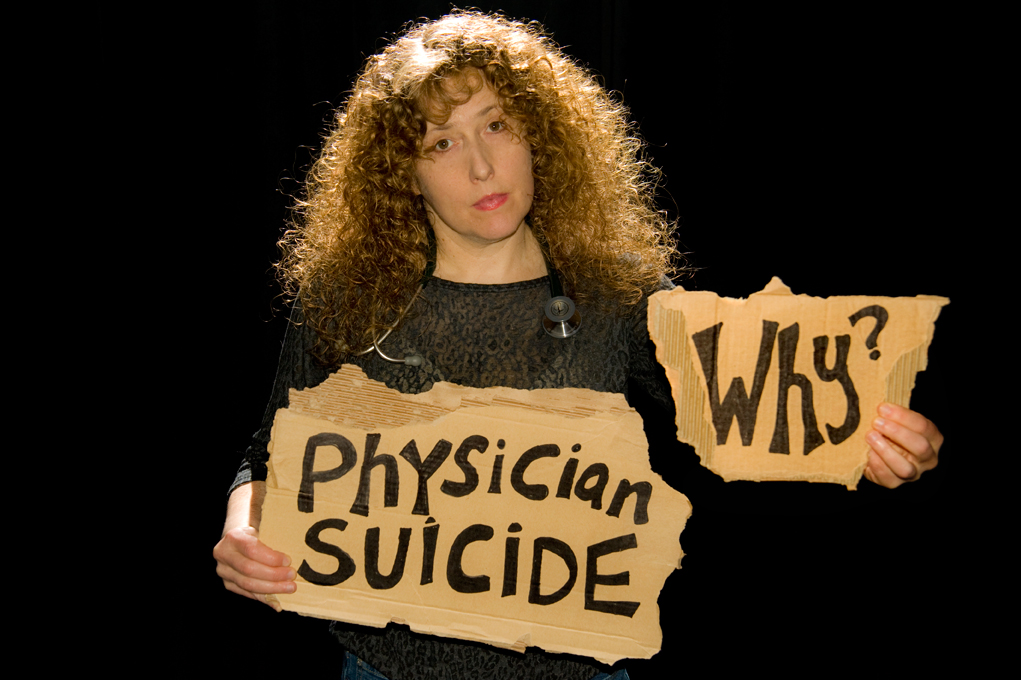
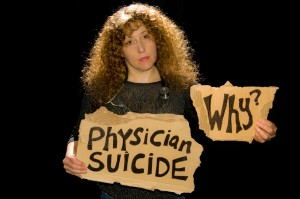
I’ve been a doctor for twenty years. I’ve not lost a single patient to suicide. I’ve lost only colleagues, friends, lovers–ALL male physicians–to suicide. Why?
Here’s what I know:
A physician’s greatest joy is the patient relationship.
Assembly-line medicine undermines the patient-physician relationship.
Most doctors are burned out, overworked, or exhausted.
Many doctors spend little time with their families.
Workaholics are admired in medicine.
Medicine values competition over nurturing.
Many doctors function in survival mode.
Doctors are not supposed to make mistakes.
Caring for sick people can make you sick if you don’t care for yourself.
Medical education often dissociates mind from body and spirit.
Some medical students believe they graduate with PTSD.
Seeing too much pain and not enough joy is unhealthy.
For a physician, a cry for help is weakness.
The reductionist medical model is dehumanizing for patient and physician.
Many doctors are emotionally detached (especially male physicians).
Doctors are obsessive-compulsive perfectionists in an imperfect medical system.
Physicians are the nation’s social safety net with few resources to help patients.
Some doctors feel like indentured slaves.
Death is perceived as failure.
Doctors don’t take very good care of themselves or each other.
Many doctors are in denial about the high rate of physician suicide.
Physicians are often bullied by insurance companies, employers, and patients.
Doctoring is more than a job; it’s a calling, an identity.
Doctors are often socially isolated.
Doctors can’t just be people. They’re doctors 24/7.
Doctors can feel severe psychological pain.
Doctors can feel powerless.
Doctors can feel trapped. Some see no alternatives to their suffering.
Doctors have easy access to lethal drugs and firearms.
Doctors have the same problems as everyone else.
Doctors have marital distress. They get divorced.
Doctors have addiction to drugs and alcohol.
Doctors have economic hardship and unbearable debt.
Doctors have mental illness.
Doctors are human.
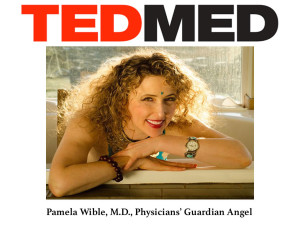
Watch TED talk on physician suicide.
Pamela Wible, M.D., is a family physician, author, and expert in physician suicide prevention. She offers biannual retreats for physicians struggling with burnout and depression. Contact her at idealmedicalcare.org.






As a third-year medical student, I can extrapolate all of the above statements and feel their truth in my gut. The economic hardship part rings particularly true at this point, but I trust/hope that will pass. At this point, I often feel trapped, like I can’t be myself, like we are constantly being watched. Upholding the utmost level of professionalism is drilled into us from day 1.
I see it already: the day-to-day minutiae, the email fatigue, the endless requests for you to DO something OR ELSE, all of it. Not being free to take care of yourself, developing a warped sense of what “time off” really means (not much), feeling guilty when you advocate for a meaningful quality of life. When it all builds up, I go see patients, and all this B.S. I’m complaining about melts away, for that time. Therein lies the key!
Yes. We need less “to do”and more time to be. Just be. I also get centered and recharge around patients. It is the system that beats one down.
Oh and please cut & paste your comment above on The Oregonian blog. Time for a candid discourse on this topic!
Extremely powerful. Fortunately I have not lost any colleague that I know personally but there was one physician suicide that I know of in our community about 2 years ago. The practice manager was a patient of mine and it really rocked her world.
But as we say in medicine death is only one extreme negative endpoint. Doctors and patients are suffering every day.
Keep up your important work.
DFD
Thanks John! Will continue “to ask the difficult questions.” This was the recommendation from the widow of a physician lost to suicide in our town.
Some doctors could have an undiagnosed brain of bipolar 2, that is very difficult to discover medically. and all it takes is one good trigger, and bam, its curtain time.
Yes, I know of many older docs who choose suicide as an end to terminal illness (legal in Oregon where I live).
Powerful.truths. Saw myself there more times that id care to count.I ve been a physician for almost 25 years now,lived in the US but was put off by the coldness,the machinery feel of it all.In my third world native country is a different deal bt then you have a whole different set of irksome problems:unchecked mediocridity,inadequate resources,damn impotence!!Back in my Internal Medicine Resident(just the first year,enough was enough for me)I became so frustrated I abandoned the carrer for more than three years.Now I live in a rural area and am planning a holistic practice.lets just exchange input.
Thanks Carlos for your honesty. Please let me know if I can be of any help in planning your practice. Physicians should nurture one another and collectively we will demonstrate what a health care system can be. I’m here if you need me. 🙂
A dear friend & surgeon committed suicide last spring. We’re still struggling to understand why, and can’t help but wonder if we could have done or said something differently to prevent it. It’s an important issue.
Yes, such an important issue and many people are unaware or in denial about the high numbers of doctors committing suicide. Unfortunately, there is no agency tracking all the data in any effective way. That’s part of the problem. Claiming this as a public health issue is the first step in healing. Please let me know if I can be of any further assistance. I’m here.
You put this so well – I just sent the link to your post to Sen. Sanders, for their health care hearing this month.
Wonderful Jennifer Michelle. Thank you. This is an underreported public health topic. Physician suicide is the triple taboo. Three issues so difficult for Americans to discuss: death, suicide, and healers harming themselves.
I am not a Physician but I know many as there are close family members Number One reason why Doctors commit suicide is
Doctors think them self as a Super Man and they consider every other physician as competitor this ego makes them not seek any kind of help, also isolates them and make vulernable for other sharks to in the tank (lawyers, insurance companies) to take advantage of them.
Doctors needs to collectively address this situation before anything they need to admit and understand they are humans they don’t think of themselves, after working 48 hours shift they think they can do this allover again after a brief nap
So true! And a repeat 48 hour shift after a brief nap. Love that line. The stories I could tell on this topic!!!!
One of the reasons that physicians don’t ask for help is that if they suggest that they aren’t perfect, their license is in jeopardy. They risk losing hospital privileges and they risk being overly scrutinized by their piers, and hospital and clinic administrators. Before you judge physicians, try being a physician who has actually practiced.
Oops, that’s peers and no comma following.
Thank you for this article. I am in my final year of medical school and have had several classmates attempt suicide over the course of my degree. I love medicine and I love people, that’s why I chose this profession. Sometimes when awake studying at 3am, or watching an autopsy, or witnessing highly emotional scenes at the hospital, I feel incredibly alone. Sort of like I’m not a part of humanity! It deeply saddens me that classmates and colleagues feel they are unable to seek help for their problems, and I hope there is more research in this in the future.
Julie ~ I’d love to talk to you. You are not alone in your feelings. I am dedicating myself to helping other medical students and doctors be the healers they always wanted to be. There is no need to continue training physicians in a manner that isolates us from one another and leaves us feeling disconnected with our hearts and souls. Call me anytime. 541-345-2437 . . .
Thanks so much for calling attention to this very real, and very serious issue. I am a physician (psychiatrist, fortunately) as is my husband. Our 29 y.o. Physician son died of suicide (now the more PC term that physicians should be aware of) in June of last year. We struggle everyday to understand the “why” of this. As you point out, the causes and contributing factors are many. He struggled with depression and alcoholism and was being monitored by the Missouri physicians effectiveness program. When he relapsed 1 week before he was to begin his oncology fellowship at a high-powered academic institution, he notified the board, then got drunk and took his own life (with a scalpel). No one at the hospital claimed to have any awareness of his struggles, worse yet, they cleansed the death notice we provided them of unsavory details. They clearly see his death as an injury to their institution. They have offered little in the way of condolence to us. This matter must be brought into the light of day. The lack of data about the number of suicide deaths is appalling. The monitoring people from the Medical Board ( who were the last to speak with him that day) have provided us with scant information. They told us that they did not plan any sort of internal case review. He was seeing a psychiatrist, but they never sought collaboration with him. They thought he was a “model patient”. So this is what oversight by the Medical Board provides to impaired physicians. Well, I could go on…..and probably will…but want to hear more from others. How can we take action? I cannot bear the thought of young doctors as dedicated and talented as my son dying in such a tragic manner. Your list certainly resonates with Greg’s struggle to come to grips with allowing himself to be human and vulnerable in such a highly competitive environment and to deal with the shame he felt about his very human vulnerabilities.
Thank you SO MUCH for being open and honest about the tragic loss of your son. I believe the Medical Boards should be tracking these deaths. We should certainly be able to have correct data and statistics on the loss of our own colleagues. The level of denial is disturbing. We can not allow our healers to suffer in isolation. The first step would be that we collectively recognize this as a real problem among physicians.
I have a shameful realization in looking back many years. The psychopath who ran my residency program had decided that He did not want me to succeed. That is not too unusual. He went out of his way to cripple and destroy me. I am certain that he wanted me to suicide during residency. There is no doubt about it. We recoil from believing that; but there is evil in the world. He was not empowered to erase MY humanity – but he came closer than I even want to admit. One think is sure – anyone who died from suicide lived in a world that was not fit for human beings. That is the fault of everyone in that world.
I, too, endured a residency littered with sadists. I refer to my four year med/peds training fifteen years ago as “my own personal Vietnam.” Thank God my husband and family remember who I used to be. Every now and then I catch a glimpse of that happy person, and I’m trying to find my way back. At least, I can say I did NOT contribute to the kick-you-when-you’re-down shame and blame culture at my institution. I did stand up for my interns and I did not allow them to be bullied and humiliated. I tried to be the senior resident I wished I had been. Probably good for my trainees, but not for me.
I have recently found Dr. Wible’s info, and I am looking forward to learning more. Also, I have found a physician coach, Dr. Dike Drummond (The Happy MD.com) who has been a life saver for me. He has helped me realize that I deserve to be happy and that my original intent–to take care of patients is my calling. He has pulled me back from the edge that I was teetering on (very clear to me now, and so scary to think I had no idea how close to that edge I was.)
My point, is to encourage my colleagues. There is hope, WE are that hope. And there is help, hence this web page, and my coach as an example. I’m seeing things in a new way now, and I’m on my way back to the life I deserve.
Thank you for allowing me to contribute.
It is true that people who commit suicide do not deserve to live in a world so cruel and it is not a sin, It was taught that if you kill yourself you go to hell. That you are a coward,selfish and weak. It is to scare us because it is the opposite. I came to realise that taking your own life is a sacrifice and has to be done by a person who is very strong and complete in spirit and it is the soul suffering. How could a mother take her live, I seem to meet children and adults who have lost a parent, I came to conclusion that people suffering who care and love so much it is unbearable to live in a life that is hopeless and helpless. And when you have no power to care for your own child or have a calling a degree to heal and save life. It make sense that suicide is very high in medical field. It is from my own experience with interns and hospital politic that i became a lost soul. I had no faith in humanity and do not try to take my own life pre medical life. I started with wanting to take the life of a list of people. The first was the last person. This was a intern that look at me like she knew me. This was after i knew the truth. That was 14 years ago. It is from this site and my isolation and total feeling i would die before treatment i died. And from then on i became strong in faith and in all my unconditional questioning of why. Praying for Gods will to be done, I think i am dying. But want to live, Be the caregiver and person that did not fear asking for help because if i ask and you deny i may snap.I have and will i have to avoid all walks of life and have for 14 years. If not for internet i would be dead. I am begging you to help me and let me help end what i have to share is very chilling cold hard facts, I did not even know i had recordings and records of what i was experiencing like i was having a out of body experience. Like how you Dr. Wible explained when asked what qualifies you to question or ask why? To conspire and manipulate me to a point i became detached on shut down just as i always have being abused as a child. It is chilling today because the person that i considered a murder and hold hospital accountable for. Was the doctor i blamed for killing my baby and torchering me. It has been 30 years, I stopped looking for him along time ago. And have come full circle. My purpose has made me thinking he may have killed himself because it was when i went to follow up appointment i was told he moved is practice. to i think mid west. I felt his soul in the descriptions given in how it is covered up. You said you come to appointment and they are gone. I know he knew he clearly caused deep pain that i did not even understand i was only 18 years old, He should not have played God. I forgive him and every doctor under the administration, And that has been my target always, The Doctors were personal. I would say i want to slap that blond haired Brown noising interns face. I am very much a part of history in many lives. Government will be hearing my claim Jan, 13 and do not want to hurt or share my life with anyone, But will be heard. Not anyone knows the whole truth only Me and God. But i did have many witness to many issues. I was there. I clearly have figured out what i know happened. It hurts even more because so many lives lost. Obama will care. It is scary today. But i have no more questions. I need no answers. It has to change i can not live among the administration. I will no be covered up or un notice, It is in Gods hands. I hope i can have everyone’s support i had a calling too.
Dear MDKK,
I am so sorry for the tragic loss of your son. I’m an RN who received my degree from Johns Hopkins and spent my whole career there. I know these pressures affect nurses as well as MDs. I have made a special effort to be supportive of all the residents and attendings I encountered in my area (OR). It’s so easy to be critical of them and they don’t need one more stressor from the OR nurse. They don’t have much quality of life and we need to change the whole system. You and your family are in my thoughts.
I thank you for the website and the many comments by people. I qualified in the UK and things here appear to be the same. I have several colleagues who have committed suicide over the years, and I feel lucky to have survived myself, for all the reasons you describe. I am particularly taken by the PTSD image. Yes indeed I was traumatised in medical school and it continues to happen, but we get accustomed to it, to the point of becoming an abused class.
Thank you for sharing your thoughts Christian. So sad that medical students and physicians have become accustomed to so much abuse in what should be a healing profession for all, patient and physician. Let us bring this issue to light so that we may heal together.
Suicide is becoming an epidemic in our society. Every suicide is a tragedy that leaves a wake of grief and unbearable guilt. Unfortunately, family, friends and loved ones are left to suffer the rest of their lives due to the “what ifs and whys”. I have been touched by suicide more times than I can count, most of them young people between 15-25.
It breaks my heart that anyone ever reaches the point where they feel their life doesn’t matter or they feel they have no where to turn. Yet I know everyone who contemplates taking their life has many, many people who lave them and would do anything to help them. As a society, we need to teach our children it’s okay to ask for help!
My desire is to start a program, go into middle schools and high schools providing tools and messages of hope and purpose. Please email me if anyone has any insight or resources that could be helpful. We must shine a light and turn the tide on this tragic epidemic that is gripping our nation! My email is margopowell @yahoo.com.
My post was meant to say “many people that LOVE them”.
Pamela, thank you for your important work in this area and your powerful insights.
My purpose for coming to this sight was because a beautiful female acquaintance took her life recently. She was a physician with a promising career and successful practice. She was married to a handsome pyscholgist husband, had everything to live for and yet lacked purpose. Couldn’t make sense of it then and still can’t. My condolences to all that have suffered a loss to suicide!
Hi Margo, Thank you for writing. I am going to start interview people (physicians primarily) who have survived near-suicide. Doctors are the worst at asking for help – especially male doctors. Men don’t even like to ask for directions when they are lost!
Oh my! Where do you live? We must stay in touch. If you hear of any docs who contemplated suicide and then chose not to proceed, I would like to speak with them.
Hi Pamela,
Hadn’t come back to your site since my post. I recently heard of a young intern who recently tried to hang himself in the hospital he was working at here in Honolulu. If I can find his name and contact information for you, I will.
I am diligently working to put my program together for young people. The statistics surrounding those most vulnerable are frightening. The numbers are increasing dramatically:(
Thanks for keeping me informed. I am offering a biannual retreat for physicians to prevent suicide, depression, and burnout. Please let folks know. It is open to anyone in health care, but ESPECIALLY physicians. Physicians rarely ask for help. They need to be lassoed and dragged in. (excuse the metaphor, but it is TRUE!)
I am a Midwestern family physician who attempted suicide almost 2 years ago, shortly after starting a new, stressful position and then subsequently discovering my husband of 18 years was having an online affair. I had been teetering on a fine line with depression and suicidal ideology for many years, and my resources had simply been used up. I carry more shame than I feel I can bear sometimes, and occasionally surviving seems like a curse. I have continued counseling and medication to fight the battle against depression, but I’ve had a hard time keeping my marriage together while doing a demanding job. Recently, I became somewhat overwhelmed at my work, and got teary. I told my boss I needed a minute (it was the anniversary of my attempt), and instead of letting me have the 5 minutes I needed to collect myself, he called in a colleague and told me I needed to go home. Granted, I work in a busy urgent care, but I didn’t think it merited the threat of firing me. I’m so sorry I missed your most recent retreat. I would love to attend one.
I will be offering one more retreat in May. It will be the last of its kind. Very intimate and healing for physicians. I hope you can make it. Please keep in touch and let me know if I can ever do anything for you. I’m here.
I am one of those….you asking powerful questions and I commend u for it
I am one of those….you asking powerful questions and I commend u for it
I think almost everybody who goes into a healthcare field has a strong sense of purpose . . . then you arrive at the factory floor (medical school/nursing school) and realize that you’re still competing with others and should anything happen to you, somebody will step in to fill the void. Given how dehumanizing healthcare is, (for both patients and care providers), it is not wonder that doctors feel they don’t have a purpose. And of course there is the issue of the biochemical etiology of depression, meaning that depressed people might not “have a reason” to be depressed, yet be very depressed.
I enjoyed your post and these stories need to get out there because our
health care system is SO SICK for reasons the general public has no idea
about!
I’d love to mail you a book if you send me your mailing address.
Also LOVE it if you would come to the next retreat. You should
heal from the abuse that you may still be carrying around. It is
so hard to get the sadness and anger out of ones system after
being SO ABUSED in a health care training program!! I know!
It took me a good ten years to heal from all that sadistic treatment.
I bet there is a way you could still practice medicine – on your own terms
and consistent with your highest values. It would be my honor to help you do that.
~ Pamela
While I am not a physician, I am a medical caregiver. I have been a nurse over 22 years…now, after all these years I have discovered (with therapy, reading mountains of books, clocking countless hours of research) that there are reasons some of us choose the medical field. For myself, as a wounded child, I believe now I want to help heal and reach the “wounded” in a way that was not there for me as a child…. so after years of medications, 4 in-patient stays, hospital oncology, hospice and now pediatric private duty nursing. I want a sabatical. I want to become a doctor office fish aquarium cleaner-so that the fish/eels AND patients can see each other clearer and learn to judge less, understand more and speak truth in love the way it truly was intended. Right after I get out of my wading pool and finish my celebatory cigar.
I understand everything that you stated about how much it takes to be a doctor and how much you do to heal a very sick world.However,we as patients hurt as well…Here is my story. I have been suicidal ever since a doctor that I trusted and had a great doctor patient relationship with. We both agreed on a very minimal surgical procedure and the cost was basically average for the sinus procedure. But he took it upon himself to bypass that and it cost over 90.000 and left me miserable 24 hours a day with Empty Nose Syndrome. I know I will kill myself while the doctor will be at his grill on the 4th of July. I’m sure he needed the money for his huge practice.I would rather die than sue him,because I’ve read that doctors kill themselves when they are sued,and I’m already dead
I suggest you write a letter to the doctor and that you seek help from your family physician, therapist, or counselor.
Gary, I can relate to your plight… I have PTSD “around” doctors because of patient bullying, neglect, and abuse I have both witnessed and incurred myself. I have managed to make a degree of progress in releasing the pain this (and a different past abuse) has caused me in an “alternative” type of counseling called “re-evaluation counseling” (which helped b/c it is emotion-lead and experiential) … Re-evaluation counseling (like anything else) is not perfect, but if one (you possibly) is able to over-look/accept a few imperfections, the individual one-to-one co-counseling counseling sessions are invaluable, and, potentially life-saving… my successful utilization of this counseling is The reason that I am no longer suicidal (there is info. about this counseling online). The area in-which I have made my most progress, however, is not specifically doctor-related, but I have began to Try to work on my doctor-related PTSD…. Meanwhile, my quality of physical health continues to become, Depressingly, compromised because I need an (objectively) fairly simple surgery but remain too terrified of doctors to, risk AGAIN and, get Close to having the surgery…. the reasons (I’m reading here) as to why doctors have problems are, basically, what I thought; but it is excellent to see that this is being actively discussed more… it is an extremely unfair, and unfortunate, medical system and culture for both doctors and patients.
i am so sorry that doctors commit suicide but my doctor ruined my life for profit and my target day for suicide is mothers day. He will be playing golf that day.
I would hope that you will seek out support from the skilled professionals mentioned above.
Don’t forget about bullying by police for illegal search of your patients files and regulatory authorities who often treat colleagues in a very poor fashion during their investigations, hiring experts who create most dishonest reports. I am a coroner and would be most interested in helping any physicians suffering from stress and depression.
With embalming fluid?
I traveled across country to attend medical school in the northeast, and became precipitously depressed before 3rd year, and was hospitalized. Everything was so depressing, the trees looked barren bones in winter, I would use a public webcam setup back home to see what home looked like, I was that homesick. I visualized the day I would be able to leave this city. My psychiatrist worked at the school and did not like me, and specialized in ER care, not outpatient, and even I had to stop going to her because she stared at me in a kinda of angry way, and just asked about symptoms, quick 3 min. visits. So, yes, schools and hospitals hate it when one of their own has mental health issues.
I had significant trouble on one rotation where the attending took great pleasure in bullying the students, and I saw real pathology among fellow students who felt like they couldn’t “take it” anymore, and complained of “PTSD”. I am not currently practicing medicine (for reasons quite possibly stemming from the fact that I never could find adequate mental health care). But I am surprised nobody at the school asked me what they could have done better (maybe they concluded that I Darwined myself out of medicine!). I would have said:
1. Vitamin D. Seriously, up north there is less sunlight, and students/doctors complain about not getting to see the sun (could there be a physiological reason for the desire to get some fresh air?). They might want to consider giving all students/residents/attendings Vitamin D, considering high suicide rates, and/or consider blue light therapy for seasonal depression. Even in areas with a lot of sunny days, doctors/students are keep indoors for large stretches.
2. Poor nutrition. I eat much, much healthier now. It is important to make fruits and vegetables 1/2 of the foot on the plate. Have you seen what they serve in hospital cafeterias? Corned beef and junk like bacon and scrambled eggs for breakfast. Berries pack a lot of antioxidants, and for me, they help relieve stress. High quality food would include things like 2 cups of frozen blueberries blended with a banana, not what is served in hospitals today.
3. Malignant workplaces. Some hospitals/clinics have a great group of professionals to work under, other times there is a culture of belittling and harassing the person underneath you. Sure, if all you’ve known is the abrasive culture then you might well consider getting out, or unfortunately harming yourself. Some people can take a real perverse pleasure in messing with you! I was very naive when I started medical school, believing that fellow students would be helpful, and that attendings were generally interested in teaching. Medicine is competitive, and attendings compete with students even, so you have to constantly make sure you’re not overtly being a brown-noser while you try your best to please the attendings while not “showing off.”
These high maintenance superiors take a lot of physical energy and brain power that could be used to care for patients, and this very depressing! This is why that radiation oncology doctor killed himself . . . his own colleagues didn’t value his time, or the effect it would have on his patients, to drag him through the mud. Poor guy logically concluded that either his colleagues were sadists, or they were correct in appraising his value somewhere around the level of pond scum. Either scenario is depressing enough.
Medicine is so competitive (attendings do hate students who want to go into their specialty) that I have *no* doubts whatsoever that a good chunk of attendings are perfectly fine with 400 physicians suicides a year as only those who are tough like them deserve to be doctors, (not suicides who they view as just being weak people) and more deaths among colleagues means less competition.
4. Lack of sense of team. Doctors fight with doctors, and students are little more than transients who get kicked around, on some rotations. Often the department head is inapproachable, and runs the department like a fiefdom.
5. There is nobody to commiserate with. My parents are doctors, and they can discuss things with each other, I had nobody. If you are a student doing poorly on a rotation, or having problems fitting in, or have a personality conflict with an attending there is nobody to commiserate with:
A. Professors, teachers, attendings will tell you to buck up, and that you are weak.
B. Fellow students who aren’t having said problems will look down on you as everybody is competitive.
C. People outside of medicine won’t get what the big deal is.
6. The future is bleak. I really love a lot about medicine, the teaching, rounding on patients, the community aspect, but for some reason a lot of attendings didn’t go into medicine for these reasons, or forgot why they did it in the first place and trash talk medicine. I got depressed reading dribble online from malcontents, should have realized you probably can find a happy medium. Also, lot of attendings’ sort of teach via intimidation and you only learn tidbits of knowledge, and it is depressing that you don’t get taught more.
7. Too much self-pity. It was depressing all of the self-pity talk among doctors, I remember hearing an orthopaedic surgery resident giving us a lecture, he lived in New York and complained that he was still paying of his tuition loans. Well, yes, you will need to do that. The guy sounded really, really depressed, even though he would in the future be able to pay of his loans, I got depressed just hearing about it. You hear nightmare stories about GP’s going out of business, but in reality they could work for a group practice or do intensivist work. It didn’t make sense, but I kinda bought into all of this self-pity as a student.
8. Lack of control over your life. For me, my mental health breaking point was when I considered the randomness of residency training. My medical school experience overall was hell, some rotations were great, but others were a nightmare. I was homesick, I would have gone with a peds specialty, or general peds/med-peds, and devoted myself to part time international service. But there was one big problem that held me back from doing the best I could (or even caring in the end): I had no choice with regards to residency and could get a malignant place. I could end up in middle of the most malignant residency program on earth, and I would always have the memory of the nightmare rotation experiences. Yes, not rational, but perhaps tinted by depression.
My last piece of advice would be that if you need the services of a psychiatrist, don’t go to one at your own institution! I was asked to sign paperwork so that my psychiatrist could communicate with the school concerning my condition . . . big mistake. Of course, I’m sure patient confidentiality goes out the window when it comes to a student with mental health issues. I was pretty naive.
I appreciate the opportunity to share my experience, but I sadly doubt that anything will be done to address this issue, even though it is a silent epidemic.
Thank you for reaching out and telling your story. These stories need to be told and I am happy to be that portal in which to share them with the world. There is no health care legislation that can help us if we have such sadistic training methods. Enough is enough. This is no way to treat the bright-eyed young students who aspire to be healers. Here’s what I suggest to premedical and medical students:
1) Find physicians who are HAPPY in their chosen field and ask to shadow them. Ask them for advice.
2) NEVER ask cynical and jaded physicians for career advice. They need therapy to heal their own wounds.
3) REMEMBER your personal statement. You are paying 50K/year tuition to be trained to be the physician you described in your personal statement. You are NOT paying 50k/year to be talked out of your personal statement or be told your dreams are “unrealistic.”
It really irks me that the older generation of doctors seems to victimize the younger generation. It is abusive and not at all helpful to anyone. There is a quote about this that I love: “Those who say it can’t be done should not interrupt those who are doing it.” We are far too many sick doctors training the next generation of doctors. And they are teaching them to be depressed, burned out, and perpetual victims. It is so unnecessary.
I’d love to send you my book:http://www.petgoatsandpapsmears.com/
Inside there are inspiring examples of doctors who are loving medicine.
We need to study what works and stop the cycle of abuse and self-pity.
Pamela
I disagree. I think the jaded physicians should be asked for advice as well so that one can get a true honest idea of the profession (the good with the bad).
It is important to understand that some physicians grow to hate the field and why. Overwork, anxiety, feeling locked in due to loans, etc. If only the happy doctors are questioned, you’re not getting a clear idea of the field.
Valid point. Too often we are exposed to the discontent docs. I favor Abraham Maslow’s idea of studying the self-actualized to see what they are doing right.
An old saying a wise man said is “No one can screw a young doctor like an old doctor.”
Deb, bear in mind that when you get a jaded doctor’s point of view or advice, you are more than likely listening to someone who is very depressed. You’re looking at the world through their depressive lenses. (Any of us knows how different the world looks when we are “down”…whether our mood was a transient slump or a major depression.) A physician who is constantly jaded is not responding only to what is going on externally. Those things may exacerbate his or her outlook or they may simply be easier to talk about than that person’s deeper issues.
We each come into this world with a different set of coping mechanisms. When you add upbringing, modeling, family expectations, etc. you might discover that the jaded physician is in fact leading a life that, objectively, is more prosperous, more fortunate & that he is healthier and wealthier than a doc who is not feeling much anxiety about workload and student loans.
To get “the good with the bad”, you need to get the pros and cons from someone who is not depressed. Empathize with the jaded physician, thank him for his insight then go take a walk in the fresh air and realize that being a physician means having a whole lot of options. Enjoy the possibilities and don’t get dragged down by anyone who makes you second guess what you chose to do.
Dear Anonymous:
The story you are telling could by my story, with only a few changes.
My advice is that you should live, and live life abundantly, and honor the source that keeps you going.
If you are brave enough to survive major depression, you are brave enough to read on – I have some brutal things to talk about.
For medical training, I have the following warning. Perhaps it is too late for a warning – for American medical training, it is rather an epitaph, perhaps.
“He who fights with monsters should look to it that he himself does not become a monster. And when you gaze long into an abyss the abyss also gazes into you.” – Nietzsche
Let us be brave enough to gaze into the abyss for a second. We must be cruelly honest in looking at our society. Suicide is only one extreme manifestation of human misery. Our American culture is filled with an inhumane tolerance of several things: Aggression, Competition and Frustration.
Preparation for medical school does not call forth the excellence of every human being who might be a doctor. Instead, it has not the slightest idea on how to contribute to the making of a doctor. It creates meaningless chores in which to demonstrate aggression and competition. It does not exist for the improvement of the student, but for the purpose of labeling the majority of students as LOSERS.
It is wicked to call some other human being a loser. That is my opinion; my moral structure alone. I will say it – anyone can disagree. But it is wicked.
Americans worship at the feet of Flexner, of the Flexner Report of 1910 about medical education, knowing nothing about it. Mr. Flexner – he was not a physician – wrote a monograph about how medical education in America should change, in his opinion.
Mr. Flexner was a high school principal. A terrible echo of High School permeates Medical School and residencies. He was a technocrat, and attended to how people could be manipulated to become more machinelike. He did not seem to believe that physicians were people, but Organs of the State and Society, and the machines of medical education should be modernized and industrialized to manufacture standardized product. For the next forty years, he was the deity of American Medical Education – he showered countless millions of dollars onto Good medical schools, and helped to close Bad medical schools – the measure was solely his opinion.
If you read Francis Peabody’s “Care of the Patient,” you probably didn’t know that it was a veiled criticism of the new Flexnerism in medicine. Peabody was right – but he lost.
Flexner believed that educating women for medical doctorship was a transient and frivolous fad – they simply weren’t cut out to be doctors, but let them have a seat in the training hall, anyhow. He wrote a chapter on Negro Medicine as well, agreeing that Negro doctors should be trained, as they could do public health by containing the epidemic of diseases “in their population.” Flexner respected nobody, I fear.
I could chatter on and on, but – if you found something that made you not die, even if it did no more than just keep you breathing, hang on to it. It is the Path, and all the rest is just people’s self-deluding BS.
All great points. I validate every thing you’ve said.
The doctors are one of the most vulnerable group of professionals. However, we are trained to be hard skinned from the Day 1 in the medical school. We are all made to believe that if we do not sustain the stress and the brunt, then we are not fit enough to be doctors and we should better be out of the system. We are a ‘heard of sheep’ where we are at the mercy of external forces as well as reasonable and unreasonable demands. In other words we learn to live in a world where ‘survival of the fittest’ is the rule and we are ready to take it all whether we like it or not.
Someone has rightly said that doctors are the worst as far as seeking help is concerned but the poor busy doctor has no time to seek help.
Unfortunately if we do not first heal ourselves we are less able to heal our patients.
If doctors are discouraged, patients learn to be discouraged. If doctors are victims,
patients learn to be victims. Is this health care?
My family had our share of personal tragedy when we lost our nephew, to suicide while on his 7th week of surgery residency in his dream program @ one of New York’s prestigious surgery programs.
He was the oldest among the children in the family, a vibrant , happy person who sailed through undergraduate school and obtained his first choice in the match program. We were all ecstatic when he started his residency at 25; he was the family clown and everyone was so proud of his personal achievements…until that fateful day we heard from his landlord
the tragic news. We were all stunned and cannot believe he was really gone. There were no signs of depression… We knew he was tired and sleep deprived… He told stories of how he and his partner in rotation fell asleep leaning against the walls while waiting for their patient’s turn for a scan. He spoke of them as funny tales of residency…he spoke of the how sisters , victims of a car accident brought in the ER stunned him for a moment because it reminded him of his mother and I who often travelled together without seatbelts….in hindsight they were tales of disaster looming in the horizon. We had no idea how the combination of sleep deprivation , hospital experiences and life and death responsibilities were affecting him…
As we learned later these are common elements that affected these young doctors in the most devastating way!
In his memory, and to keep his dreams to serve alive, the family established foundations in 2 medical schools; both
are intended to provide mental health support :one in a workshop format, the other as a lecture series provided by psychiatrist to first year residents . Our hopes are the foundations will continue in perpetuity to remind these young residents that there is help, someone to call during those first critical months of residency ; these young doctors just moved to their programs, in a new city, with no family or support system , are overwhelmed with their expanded responsibilities while putting in 80+ hours of work a week. As one comment said, ” how can we allow someone making life and death decisions less sleep time than the average worker?”. These work schedules for interns are in humane!!
Can you please share the name of your sweet nephew and the specific foundations that you have established in his honor? I would love to speak with you if possible. I will send you a personal e-mail. Thank you for speaking out. These are not isolated events.
I will definitely get back to you as soon as I speak with my sister. I’m in a completely opposite time zone right now.
I’m a Dentist, but totally understand what you are saying. I feel at times the profession can be quite isolating and as its always about achieving, hitting targets, being highly professional, and operating, rightly so, at a high level. Then ultimately a few will crack and sadly take their own life. If you add into this health worries/financial issues/relationship problems. It’s clear to see how these problems escalate quickly. I think in the medical fraternity I think we could start by simply asking colleagues if they are ok with a nice big welcoming smile. Mental health issues are so critical it’s a hidden killer and rightly deserves coverage especially amongst physicians. Please all take care of yourselves……it’s all you have….take care.
I am still in a state of shock hearing that my brilliant, loving, compassionate, successful, well respected, honest, hard working physician committed suicide this past week. Pressure from the changing medical community/insurance/had forced him to close his 30 year practice and he went home and shot himself in the head. The letters keep coming in of how many people loved him, were healed by him and admire him. What a tragic end to a successful career. Everyone is asking why. He was the best of the best, surgeon and specialist, nice home, nice family and now he is gone. Totally tragic.
This is an excellent idea. It is needed tremendously. I definitely graduated from med school with PTSD. It has changed me forever. My mom’s friend that I have known since I was born saw me for the first time since I went to med school and she said to her….she has changed so much….was it worth it? I wish I could change back but I realize that I will never be the same again..and it isn’t in a good way. We had two suicides and one murder… skull crushed with a bat…and one serving life in prison for murder during a delusional episode after not sleeping for almost a month. Yes I went to a hard core school (old school kind of place). PTSD isn’t benign…it truly affects you to the core…it changes your brain (check out Nolte for reference or geez…I can’t even remember the other huge textbook I read so many times). It makes you numb and it makes you have a terrible memory. I used to have an amazing memory. Anyway, I try my best to not let anything affect how I dealt with patients. I believe I did a good job separating things; but, all along I was and still am destroying myself on the side so I know it is going to shorten my career. I doubt I will practice for as long as my father did (until death) if I practice at all on my own. But, I would never divulge this information to anyone since I know it is seen as weak. Believe me if you knew me you would never think of me as weak…on the contrary…I am considered as a come back kid very resilient….
and I agree…please change medical education…we were so beaten down on our clinical rotations…I almost dropped out after the first week of my first rotation in surgery….literally I had the papers ready. It takes a lot for me to break down and cry but I think I cried at least once a week on that rotation…12 weeks of hell…along with everyone else…but we hid it from each other of course.
This blog is helpful for me to read. It makes me not feel as if I am so alone. I know that there are others that are in the same boat. I appreciate that very much.
Oh and by the way I bet you your father knew my father who was also a medical examiner/pathologist in Philadelphia around the same time….
I hope you continue to help physicians like you are doing….even having access to something to read like this blog helps tremendously. We don’t always need much….just something every so often…to keep things going. Thank-you so much for being such an awesome role model. I hope one day I can be the same.
Thank you so much for sharing your pain. By doing this you give permission for others to do the same. Medical students and physicians need to stop this cycle of abuse. There is no reason why human beings should be treated inhumanely. Especially those who want to be healers. Never made sense to be subjected to such brutality. Please share about the murder and suicides. You can private msg me if you want. I emailed you. Bless you and please let me now if I can be of further service. You can call me anytime. I’m sending my cell phone number to you. Office is 541-345-2437.
I’m in my first year of practice outside of residency and I can’t begin to tell you how often I think of death. Not because I hate my life- I have a wonderful husband and family. But the pressures of daily life as a doctor are overwhelming. I work constantly! Even on my days off, I’m working. When I take a day off, I pay for it later by double the amount of work waiting for me. I have patients yelling at me when all I wanted to do was help. They try to fool me and manipulate me. Insurrance companies deny my patients help… Leaving me with no resources to help. My boss is a douche- unethical and dangerous. I want to build a relationship and do what’s right for my patients- but the company pushes me to see more and more patients in less and less time. I cry at work, I cry myself to sleep sometimes. I dont feel depressed, and I know my life has value, but sometimes the thought of suicide is just to escape the pressure of the profession. It’s not like I can realistically give up the job, my calling. I’m neck deep in debt and will never be able to pay it back if I leave the profession.
I totally get where you are coming from Michelle I was there. I’d LOVE to speak with you. Call me anytime 541-345-2437. I have some great ideas that will help. Peace, Pamela
You don’t have to be a doctor. Remember that. Don’t let debt force you into anything that hurts your soul.
I haven’t posted for awhile. My physician son died by suicide a little over a year ago. I am struck, and appalled by the lack of data gathering about physician suicide. To my knowledge, the academic institution where my son trained and taught, has done nothing in the way of a psychological post- mortum investigation.
Pamela is right in noting that the first step might be for Medical Boards to accurately record the number of physicians who are lost this way. If the military can do this, so can Medical Boards. Clearly, they don’t want the negative PR.
I have asked again that the Medical Board track physician suicides. I was told that it is quite difficult to track these as the cause of death is often listed in innocuous terms. They referred me to the Medical Examiner or the Oregon Psychiatric Association. I’m hoping I can find someone (other than myself) who is interested in tracking these. In the interim, I have started a notebook and I am tracking names, method of suicide, and some other basic data. I have about 40 doctors in my notebook so far. But I am pretty certain that I am not supposed to be the only one independently tracking these deaths out of my home in my spare time as a hobby. I do need help here. Please.
i feel mental. frontal. stigmatized. like in a cage, whereof you cannot get out. sometimes feeling so powerfull makes you feel so **** miserable. and I`m a doctor. nice. yet a trainee who sees no way out of the problems. it`s okay and everything’s fine but you have this feeling of wish to cut your throat. and everything’s fine but the stress. i`ve got many achievements in my brief residenture. this is not what we were told we`d gonna be. now these requirements.. they feel to be so too much. too much… and sometimes you think- why on earth? why me? why ****. I did not want to know all these answers and face everything that. i feel fine. so fine. but this feeling of explosion that could happen in any time makes mourn already. they say fight against it. you should know how. you are a doctor you are invinsible. and you are strong. and eventually among all of them.. you feel to be the loneliest person in the world. and there’s no one to understand.. no one.
Sad that healers feel so isolated and alone. Doesn’t have to be that way. We can nurture one another and truly have a compassionate and humane health care model.
#1 stop trying to get rich on the backs of poor people.
ms wible doesnt believe in single payer universal health care but i have news for her; its coming.
no im not a doctor and youre going to find it awful hard to convince me how bad your lives are; compared with someone ill with no money and a skunk for a health insurance policy.
ty
sharon
I am not against any particular insurance program. Added complexity, bureaucracy, and regulation is not the answer. Patients need to have compassion for doctors and doctors need to have the same for patients. Recapturing the sacred healing relationship is essential. Health insurance is secondary. Remember – Health insurance is not health care: https://www.idealmedicalcare.org/blog/health-insurance-isnt-health-care/
Pamela your wisdom is LOVE guidance for all…
Thank you for being YOU!!!
SENDING LOVE!!!
Thank you Joey! Spread the love . . XOXO Pamela
I didn’t read through all of them, but one I didn’t see is that seldom if ever can any of us do net good without doing some harm somewhere. Surgeons especially are more involved with the cutting than the healing. Just about every medication can have some unwanted side effects. And yet the physician’s oath says simply “Do no harm”.
Dan Robinson
Good point. First we must be human to be humane.
sadly….there is MORE money from cutting than prescribing…..so, mostly there will be a lot of harm!
I agree
I forgot to mention, no procedure is a sure thing. Everything has unknown risks, which are more critical for doctors and patients.
Pamela, the work you’re doing is making a difference. Don’t ever give up!
My experience in developing my school program addressing Bulkying, Suicide, Substance Abuse and Violence, is school officials want to sweep this and other
problems under the rug, “out of sight, out mind”. The Problem is that eventually
this tragic epidemic is going to shake the very fabric of our society. Many
communities are reeling from these tragic losses, as we speak.
The solution does not lie with administrators, teachers and state federal government.
It must be concerned caring individuals such as your self who stand up and take a stand. It’s the “grass roots” organizations that are making a difference.
KEEP UP THE GOOD WORK and MAY YOU BE BLESSED IN YOUR EFFORTS!
Every life is valuable! It’s up to each of us to make a difference in the lives of every person we meet. Let’s all start with a SMILE and a sincere question, “How are you?”
Hey Pam … what a wonderful post. In it you expose some of the reasons I believe physician suicide is almost always a complication of a prolonged experience of physician burnout.
Burnout is set up by the stresses and conditioning and isolation of the process of education that leads to your boards and then the often grinding experience of being a physician in our modern healthcare system.
All doctors are conditioned to be workaholic, superhero, emotion free, lone ranger, perfectionists and we are never taught how to turn it off. This and our prime directives of “the patient comes first” and “never show weakness” plus the fact that ALL of us are traumatized by our training … sets up a situation where surveys over the last 20 years show an average of 1 in 3 doctors are suffering from burnout on any given office day, regardless of specialty.
The key to preventing suicide IMHO is to somehow shatter the battlefield mentality between doctors in our groups. I strongly believe that any physician who commits suicide has given LOTS of clues to their distress over a very long period of time. We would recognize these if our culture as doctors is to look out for and care about our brothers and sisters … when we commit to having each others backs. We know burnout and suicide are risks. We know that the person in the grip of burnout is often unable to see it or admit to it. We must be proactive, reach out, be loving and persistent to overcome their “show no signs of weakness” programming. Love them into awareness and save their life, their career and family.
No physician is an island. This culture shift can happen. If you have a colleague who you sense is struggling … I encourage you to reach out to them. They will deny it and rebuff you. It is just their programming talking. Let them know you are there for a cup of coffee whenever they want to talk/connect/commiserate/vent/bond/go for a walk. Keep in touch with them … keep reaching out. Be available and come from your heart. It WILL make a difference and you will perhaps save a life.
This is such a powerful discussion. Dr. Wible, thanks for drawing attention to this issue. You rock! 🙂
I am not a doctor, but my brother is. A few years ago, his primary care practice went into serious financial distress. I ended up helping him for almost a year, assisting with the practice closure (an avalanche of work!), then helping him file both business and personal bankruptcies. Much of that story was fairly public (my brother’s supportive colleagues, the larger medical community, his patients — they all knew).
What people did not know was that for a few months before I came on the scene, my brother was so depressed, he was contemplating ending his life.
A person considered a wellspring for his community, a pillar supporting the lives of literally hundreds of very ill patients, would have succumbed to despair. He felt like his role in life was to be a giver, to be strong, to need nothing for himself. He did not know how to ask for help, so he was preparing to end his life.
God, what a tragedy that would have been! Once, my brother had to convince an 89-year-old lady to stay overnight in the hospital for tests. She was worried about her cats: she had no one to feed them. To convince her to stay for her tests, my brother borrowed her keys and, after his shift was over, bought cat food and went to her apartment and fed her cats. Obviously he is a person of exceptional compassion.
And this is the person who was contemplating throwing himself off the roof of his medical office building. It sickens me to think of it.
Sadly, during the time I was working with my brother, one of the doctors in his medical building did die of suicide, intentionally overdosing on heroin.
Meanwhile, another primary care practice in the same building filed for bankruptcy, and a second was in severe financial distress.
The medical system in this country is broken. The dominant medical culture in this country is likewise insane and evil — med students are hazed into it, becoming enmeshed in its toxicity, never understanding themselves as Healers. Dr. Wible wisely points out that many of the doctors in the system are burned out and toxic themselves, part of the problem (even if they don’t mean to be).
Med students: bracket the toxicity around you, for your own emotional survival! Medical training is to be endured, like boot camp: get out, then find the wisdom your training is failing to provide you. If you feel brave, subvert the dominant paradigm in place, like Patch Adams or Paul Farmer. Because rebellion is the only sane response.
As for my brother, eventually he landed on his feet. For financial reasons he is working for a large hospital complex. The goods news is, he is now out of debt.
Meanwhile, he still has to contend with the dominant medical culture and all that goes with it.
One thing that has helped him tremendously is creating a Finding Meaning in Medicine (FMM) group at his hospital, inspired by the work of Dr. Rachel Remen. FMM is like a support group for medical professionals. I don’t know a lot about it myself, but I recommend those reading this comment thread who are in medicine or have someone they care about in medicine find out about it.
My brother’s FMM group, doctors and nurses, keeps its members sane, helps them cope, gives them a sense that they are not alone. I think such support groups — which should also be created in med school programs! — are critical, given the level of despair among healthcare professionals.
Try to keep a sense of humor, people. Take care of each other. Challenge the dominant paradigm.
And if all else fails, simply walk away. Anything is better than ending it all. Life, even when it sucks, can amaze you with its beauty. I speak as a suicide survivor myself — and had I ended my life, many years ago, I wouldn’t have been around to help my brother — a profoundly deserving person if there ever was one — when he needed it. That was my “George Bailey” moment.
I do not have a conventionally successful life. Many would probably privately consider me a loser. But: I am still here. And because I am still here, I was able to help someone in his hour of need. So my life has mattered, after all — for acting as cavalry for someone else, if nothing else.
So if you want to end it all, just walk away. Walk away, and reinvent. Life offers inexhaustible opportunities for reinvention — and yes, even happiness. 🙂
As Catholic priest Fr. Jim Misfud used to say, “Never give up!”
Blessings to all!
Keep up the great work, Dr. Wible!
So liberating to bring these stories into the light of day. So many of our doctors are in the dark night of the soul. We can save each other just by sharing the truth of our experiences among supportive colleagues. And I’d love to meet your brother. What an awesome human being. The cat story. Beautiful.
FABULOUS COMMENTARY! Many who are “conventionally” successful should have your wisdom! Thanks…..you made my day!
Respected Dr Wible,
Its a great service that you are providing.
Its a really terrible condition for International Medical Graduates and Doctors who have to spend a lot of money and efforts and time and need to work very hard than US and other graduates so that they may have some chance somewhere for residency. Sometimes, giving both Home Medical College exams which are every month in my medical school and about 6 years long is exhaustive and then those who chose the path of US, they again need to pass the qualifying exams with very high percentiles… Sometimes while doing this we all forget the life and is distressing!! Need some motivation.. In developing countries… no self help groups!! Need guidance and help to avoid depression.
Call me anytime 541-345-2437. I am here for you if you would like to talk 24/7.
If you are in training to become a physician, or are already practicing, you need to take a good long look at those doctors that have been working for 10, 15 years more than you. THAT will likely be you in a few years.
If you don’t like what you see, you might want to start planning another career. Of those doctors that are so miserable, so devoid of hope & happiness that they decide to take their own lives; how many of them, do you think, wish that they would have left medicine long ago?
How many of them do you think kept pushing themselves, thinking:
*Just get past this year and things will get better.
*Just get through med school, things will get better.
*Just get through residency, things will definitely get better.
And you know what? For many them it never gets better.
Regardless of their particular reasons for committing suicide, you know there was a moment near the end where they regret not following their heart–their instincts; they regret worrying about what other people would think of them, if they left medicine.
No matter how badly their egos would have suffered, it would pale in comparison to the violent act they soon take upon themselves.
I bailed over 20 years ago, and have yet to regret it.
Sad that the only way out of the misery is suicide or escape the profession entirely. I host a retreat to help doctors LOVE medicine again. It is easy to create the practice you have always dreamed of. Regardless, you CAN NOT be a victim and a healer at the same time. Choose one.
I didn’t realize that so many others in the field suffered as I do. I have tried to get help many times but it’s hard because I don’t think that anyone takes me seriously and I don’t think I can be completely honest with anyone without major repercussions. I don’t have any friends to socialize with and all my relationships have failed. I come from a background where I was the first to get a higher education so they think that I should be elated to just have MD behind my name and tell me to suck it up. I don’t want to possibly lose my license because honestly I love taking care of patients and sometimes that is the only time a get a few moments of happiness. But things have just been so bad for me that I have resorted to just doing locums so I can isolate myself because sometimes I can’t stop the tears. I have tried a few times and the last time probably would have worked but at the time I was lying there looking at the dog I had then who was curled beside me nudging me to get up somehow I drove to the ER although severely hypotensive where I was hospitalized and they chalked it up to the fact that I had not really been eating or drinking for weeks. I no longer have that fur companion so I find myself alone and thinking about an escape a lot
Oh, I hope you will attend the retreat in October. This is a real lifesaver!
To all physicians, medical practitioners and students. Pamela Wibles’ blog is so true. If only someone could do something about it all but we just don’t understand emotion or the problems concerning how we all feel and behave and think.
There are some interesting approaches such as Adaptation Practice (AP)
Clive Sherlock
Having spent too many nights trying to keep my patients alive and well (being the doctor who delivered probably the most drug addicts in 2009) I found myself undermined by a religious healthcare system. I spent many nights hoping I would be alive when morning came. This was not the life I wanted, but now I will suffer a few more years to provide for my family. My bankruptcy case is tomorrow and I hope I at least won’t have to become a bum. How many doctors do I know who have committed suicide 7, how many do I know who have contemplated suicide 4.
Please let me know if there is anything I can do to help. I’m here if you want to talk. 541-345-2437.
I graduated from medical school 15 years ago. Although I don’t know of anyone who admitted to depression or suicidal ideations, we were all guilty of self medicating. I drank ten times more as a medical student that I ever did as an undergraduate. No one wanted to appear weak and admit to someone else that he/she was depressed. It was all done under the guise of letting loose and having a good time. Basically, keep you problems under wraps, don’t let anyone know you have some screws loose. About halfway through my residency, I became a full fledged alcoholic. I would have never admitted it at the time, but now I can look back and say that without question. I remember excusing myself from morning rounds because I was hung over and had to go throw up. I guess in your 20s, you can still manage to function doing those things. I was always a combination of tired, depressed, and/or inebriated when I wasn’t at work. Since I felt so unhappy, I assumed it was because I didn’t like general medicine so I elected to do an ICU fellowship. Things went from bad to worse. I am amazed that I did a relatively good job through fellowship with the state of my mind. Upon completing fellowship, I was a physician in a prestigious field, great husband, two kids (and a picket fence in front of my house… no joke). I was also a “functioning” alcoholic who could not understand why all of these things didn’t seem to bring me out of the funk I was in. After five years in practice, I noticed that I started to slip professionally. I was not thinking clearly, I was making mistakes at work. I had a few colleagues call me out on it. I even had people in my group talking behind my back about how I was incompetent. Mind you, I had been a productive member of the group for many years before this downhill spiral. No one asked “What is going on with you? Are you ok?” I was terrified to say anything to anyone for the reasons listed by other physicians: fear of licensure being taken away, fear of being “outed”, fear of complete loss of respect from others in the medical community. I just kept going until literally one day I could not even think clear enough to write orders. I called my medical director and said “I cannot do this anymore.” Sadly, my very first thought was “Crap there goes my entire medical career, down the tubes.” There was absolutely ZERO thought about the fact that I had cried every day for the last three years and daily contemplated driving off a bridge into a lake. In the medical field, you are not allowed to be weak like that, especially when you are in the ICU. I am taking care of people who are complete train wrecks, so I am not allowed to crack. But I did. I took an entire year off work and my family fell into financial disrepair. I eventually decided to take a job in primary care, which I enjoy immensely. It has given me the perspective that I didn’t have back then, that it is NOT NORMAL to feel like you want to die every single day for ten years straight. Normal people don’t feel that way. Normal people don’t work in careers where not only are you completing for some sort of intellectual “gold star” with people around you, but you are surrounded by some of the saddest cases you can imagine on a daily basis. What is normal is the fact that after ten years of working in an environment like that, I realized that what I had become was not normal. “Suicidal” is not a normal adjective to describe yourself. I thought it was for ten years of my life. I am emotionally healthy now, still in medicine but actually enjoying my partners and my patients. It is so ironic, how we encourage others with these symptoms to reach out, but we never do. The stigma is there. My old partners treat me like crap, there are a few who were true friends, who are happy that I sought and received professional help. The others view me as ‘weak’ for admitting what I did. It is there. So that is why physicians feel so alone. Our own kind is not supportive, and no one else understands the pressures we face. It is a tough place to be.
Jill – Thank you for your courage in sharing this. It is so important that we claim our depression, suicide, drug and alcohol problems. We can not be victims and healers at the same time. More physicians should reach out to one another. So many of us are suffering in silence. Call me anytime: 541-345-2437. ~ Pamela
though this issue is very sensitive, it is very hard to express our feelings and specially about the thought and plans of suicide to any one. i am a medical student and doing my residency in psychiatry ( don`t know to say fortunately or unfortunately). before joining my residency i was having depressive episode but was unaware or you can say ignored my symptoms. when the symptoms progressed i consulted with one of my consultant when i was on the verge of committing suicide. i started medication. i know every aspect of this disease and my seniors and consultants are very helpful then also i have a hesitation to express what i fell. whenever they ask about my disease state i tell them that i am fine now, though active suicidal thoughts and plans are there. when i deal with such patients i can empathize them well but when it think about myself i fail. possibly this is one of the reason that physician`s mental state is guesses only after they end their lives as they can not express them-self to anyone.
Thank you so much for sharing this. It is a paradox that we, as physicians, take an oath to preserve life, while we are secretly considering taking out own lives. I’m preparing a TED talk on this topic and would love to speak with you. Call me anytime: 541-345-2437.
A loved and admired family member and physician killed himself one week ago today. I am sickened and disappointed in the medical community to learn how poorly they take care of one another. I am disappointed to learn how our physicians, our healers whom are typically compassionate individuals are treated by their “system.” How can it not be part of the medical boards scope of responsibility to track physician suicide – look for trends to support and protect its physicians- that in turn protects us, the patients. The medical world needs to wake up and redefine the role of the medical boards. Everyone I have talked to about this family members death has said the same thing- being a doctor would be the most stressful occupation they can think of. It is a tragedy they don’t have much of supportive community.
Hi Beca – I would love to talk to you about this. I am preparing a TED Talk on physician suicide now.
This is true, especially what Anonymous wrote (May 19, 2013). I am a third year medical student. I have done very well in both my coursework and national boards. I have publications, research. On paper, I am successful. Yet I find myself thinking about killing myself frequently. Walking into traffic, jumping through the window, just dying in the course of a normal day. Miserable thoughts.
I went to the school psychologist to be fixed; I was referred to the school psychiatrist, who looked just as broken as I felt. He offered me antidepressants, if I “wanted to take them.” It doesn’t make sense.
I never felt this way before medical school. I loved, I thought, I reflected. I enjoyed being creative.. yet now I’m chained by procedure, bureaucracy, and paperwork. There are no creative solutions to problems, there is no effective effort to improve the system except from big top-down initiatives of whatever hierarchy you’re subject to. It’s maddening.
I used to watch the stars and smile. I volunteered. I ate well and exercised. I enjoyed playing with children. Now I’m finding a sort of perverse pleasure in patient’s pain; I recognize this as sadistic. I’m shocked. I’m revolted at how far my soul has degraded.
It’s insane. I’m chronically sleep deprived: I can’t think or learn when I don’t sleep. I can’t smile without ulterior motive. I’ve confided in my family, who don’t understand the demands or the situation and have told me that “it’s my decision to feel sad.” The attending don’t teach; half of them treat us as annoyances. Learning and healing both got lost somewhere. The good teachers leave or are ground down. I’m full of hate and sadness. I’m not sure why I’m still here, but I am. I feel like an echo of myself.
I’m getting emails and blog comments every day from doctors and medical students who have been wounded by their training. It is perverse and sickening that people who are essentially humanitarians can be treated in such an inhumane way. Our training programs need to be places of nurturing ad healing, not sickness. We need positive mentors in medicine. We are suffering from a lack of leadership and our profession is losing its soul. In an attempt to salvage my beloved profession I wrote a book (like chicken soup for the patient and doctor’s soul).
It may help you see a light at the end of the tunnel. I am happy to talk to you if you would like to call me this weekend. My landline 541-345-2437. If I don’t answer just leave a message and I will call you back.
Dear Pamela
I am a veterinarian of 25 years with a great husband and two well adjusted grown children. I have bipolar disorder, and, until recently, blamed quitting medicine 5 years ago with my mental illness. Now I am wondering is it malignant perfectionism, instead, that caused me to leave. I have always been described by others as being “too hard on myself”, especially at veterinary school and in my professional work. Recently I have realized that these observers are correct. I cannot bear to be caught in error. I think that I am a failure if I don’t figure out every diagnosis. I am mortified when I misdiagnose a case and a colleague figures it out. I did very well as a student and have been a very successful doctor, so I don’t think that I am intellectually incapable of the work. But the inherent imperfections associated with medicine – I read somewhere that physicians misdiagnose cases 19 percent of the time- has honestly been something that I cannot deal with without falling apart. So I feel mentally incapable of the work. Social media has multiplied my fears greatly. Anyone can get on the internet and say horrendous things about their veterinarian. I would love to go back to work in my profession but I fear that this is an incurable problem. Do you have any advice for me? I would like to get some counseling to help me deal with this. The therapists that I have seen are kind but don’t seem to understand that this is a very deep rooted problem. My colleagues don’t seem to understand either, and some are cavalier enough to say that they just don’t make mistakes. Thank you for this blog. I feel less alone,
Kate ~
Please watch my TED talk: http://www.youtube.com/watch?v=5cvHgGM-cRI
It is hard to be a perfectionist in an imperfect medical system.
I have a great therapist I would recommend who specializes in
people like us! I think she could really help you. I’m here if
you need me too. 541-345-2437. I will email you privately with
more info.
Pamela
It’s refreshing to see someone recognize the struggles in medicine.
I feel abandoned by those who are supposed to be training me, and looking out for my best interests. No one sees the extra time, or effort, I put into my work, but everyone will see a single day I am missing for clinic (due to illness). 4 years of hard work is brushed aside with the comment “you’re clearly not working hard” given 3 episodes of tardiness in 4 months, over a 4 year span of time; makes me more depressed and hopeless than I was feeling before that statement (which was pretty damn depressed).
Why bother? Why put in the effort to come early, stay late, teach trainees and work to educate and connect with patients if being 20 minutes late negates 4 years of hard work (as a resident and 4 years as a medical student, and 3 years in university)?
I keep coming up with reasons as to why I shouldn’t end my life, but those are consistently dashed by my superiors. I see no reason why I should struggle to make it through day to day life.
That being said, I appreciate your outlook on life and the hope you project. I love my patients and I love medicine (which is huge progress compared to 2 years ago). I just hope I can learn to tolerate myself.
Yes. I know the struggle. I was suicidal for 6 weeks and did not get out of bed. Then came my epiphany. I asked patients to design an ideal clinic. They healed me.
Contact me if you need help: 541-345-2437 Please do not end your life. You are loved.
Everyone can understand how sad this topic is. Doctors are very important and all of you deserve more accolades and money. But there is a very big topic that causes Doctor suicides to occur in the first place. It’s GREEDY DOCTORS!.They put pressure on the whole practice and teach new doctors that the so called “Calling” is a crock and its the money that defines the doctors. Sadly its society,economics and politics that causes this ,but greedy doctors dont have to get sucked up in corruption. My doctor received an economics degree from Duke University before going to medical school and became the chief financial officer of his 12 doctor practice. However, he has the worst doctor racting in our area and has botched many surgeries to include me. The doctors and staff in his practice are always sad and its like a morgue in the building when you enter the building. I would hate to be a doctor or nurse under his command. They are very short with their patients. Greed and Stress KILLS!
Last Memorial Day my surgeon killed himself. In 2005 he had saved my life after I was involved in a terrible accident. I named my son after him :'( He meant a lot to me because without him I wouldn’t be here. It still breaks my heart til this day and always will. I’lll never be the same. He was my real life hero and now hes gone. I’ll never get to thank him again for what he did for me. If your a physician please seek help. There are people out there that love you and whom you have made a difference in their life. If you do that they suffer with guilt and sadness. Please get help!
These stories are so tragic and it really are not known by many,and it pulls at the heart strings. I have always respected doctors and always will. My story just well be very remote …maybe. I had sinus congestion and went to an ENT. He laughed and joked with me and said “Hey man, you are gonna be just fine with a minimally invasive balloon plasty. He went on to say that he could do it in the office but my insurance carrier wouldnt pay for it unless it was done in the hospital…..Well, he put me under and did six procedures and ripped every bone apart in my face and left me in pain like i had been shot in the face with a shotgun for 3 months straight. I sent some bad reviews in the doctor vitals and stated to his office that I wanted to kill myself and he had the police arrest me. The case was thrown out and I’m still suicidal because the pain is getting worst.I have no nasal turbinates and he ripped a hole between my soft palate and throat. When I eat ,the food comes out of my nose. He and his wife laughed at me in court when i came in with a mask on. He and the hospital was paid over $70,000.00 dollars for an agreed $3000.00 procedure. God bless him. He probably needed the money….Patients are products of suicide just like doctors.Don’t ever worry about that doctor committing suicide….He loves his quality of life too much!
The organ we neglect the most is the heart. If all parties involved could bring more care into the conversation (and understanding) and less fear perhaps there would be more peace and less struggle. I often see the frustration on the faces of my doctors, the helplessness….and feel the pressures they face. I try to offer empathy. Perhaps small gestures like this can at a minimum create a breath for these doctors.
I have had challenging interactions with my doctors as well, where ego trumped quality care. I have also fought tooth and nail for my care and proper medical
times perhaps in a n aggressive way at times; feeling like that was the onky way get my needs met and be taken seriously. Not proud of this though important to be honest.
It saddens me that the system ( I worked in health care for many years) doesn’t support these physicians better and offer a safety net when needed. If we all come to the table with more authenticty, less shame and fear and a sense of ‘we’ perhaps we can change the status quo, and begin to heal.
I will do my part. And on behalf of the patient population, I offer my sincere apology for any ways we contributed to the problem and hurt you. Keep hope alive!
Very nice of you to take look at this sociological problem. 1) Unlimited, or a least easy access to the drug box key. 2) super ego, super brain, super careerist lead some people to very high expectations for themselves which are bound to go unmet at some point.
3) lack of real, long term coping mechanisms for all their uber-realism of pain, suffering, sickness, aging and death. 4) the idea that they are or could be vulnerable 5) the idea that everything is possible and knowable that all problems have solutions 6) that all mysteries will be solved, eventually. These are just a few things that pop into my mind when I consider the problem. I didn’t even go into the cooperation vs competition amid the professions. Yes, nurses can gain from this, also. Hopefully, you’ll get a grant to study this subject and be well-rewarded.
My best wishes to a healthy and happy livelihood, Michael
Thanks Michael! Love to hear your other thoughts from a the perspective of an RN.
Here is my TED talk on physician suicide.
One reason doctors suicide is….because they cannot stop being a doctor any other way. A big big trigger is the metamorphosis of healing professions into ‘business’ in this society, to the extent that ‘professionalism’ is taught in med schools, i.e. emotional DETACHMENT from one’s patients. The rationale is to avoid ‘burnout.’ No more the role of respected doctor in small community seeing neighbors from birth through death…..connected to….everybody.
Now….going through today’s colleges and med schools = indentured for life with excruciating student loans….so less financial reward than ever and diminishing emotional rewards. Health insurance companies are the devil = totally evil = absolutely no connection to healing and health whatsoever. We need government paid for health care for all with doctors (and teachers) having appropriately high salaries. We need a medical system that we can all respect = i.e. one that is based on healing patients, not making money for institutions. If there was a physician-led movement that fought for single-payer-(gov’t paid) health care that viewed this as essential for the emotional and physical SURVIVAL of doctors…..that might well be an acceptable alternative to suicide.
PS–aside from private practice, former acupuncture core faculty, Bastyr University – alternative medical school; former adjunct faculty, Green River Community College (Anatomy and Physiology)…former faculty, The Swedish Institute, NYC
Yup so true, but most of suscide in our country like m from india, finds it to be due to broken heart, and thereafter the other causes like stress of work n family matters..the main reason behind this: your expectations!! You expect more the more will b the stress.. mens in our country are mostly shy ,feared of talking to girls, n if aome girls talk to dem they go into the the relationship n in last land up into the broken heart syndrome. This might b the acculturation problem we are facing… as we are accepting us, uk cultures:)
And in such cases what will u do,(broken heart) possesiveness, care, guilt, love, hate, gelousy, anger, greef…
this all the emotions come to play.. if any one has ans to overcome this have some thought on it….
While I’m not an MD or DO, I’m a DPM. Let me say that our field of podiatry has become beleaguered and we face almost all the same issues as our MD/DO colleagues and a few others as well. I am without a residency after 250K in debt, due to an ongoing shortage (1/9 from the two recent graduating classes is without placement). Add to this growing debt, hazy scopes of practice, and most hospital and healthcare systems questioning why they would even need us and well…sometimes I do have to wonder what lies in the other world… There are more like me out there. We are looking for a reason to fight, for someone to believe in us
If that is true, and there is no residency for you, then the system screwed you. Are you going to feel bad, or take this opportunity to put one foot in front of the other and realize that they may have screwed you over, but they cannot take your happiness or zest for life from you. Don’t give them that.
I have been so happy with the doctor I was assigned when I finally got health coverage again, precisely because she actually cares. She even came and held my hand when I was getting an IUD placed (since she couldn’t pass it, she’s very gentle and my cervix was *very* closed) because my friend couldn’t come and I was so unhappy to have nobody to lean on… and she just is like that. She is so gentle and so kind. And while I love that and am super grateful, it also makes me worry about her sometimes, especially when she tells me things like that she’s often there until 11 pm or later to finish her charting, then back at 8 am for the next day’s appointments… Then she is surprised at herself for telling me personal things, but I’m one of those people that you just tell stuff to – and I’m glad that she does. People need people to support them, even if I am “just” her patient. So I shall continue to be deeply grateful for her personal approach, I shall continue to *tell* her how grateful I am – and I shall continue to do my best to be someone *she* can talk to as well. Life is too hard, the only way any of us is going to make it through is if we support each other.
I lost my maternal grandfather to suicide in 1983. He was a Family Physician in a rural town in Southwest Alabama. For a period of time, he was the ONLY doctor in said town. He had a previous attempt at suicide before he was successful. The first attempt was with an overdose, but my grandmother found him & he got the care he needed. What truly happened was swept under the rug, not only within our family, but in his circle of medical “friends.” Unfortunately, despite him seeing & being “treated” by other colleagues, one of which was a Psychiatrist, he was told to essentially “suck it up.” Sometime thereafter, he shot himself in the head sitting in the car outside the home my grandmother still lives in. Initially, as I stood in the shadow of my grandfather as a practicing Family Physician in the same town my he practiced medicine in, I would wonder how such a well loved & respected physician, husband, father, grandfather, & friend could get to the point where he no longer had the will to live. Now, after having been in the profession as a practicing Family Physician for 4 years now, I get it.
Thank You! Thank You! Thank You! I have been a physician for 17 years now. I have what some would call a very successful career. I have been through 2 divorces in the past 7 years. I had one close call with a suicide attempt 6 years ago and a truly attempted suicide 18 months ago. I have not decided that I won’t try it again. I want to say thank you for putting this information out.
Is there a way that we can change this? I have a good counselor, and I am on good meds. I just don’t know how much more of my heart and soul I can prostitute to the powers that be anymore.
These are more rhetorical questions. I just want to say thank you for doing this.
Gregory ~ Please come to my retreat in May. I will waive the tuition. There is help. You can heal among like-minded doctors. There is a way out of the gloom without ending your life. Call me anytime 541-345-2437.
If your job / career is making you feel suicidal. Quit. No buts. Downgrade your lifestyle and just be happy.
Wow Deb, you’re a damned genius. Why didn’t any of us think of this!
There is so much wisdom in your brief post, Deb. I am a doctor who was nearly successful in “completing” my suicide 10 years ago. After swallowing a carefully calculated lethal dose of a common analgesic, with extra “just to be sure”, in combination with something to make me drowsy, I fell into a coma for 24 hours. I evidently then had a seizure and fell out of my bed. My then-15 year old son who was supposed to be staying with a friend stayed home from school on the 2nd day & had picked open the lock to my room to see me. With the door open, he heard the fall & other noises that accompanied the seizure (I have no recollection of this). He dialed 911 immediately. I was very close to death. (He and my other child were in counseling after my attempt, as of course was I)
If I could impart any wisdom it would be to reiterate Debs’. I can only add his: Do not worry in the least what other people will think of you if you turn your back on a career or a lifestyle that is killing you. Take care of yourself and your children. Work 1/2 time and live in a small house or (gasp!) an apartment. Find another career or another version of doctoring. Don’t get owned by your possessions, by the expectations of others or an image others conjure up when you tell them you’re a doctor. The image is their burden, not ours, not mine. Trying to live up to the expectations of others almost cost me my life. That will never happen again. I now see the ways in which we are both admired and pressured by people who know nothing about us other than our titles…and try to steer clear of either.
After my attempt I searched and searched for any literature on near or “uncompleted” suicides. I found one little book with 3 examples in it in my local Barnes and Noble store. That was it, and my search was not limited to physician suicides. I read that book over and over….I SO understood those stories. Pam, you will be doing an invaluable thing by collecting and assembling stories of near suicides. For someone like myself, who didn’t think I was even depressed and thought I would NEVER take my life, I had to know if there were others like me. There was something very comforting in knowing there were….even if it was only three.
All of you are talking about suicides in developed countries where taking help for psychiatric problems isnt taboo,But here in the developing/3rd world countries-already suffering from acute shortage of doctors-the remaining ones are terribly overworked,underpaid,abused physically,mentally,& treated worse than cattle.And the ones who appear to be untouched by the above,cannot share their woes anywhere-its a taboo to even talk to a psychaitrist here,& if people come to know you are under medication,its a professional SUICIDE-So many either self medicate/never visit a shrink.Suicide amongst doctors is never even reported in a country where a farmer commits suicide by the second-Anyways nice article!!!
Radhika ~ I am so sorry. I never thought it could be worse elsewhere.
One of the particularly sad aspects of this from a residency perspective is the ACGME, who sets the Bible-like standards for medical education that are so full of loopholes that violations are the norm rather than the exception. How many colleagues find themselves in the muffin top of duties vs. duty hours? If you work too long it is your fault for not leaving, for not being efficient enough. You are coached to say the right things to the examiners, and if you suggest something that needs improvement you are shot down by your peers who simply seek to survive residency, not to “learn” anything.
You are told that you may not understand the questions asked by the ACGME on their survey. Not that you don’t read medical journals or textbooks.
There is a mob of physicians who went through old school medicine and think that the 80 hour workweek is creating “soft” doctors without adequate experience. They are often our attending physicians, and won’t believe the studies that show that reduced work hours don’t create terrible clinicians.
Another is the FORCED SILENCE of residency. There is no room for opinion or blog, criticism or humor–those are the the things that can destroy a career.
One more is the peer pressure, the singling out of the “weak link” and destruction by competitive peers. As in all walks of life, there are cliques among residents and faculty. There is isolation by difference.
There is also such a difference in residency dynamics between programs.
If you are a medical student, the things to seek out in residency program interviews is about the dynamics of the residents, approachability of faculty, how questions are viewed, the lifestyle of a PGY1. Find out about burnout–look at the residents who interview you for signs of fatigue or stress. Find out your schedule, how much faculty love to teach, whether they expect you to know it all at the getgo, or train you as you go. This is YOUR learning experience, and it should be a safe place to push your boundaries, just like a family…. IT IS A FAMILY. Once you are out in practice, you are on your own. Take charge of your education.
And breathe.
Breathe.
Breathe.
May God bless each and every one you medical students and physicians. I am not one of you, but have been a RRT for the last 12 years. I just recently retired as I could no longer stomach the bureaucratic bs at the large academic medical center that I once worked at. PTSD is nothing to scoff at. I remember graduating with this 12 years ago and I realize that RT school is where near the level, length, or intensity that medical school is. Please remember that you are all valued, and loved. Do not look to your school or bully teachers to validate your worth as a human being and doctor. It will never be enough and they know this. When you are young and want to please and desperately need that praise, it’s hard to see past their manipulative ways. It’s and old way of “teaching” that doesn’t work for today’s up and coming generation of medical students. Kindness, compassion, accountability with fairness will get you so much further in life. You are all so much more then the letters behind your names. Sincerely, Cheri semi-retired RRT-NPS
Pam….I enjoy reading your thoughts on FB and articles on “Kevin MD”. One of the articles you have touched on recently is Physician suicide. I feel from conversations with MD’s I have worked with one of the big stressors is the bureaucratic nonsense and the resulting financial pressures from constant Government interference in the practice of medicine. Paperwork and foolish regulations are preventing MD’s from doing what they became doctors to do…..help others. In the Surgery Department I worked in there was a conversation going on with 9 surgeons and 17 Registered Nurses….only one of the nurses would become a nurse again and none of the MD’s. A Internal Medicine Physician that I know, has three people in his office to handle billing with Medicare, Medicaid, and Insurance, he only has two nurses! He sees a patient every ten minutes just to pay the bills. This is such a sad statement on medicine today.
The healthcare field is changing and becoming more computerized and filled with red tape. Paperwork has taken the place of people-work, which is the reason we all became involved in the first place. The do-more-with-less practice is here to stay whether physician, nurse practitioner, or registered nurse. Assessment and practice no longer drive medical care, the government decides by what they will allow or provide coverage for. It hurts the hearts and the soul or every one of us in healthcare who become the walking wounded and experience not only PTSD, but compassion fatigue. There is nothing more to “give” because inside we are empty hollow shells of what we thought medicine and empathy could do.
Thank you for this article and discussion (I came here via DrGrumpy).
I considered suicide for a period of several months in the 4th year of med school, seeing it as an exit option from an (nearly)intolerable present and daunting future. The scary thing(for me) was that it was not emotional, it was an analytical exercise.
Now, 30+ years later, I find myself musing(not seriously yet) on suicide due to many of the factors you list, and I’m in survival mode hoping to find a winning lottery ticket so I can retire. I think it is time for me to repeat previous therapy.
A decade ago, my distress was greater, as the sense of being trapped and harassed were worse. Relief came with a mission trip to do medicine in an impoverished country where I was rebooted. My dissatisfaction withered and my joy in medicine was restored, although the wearing down restarted immediately with my return. I intend to do some doctoring in the 3rd world when I ‘retire’, a better exit plan than I had in medical school.
I’m not in the medical profession and live in Australia, but whilst researching a medical procedure I stumbled across your site.
I’m heartbroken reading the entries on your website. It had never crossed my mind what mental state our doctors and healthcare workers were enduring (I assume like many other people who do not work in that industry).
As a result, I did some research into Australia’s suicide rates in the healthcare industry. Whilst our medical systems vary, the below link has attached a world-first national mental health survey of thousands of doctors and medical students in Australia and I thought the stats might be useful to you.
You are doing a wonderful thing addressing this issue and I wish you all the very best.
Excellent research Jillian. Thank you!
This was quite eye-opening. I found the link on VIN (the Veterinary Information Network) which is a vets-only website where we can consult with each other & with specialists on medical cases, and also vent and look for help from others who understand the unique stressors of veterinary medicine.
Some of them are the same as yours, and some are unique. Veterinarians also graduate with crushing debt ($150-300,000) but the starting salary is much lower at $65,000. As things stand, a new graduate will be in debt for a very long time, which keeps a lot of vets stuck in bad jobs and makes buying a practice hard if not impossible. We also have bankruptcies, substance abuse, difficult home lives, and suicide. There are also a lot of the same issues in dealing with the public, like rude and aggressive people who come in having already consulted Dr. Google, and who are ready to challenge every medical suggestion. And of course, anyone can go online or file a frivolous lawsuit and ruin a good doctor’s reputation through no fault of their own.
We have other stressors that the human medicine side does not. Because few people have pet insurance, everything is basically an out of pocket expense. So, many people can’t or won’t pay for necessary medical treatment for their pets. Our patients often go untreated for treatable conditions or we are asked to determine what is going on without the benefit of available diagnostics. I have had wealthy physician clients (I knew them personally) refuse ultrasound, surgery, or even dental care on their pets. And outside forces are chewing away at veterinarians’ sources of income. Each office has to be a stand-alone hospital with full surgical, radiological, dental and diagnostic capabilities, which makes them expensive to run, yet now every mail-order catalog and pharmacy is selling meds that used to be vet-exclusive. Also, we have seen the rise of “non-profits” which get donations and public funding to undercut our prices. No vet would deny a truly needy person the opportunity to have care for their pets at one of these “non-profits”, but these organizations do not check financial need, and clients who could well afford our services walk in there for a $50 ovariohysterectomy, subsidized by taxpayer money. That is something that the human medical community does not have to deal with. Many of these “non-profits” have directors with salaries much higher than ours, pay no taxes and have their buildings and staff paid for by donations, and yet vets in private practice are painted as bad, greedy, uncaring vets for not being willing to provide hospitalization, pain medication, and major abdominal surgery for $50. And I find it stressful to have to practice state-of-the-art medicine and surgery on every system in multiple species. I cannot read radiographs as well as a radiologist, do dentistry like a boarded dentist, and handle everything from trauma to obstetrics to dermatology as well as a specialist, yet I am expected to.
On the plus side, a vet can still perform any surgery or medical procedure they feel comfortable doing on a variety of species, which makes for an interesting workload. And we can kiss our patients without fear of being sued 🙂
Well that is disheartening. I waned to be a vet. Then realized I’d have to put animals down. Could never do that. I’ve heard vets are asked to euthanize animals who are not terminal, just inconveniences in their lives. We don’t have death panels killing inconvenient patients yet.
Putting animals to sleep is not a problem for me most of the time. I do not do convenience euthanasias (healthy animals). The only animals that I euthanize are suffering, so I view what I do as a kindness. I appreciate that we, as veterinarians, can provide this for out patients, which you, as physicians, cannot. I can’t tell you how mant clients have told me about watching a loved one suffer terribly at the end of their life, and how they wished that euthanasia was available for people.
Totally agree Sharon.
I a 2nd year Psychology major student. I have been bullied by instructors, lost sleep and was a nervous wreak. As a patient I have see the frustration to say the least of the doctors that really do care about their patients and practice to heal. I have one specialist that constant antsy battles the insurance companies for his patients. He say he just wants to heal his patients. He literally has to force himself to stop, go outside and smell the flowers. I try to be extra appreciative and empathise ans show my appreciation for doctors and medical care professionals. I myself do not know if I will continue my degree program in Psychology or change it. I have been diagnoses with PTSD. I my dream is the counsel Cancer patients, I am a Cancer Survivor one year now. Yes, I am getting help. Keep up the good work. God Bless and Keep You.
It is the hopelessness that I can’t seem to get over driving me to daily think
Everyone will be better off if I didn’t exist. After a physician called the fraud hotline and the medical board with a bunch of BS it has destroyed me. 1st the state launched an investigation against me and sent my case forward when they compared to other ER physicians even though I was practicing pain management I was an outlier compared to ER doctors and a code I had used was not in the CpT book so they assumed fraud although the AMA publish the code after the CpT book was published.
I was supposed to have a hearing in 30 days but it was almost 7 months before I was given one however all my witnesses were sent home the state excusing them b/c I had too many although the state was allowed to call 2 witnesses. After 3 hours of their testimony regarding documentation it was my turn and I was told to hurry up b/c so much time had elapsed. The DOJ summed up that it didn’t matter whether or not I had proven that no fraud occurred it only mattered if there was a credible allegation. The ZPIC investigator for Medicare refused to meet with me, told me if I was doing pain management in her book that was fraud. I was warned several times that I must continue seeing Medicare or I would be in breech if my contract and I would personally be ousted from Medicare. After. 18 months of suspended payments the ZPIC investigators denied over 2 1/2 million dollars in claims during this time and escrowed less than 3 per cent. They came back with an overpayment figure of 500,000 dollars . While I was trying to write my appeal in error they suspended my payments again for 4 months then lifted it and took every cent stating they didn’t receive my appeal. They have denied 2 1/2 million dollars kept 150 thousand dollars and sent me to collections for 500,000 dollars and I have yet to meet with any one . I had previously employed 80 people and had 3 offices and I’m down to 8 employees, my home is in foreclosure , my 401 K gone and I have a negative bank account. I’ came home 1 day and my husband was putting a noose around his neck when I told the Medicare person in charge of my case she laughed. Since then my husband had walked out leaving me with 3 school age children stating that I have ruined his and our children’s future. I can’t even work any where else b/c Medicaid ‘a HMO refused to renew my contract and when I proposed to go Back to the ER they said that they couldn’t be assured that I wouldn’t practice pain management. It has never been about my care of the patients but just the fact my payments were suspended in the past is enough to exclude me from future contracts.
I was not born with any silver spoon. I was in out of foster homes until I became emancipated when I turned 15 and have busted my butt my entire life to have everything taken from me and no one really cares so maybe I was a mistake.
That’s horrible. You were not a mistake. We need to stop the bullying and come together to save our profession.
I’ve thought about death since I was a child, maybe because my parents were so hypercritical, fought all the time, and did not believe in showing affection. Maybe I went into medicine to be loved. In training, they complained that I was too slow, and ridiculed me that I would starve to death. The residency director tried to make an example of me- how to get rid of a radical patient advocate- and I outlasted him. The Indian Health Service expected me to see 60 patients a day, treated me like a replacement part, and I planned a spectacular insulin overdose, one that would expose the incompetent clinic staff at the same time. In accepting a lower salary, the job was supposed to pay off my loans, but in 7 months they never paid, leaving the lenders threatening me. I finally called someone, asking if my thoughts of suicide were normal, and was offered some time off to find treatment (Good luck, just cold call).
I never thought I would have to be in this world alone, but any partner I would have would leave, complaining that I worked too hard and did not bring home enough money. They would use my time at work to pursue other relationships, and I was expected to cook and clean when I finally got home. Some were physically abusive.
I came back east, and started a home birth practice that was my joy, and found a guy who wanted a woman to have his baby. Then the Board of Medicine went after me for supporting midwives. I was “On Probation” for 4 years, and finally won, but at what cost? Hospital staffs, all jobs ask about Board actions and mental health treatment.
I returned to my home town and have a small barter clinic. I make less than the poverty line, am now a single parent, and my son is on Medicaid and free school lunches. I have many patients who love me, and I recognize the relationship that Dr. Wible describes- house calls, laughing together, true intimacy! We had a practice vote on malpractice insurance, and I wrote a grant for a FQMC, but another group got it away from us, and built a $3 million dollar building, hiring folks who don’t seem to care. When I go out in public, folks who hate doctors come up on the attack about all of us rich, greedy doctors, how their lives were ruined by doctors, while they puff away on their cigarettes, swilling down the beer.
What then, is the exit strategy? As the Medical examiner, I see the suicides. I don’t want to end up like those poor torn-up bodies. I see the loving couples at church, and accept that there will be no Prince Charming for me. There will be no one to care for me when the breast cancer comes. There is no savings, no retirement. As I do house calls and care for the dying, I know that there will be no such loving doctor for me.
The last therapist, paid by the ex, said I must have BPD, and could therefore never have a safe, loving relationship. The only treatment would be complete and constant personality reintegration, which was starting to sound like the Twilight Zone…
A married physician couple in the next town died of Botox overdose, 3 physician’s wives have died. Nice people don’t talk about it, I am told…
Tragic. I have an amazing therapist I can recommend. She does Skype visits and specializes in doctors.
Pamela,
I don’t know if you (or any of your readers) have seen the wonderful PBS documentary called “Doctors’ Diaries.” It is a documentary that follows 12 young medical school students (at Harvard Medical School) for 17 years as they journey through medical school, residencies and finally medical practice. Truly and eye opening experience as to what these young people experience in order to become a doctor….. many end up leaving the profession and/or are very disillustioned. I highly recommend watching it.
If you go to pbs.org and search for the title you can watch it online for free.
Oh yes! I have seen it. We can do so much better training our healers. If so many flee the profession (by suicide, early retirement, change in careers) obviously we are doing something wrong here.
Yes, I agree. Or some stay in medicine even though they are unhappy or know that aren’t able to meet their patients needs. Thus it is the patient who also suffers.
I am a cancer survivor (3 1/2 years now!) and just recently decided to look for a new oncologist because I feel that my doc is stretched too thin. I understand the position that doctors are in…..they work within a system…..and often times a dysfunctional system…..and they end up being constrained by that system.
I know that my doc is a great doc and doing the best that she can within the system that she works. But I finally realized and accepted (with the help of an oncology social worker) that I needed to do what was best for me.
Thank you for the important work that you are doing bringing this issue to light.
Before leaving your doctor, please write her a nice card thanking her for your care and expressing your concern FOR her. You could change her life.
Believe me, I have done that numerous times throughout this doctor/patient relationship. But lately there have just been too many mistakes to the point where my trust and confidence in my care has been seriously eroded. Sometimes you just have to move on and find a doctor, a practice, where you feel that your doc can give you a few mintues to discuss concerns besides the physical exam……especially with cancer!
I think I made the mistake of being overly impressed with this doc’s medical school, residency, fellowship……all Ivy League institutions/medical centers……and overlooked her seeming inability to just talk with you……say, “I’m sorry that happened” when a mistake is made, etc. I just need a doctor who can communicate better. But thank you for your suggestion.
the world is a really strange place leaving us all in confusion..
either is a place which leads you to the right way or corners you at the worst way.. or else abandons you in confusion… i read every single comment which tore my heart by the deaths of the important people who once used to exist.. i may not be able to understand your pain but i felt pain and it hurt.. i am a 17 year old girl who is currently doing by A levels… i entered this site while i was checking out to find if it was hard to become a doctor… and i ended up here.. i read one comment and i just couldnt get enough of it and ended up reading everything… the more i read the more i wanted to become a psycologist… i know im still far behind but i am sure this eagerness wont go away.. i want to be a person who understands people without being told to.. a person who understands every silence , every smile and every reason behind a tear.. i know that its hard work but this world needs more people who can just stand and listen to person saying nothing in which that person shows everything happening at their life as i mean their silence… i hope that i get more inspiration and advice from you as i want to pursue my dream very much to become someone important..
May god bless and the people who passed away in total confusion and unhappiness and may they rest in peace…
You can do it. I also recommend that you consider family medicine. I feel like I am a psychologist for my patients. And a spiritual guide. And a healer. Such a beautiful profession. We need more healers.
I think Vipassana Meditation can be of some help. I’m not a physician but I benefit so much from the meditation. It teaches you to be compassionate towards yourself and others. And you know how to deal and accept your own pain in a very balanced way.
I’m from Thailand. My dad is a dentist. My friend’s father and my aunt-in-law’s father are very good doctors. They work in the government hospitals and own a clinic and choose to earn little. They are not rich and are very nice people. The government pays for most of the tuition in the public medical schools so it is very affordable. The new doctors just need to work in the countryside hospitals (can be in their hometown) for 3 years to pay back. But it seems the system now is making it harder for the new doctors to continue to work in the government hospitals.
I went through a malpractice trial. Worst experience of my life. I wanted to die.
I was not trying to hurt the patient, I was trying to help. Major league baseball players get millions, and yet strike out, or have a ball bounce over their head. But physicians have to be perfect, all the time. And babysit. And entertain.
What bothers me most is in the last ten years I was swindled by a real estate broker for a half a million dollars, embezzled by an employee, and they got treated better than I did in the malpractice system. Yet I was not trying to hurt anyone, or being dishonest, or stealing. When I am treated worse than a thief, or embezzler, it is frustrating. Frustration leads to depression, depression leads to hopelessness, hopelessness leads to suicide.
Ben ~ You nailed it. Doctors have turned into the nation’s punching bags in many way. How did we let this happen? We need to look out for one another. Lots of predators out there looking for the good-hearted. We can be easy prey. Worst is doctors who prey on other doctors. I’ve seen that more than a few times. Money must drive a lot of this misery. Keep your head up. We need you. <3
The doctor bashing letters on this website should give you a hint why young people are not entering the field and we older physicians are leaving it.
I’ve had some very vicious ones that I did not publish. I think a “hater troll” as they call them who sent like 10 in a row one night that were just absolutely hateful.
I commend you coming down from that ladder, your growth as a person and a physician. I love your caution to the public because I see the control the government and insurance companies are putting on doctors. Patients are the ultimate victim here. We are the ones controlled by the government AND DOCTORS. Drs and patients should be on the same side unfortunately lots of physicians are willing to risk innocent lives to stay in this shameful game. I said it once and I will say it again. A truly good hearted. Honest, faithful to his patients will always be ok. God will make sure of it. People are naive but we know deep down who truly caring for our lives. We also know what we can and cannot control as well. Do what is right in Gods eyes and you will always be ok
Your intentions may have been correct, but if you harmed a patient by error, that patient should be recompensed. That is what the business of doctoring is, and that is why you have malpractice insurance.
Exactly. People realized Doctors are human beings and not robots. Nothing in life is ever guaranteed . But the problem is people are actually dying due to medical mess ups. People are not being compensated when it is truly not their fault. their lives are changed forever yet doctors go on with their health and were PAID to cause this suffering. Doctors own your errors!!!!! people will forgive you and love you. And when you help us we will love and appreciate you even more when things go right. It is the first step in healing patient doctor relationships. Stop worrying about your wallets. If you are a true beautiful caregiver your wallet and career will always be full.
You have very little empathy. Attitudes like your will continue the cycle of abuse in health care. Read this babe:
May 9, 2014
Dear Pamela,
I’ve thought about death since I was a child, maybe because my parents were so hypercritical, fought all the time, and did not believe in showing affection. Maybe I went into medicine to be loved. In training, they complained that I was too slow, and ridiculed me that I would starve to death. The residency director tried to make an example of me—how to get rid of a radical patient advocate—and I outlasted him. The Indian Health Service expected me to see 60 patients a day, treated me like a replacement part, and I planned a spectacular insulin overdose, one that would expose the incompetent clinic staff at the same time. In accepting a lower salary, the job was supposed to pay off my loans, but in 7 months they never paid, leaving the lenders threatening me. I finally called someone, asking if my thoughts of suicide were normal, and was offered some time off to find treatment (Good luck, just cold call).
I never thought I would have to be in this world alone, but any partner I had would leave, complaining that I worked too hard and did not bring home enough money. They would use my time at work to pursue other relationships, and I was expected to cook and clean when I finally got home. Some were physically abusive.
I came back east, and started a home birth practice that was my joy, and found a guy who wanted a woman to have his baby. Then the Board of Medicine went after me for supporting midwives. I was “On Probation” for 4 years, and finally won, but at what cost? Hospital staffs, all jobs ask about Board actions and mental health treatment.
I returned to my home town and have a small barter clinic. I make less than the poverty line, am now a single parent, and my son is on Medicaid and free school lunches. I have many patients who love me, and I recognize the relationship that you describe—house calls, laughing together, true intimacy! We had a practice vote on malpractice insurance, and I wrote a grant for a FQMC, but another group got it away from us, and built a $3 million dollar building, hiring folks who don’t seem to care. When I go out in public, folks who hate doctors come up on the attack about all of us rich, greedy doctors, how their lives were ruined by doctors, while they puff away on their cigarettes, swilling down the beer.
What then, is the exit strategy? As the Medical examiner, I see the suicides. I don’t want to end up like those poor torn-up bodies. I see the loving couples at church, and accept that there will be no Prince Charming for me. There will be no one to care for me when the breast cancer comes. There is no savings, no retirement. As I do house calls and care for the dying, I know that there will be no such loving doctor for me.
The last therapist, paid by the ex, said I must have BPD, and could therefore never have a safe, loving relationship. The only treatment would be complete and constant personality reintegration, which was starting to sound like the Twilight Zone…
A married physician couple in the next town died of Botox overdose, 3 physician’s wives have died. Nice people don’t talk about it, I am told…
Sue
I noticed you talk about YOUR pain constantly… You mention only for a moment the declined health of your patient and concern for their well being. We realize you are only human but if when a patient is injured by a mistake you make. JUST OWN IT.. We suffer so much worse than you when its our HEALTH. A physician destroyed my life as I once knew it and his colleagues lied on medical records etc etc etc. i know the truth. Medicine is as corrupt as politics. Money means very little when your health is gone. You only exist to be raped financially to exist. You talk about how you were hurt financially and feel mistreated. Try having a person you paid and trusted hurt your HEALTH and have no recourse then LIE ABOUT IT AND IS PROTECTED.
I entered recovery in 1996 in a 5 month rehab program. I used alcohol, narcotics and most anything else to change the way I felt. Returning to work sent me to trips to three physiatric insittutes in lock down units. I spent a summer in bed. Didn’t practice for a year. Was in my garage with a rope around my neck.
Therapy, support groups, medications, family love have help control my diseases. I continue to see my physiatrist quarterly and take my prescribed 3 antidepressants/mood stabilizers. Support meetings at least once weekly and retreat experiences quarterly. Actively pursue recovery and helping others.
Along the journey, I have since bought my solo practice and just finished a 2 year stint as Chief of Staff at our hospital. I take joy in attending support meeting in the same room I chaired Med Exec meetings.
I share my experience, strength and hope very selectively to colleagues, patients and anyone else I think may benefit. I carry no shame but caution about public naivete’ and professional ignorance.
I am forever grateful I got down off that ladder and have pursued life. It involves ALOT of work, but I am rewarded daily.
Wow. Impressive. Thank you so much for sharing your journey back to life, Mark. You are a beacon of light for others.
I doubt I would ever end my life but I do think about it on a daily basis, in the clinic where I feel I, as the person caring for the patients, am a voiceless worker bee. Do the patients come to see the clinic managers? I think not.
I doubt I would, because I have kids, and don’t know what effect such an action would have on them, but life is a painful weight, and for the family I am the provider of money and making sure their lives are good. I would like to feel better than I do, but that takes time, and time is something I don’t have.
I just came across this article where someone had listed the link on Student Doctor Network. (I still check that site for this very subject matter).
On 4-11-13, I lost my 23 year old, brilliant daughter Kaitlyn Elkins to suicide. She was just beginning her 3rd year of medical school at Wake Forest School of Medicine in Winston-Salem, NC. Saying we were and still are devastated is a great understatement, but another thing was the absolute shock as we thought she was one of the happiest people on this earth. She was sweet, brilliant, gifted in all academics as well as an artist, poet and writer, and marathon runner. And she never, ever in her whole life showed her depression to us (her parents) or her friends except she did tell her last boyfriend that she was depressed at times, but she told him we knew….we didn’t. I think she told him that so he would not tell us.
She was highly functional until the last day of her life, going to great lengths to plan her suicide and did it like a well planned school project. She was doing very well in med school. She left us a 2 page suicide note, as well as one to 4 of her friends and one to her sister. In it she told us she had been depressed all her life but hid it from us to protect us from it and to protect herself from it. She said she could not explain why she never sought help. She said she was exhausted from the weight of her depression and this is what made sense to her.
She always told us she loved medical school. I’m not sure, but since she said she had been depressed all her life, that maybe medical school added so much stress that it made her depression worse. I think she never asked for help due to the stigma and she was a perfectionist and did not want to be seen as weak. She had to know, as well as I know, that depression is an illness, not a weakness and can be treated. But for whatever reason, she did not seek treatment.
She was an introvert, but did have close friends, but I don’t think she had any in medical school. Whenever I asked if she had any friends in med school she said that no, that mostly everyone went their own way. I did not worry about this, but in hindsight I think she felt lonely and isolated.
I had no idea that depression and suicide rates were so high in med students as well as MDs until she died.
I think as a child she must have suffered existential depression that so many gifted children suffer. Feeling alone because no one thinks as deeply as most people their age do, though I did not even know what existential depression was then, but only since I have researched since her death.
Med schools and the medical profession needs to put more emphasis on mental health of their students and colleagues . They need to make it so no one fears losing their license by admitting they need help and getting it.
I wrote a book after my daughter died about these things which I hoped would shed light on these things to people that need to hear it.
I just wanted to reply here because I am so glad you are bringing attention to this topic. I wish you continued success with this and maybe we won’t lose as many brilliant med students and physicians that could have lived on and made a wonderful impact in our world. wakehealth.edu/Oasis/Remembering-Kaitlyn-Elkins (dead link)
Why? How about when a physician’s livelihood is suddenly destroyed without a true valid reason….destroying his/her family….by a medical board that is a Kangaroo court and has no due process.
You sooooo nailed it. We are scrutinized by capricious medical boards, vindictive patients, competitive fellow physicians, and non physicians who want to level the field by calling everyone a “health care provider”. Medicine is a calling. We used to get respect. We don’t anymore. We’re insulted and treated as criminals until someone needs us.
Actually, criminals have more civil rights than physicians do, especially when they are targeted/chosen to fulfill some quota by medical boards.
Great Website! People live on and be like a cat that falls on its feet! I really like the post above,about “Whoever fights monsters should see to it that in the process he does not become a monster. And when you look into the abyss, the abyss also looks into you.”(Quote from Beyond Good and Evil,s.146,Nietzche). A similar sentiment was expressed by the poet Adrienne Rich in “Diving into the Wreck”. The work of doctors is not easy and everyone else thinks that they can do it better. People see a doctor working and they think it looks easy. But “Kids,don’t try this at home!”. Doctors please don’t believe the hype. Support other doctors. Talk to each other about what ever little thing. Say, have you eaten breakfast or lunch today?
Thank you for your articles. I have considered suicide daily for about the past 12 years, starting in residency shortly after my oldest child was born. Recently while going through a divorce I planned a suicide attempt I did not complete. I am actively getting help currently, but I still struggle with the role being an MD has played in my mental health. As a primary care physician the demands to see more patients while obtaining high quality and patient satisfaction are great. Most of the physicians I work with describe some degree of burnout, and another physician in my practice also took a leave this year to deal with mental health issues. Unfortunately it’s not reality for me or many other physicians to leave an employed practice. I struggle daily with how to balance my own emotional needs and family needs with patient needs and the need for financial stability for my children. Some discussion of how to reach a better balance without starting your own practice would be greatly appreciated.
Will e-mail you with my FAQ on ideal clinics (or how to make your current clinic more ideal).
The decision to go to medical school was wrong. The idea that I could use the talents I have been blessed with to make a difference was a sham.
I am called obscene names on satisfaction surveys by patients for not filling their narc/tranq/amphetamine scripts, called to task by supervisors for my arrogance at adhering to medical standards of care and drowning in debt I can’t escape by bankruptcy.
I am in the process of stacking my life insurance to adequately care for my wife and children. I know how and where. Knowing I am not alone does not change things.
Please call me anytime 541-345-2437. I have an amazing therapist who I can refer you to. Confidential. No paper trail. I am so sorry you and others have been so abused by a health care system that was supposed to help us be healers. Truly tragic. But we CAN change things. Please call me.
Step 1, don’t commit suicide. Step 2, quit. Step 3, get a job and sell your house. Sound radical? Not really. Killing yourself to escape sounds radical. Oh, and if your wife leaves you for quitting – thank goodness – you can then find someone who actually loves you.
Most docs are not too rational when they get to the point of googling “How to commit suicide.” And they have real concerns about how to repay 300K + loans.
My sincere gratitude to you, Dr. Wimble, and each medical student, physician, veterinarian, nurse, family member and medical professional who has left a comment here. Standing on the other side of the equation here, being a patient who had a bad experience and who was left alone to regain their “self” in the wake of that incident, when I arrived at this web page I did not expect to experience the emotions that are now washing over me. I had no idea how dehumanizingly brutal the system can also be on physicians, both in practice and in training. I am so sorry that any of us must suffer. To all who have written here, please know that you have rekindled gratitude in me for your sacrifices to work in the helping profession of medicine, human and animal. Much respect. ~ Another human.
My wife is a physician who’s just starting, and struggling. She puts an insane amount of pressure on herself, her mom (who’s also a physician) has tremendously high expectations of what a successful career is for her daughter and hasn’t never helped much either. I try to hold on and be strong for her but it is hard when someone expects to do a 100% perfect job on the first attempt; as she’s just a human and can’t do this, she gets overwhelmed with frustration and depression. It is quite hard to learn anything with such a frame of mind. I’m getting to a point where I don’t know what else I could do to help, even though I’ll never give up trying.
Thanks so much for writing this.
“For whosoever will save his life shall lose it: and whosoever will lose his life for my sake shall find it
For what is a man profited, if he shall gain the whole world, and lose his own soul? or what shall a man give in exchange for your soul?” Mt 16: 25-26
HusbandOfAPhysician, It is great that you have taken the time to write out of concern for your wife. I can tell you from first-hand experience with my own rigid, demanding, hypercritical, unhelpful parents that you have pointed out a very real potential danger to your wife’s wellbeing. My own parents’ hostile reaction towards me upon learning about something that happened in my career (that involved nothing horrible or shameful on my part) caused me to panic and carry out a long-planned suicide plan that, miraculously and almost impossibly, failed. That was 10 years ago. Less than a year after my suicide attempt, I met and married my husband – after 8 years, including internship and residency, as a single mom.
One of the most helpful things my husband has done is to support me in my decision to cut all ties with my parents. This is not a recommendation I would ever make to someone else without knowing all the circumstances (mine were extreme), but I would be glad to help your wife in any way possible. Everyone wants to love and be loved by their parents but I almost lost my life trying to please mine…and my kids would have lost their mom.
oops…I hit “Enter” too soon. There is no shame in cutting off contact with a family member if doing so means survival. Your wife may be able to do something far less drastic. She and you should see a counselor and try to identify the self-esteem obliteration and unhappiness her demanding mother is causing. It comes through in your post – this issue is big. It needs to be addressed before it wrecks your marriage, your happiness or worse.
How about realizing when one is a witch to be burnt by a witch hunting shake down mafia system like the Oregon Medical Board? Or when one realizes that Richard Pryor’s definition of justice….euphemistically that poor people end up in court because they don’t have the means to stay out of it….is in fact true for a lone doctor facing such a hive of assholes, tyrants and sophists such as the Oregon Medical Board who also have infinitely more resources than the targeted provider who is on their shake down menu?
I am not a medical professional. Although my wife is a nurse and I have a brother-in-law who is a practicing physician. I am probably writing this to the wrong group. However, I think patients can sometimes help physicians deal with their stress–if we are so minded. Let me give some examples:
1. Keeping scheduled appointments and never being more than five minutes late at the most.
2. Doing a better of job of following a doctor’s instructions during a visit.
3. Making sure our insurance is in order. The doctor deserves to be paid with the least amount of hassle possible.
4. Attitude. Being sick is never pleasant. However, even when I’ve been sick I do the best I can to be polite and cooperative at a physician’s office. If possible, I even try to show a little humor. I’ve found it goes a long ways to making the visit a smooth and positive experience for both of us.
5. Being a good historian. I always think through what I intend to tell a doctor about my illness and symptoms. If I can’t get the essentials out in more than sixty seconds, I realize I need to shorten what I have to say.
6. I am always aware of any medicines I take and I correctly pronounce them.
7. I insist on being properly examined and evaluated. Other than that, I do not take more of the doctor’s time than necessary.
8. I realize doctors are busy. I will ordinarily bring some work from the office that I can do in the doctor’s waiting room or even examination room. I have never had one physician criticize me for doing this.
What I am describing is basic civility. Too many people in America no longer observe elementary courtesy in their dealings with others. We live in a “me-me-me” society. Patients have a right to ask for competent care from a physician, but they also have an obligation to do their part as well.
Breath of fresh air! Thanks so much Mark. Every little kind gesture CAN make a difference. 🙂
Hi – Yes I am a Doc. Yes I love being a DOC. What tears me up and keeps me awake – what is it? HERE IS WHAT IT IS – It is OPEN season on Docs.. yes no rules people. If you want something or you had a bad day or you are just a person with bad motives, you can take out your angst on your doctor –
Any professional needs to be PROTECTED AND SHEILDED – ANY public service PROFESSIONAL – . We are skilled, highly trained – I trained at one of the top programs – years of study and experience that I carry with me – not ego – this is a value that cant be replaced. Protect it. To be a doctor -it is not a job, it is and always will be a profession
We strive to use what we know- the art of medicine requires connecting with patients – we do it well when we have staff and managers and nurses who work with us as a team. When we are out there like the lone ranger with no sidekick – alone- we are attacked. More now than ever when the public is fearful and insecure with the state of things in general.
My friends out there – my fraternity of fellow docs – do you feel that now as I do – that now any person with any kind of issue can feel free to spit, fling poo, curse my mother, insult my heritage, frighten me, hit me, or worse call their lawyer.. and really – who the heck is out there with me?? yeah, nobody – thats how I feel – in spite of the web ads for the feel good fuzzy groups – nobody gets it except you
my fellow docs.. do you find yourself being locked into being impersonal and pretending everything is OK when it is not- are you afraid if you fuss you will be singled out and hurt also? – you are my fellow abused child – you pretend you dont see me suffer as much as you suffer.but I know you see it – I see it happen to you. .. sometimes I hear it in your voice when you call me for a consult – you feel bad for me – and I pretend I dont hear it because I might cry –
and the Lone Ranger doesnt cry.
yup.
I come from a very different setting and even though medicine in my country is slowly becoming more and more competitive due to the increasing numbers of students choosing the course, but I feel that things here are much better. I have never heard of physicians committing suicide although stress and panic is rampant. Maybe these are a few reasons why:
1. We live at home. My country is so small, we only have one university and one teaching hospital. No village/town is more than an hour away (unless there’s rush hour traffic, when it becomes 2) and it is culturally accepted to live with your parents until you get married (even if you’re 50 when that happens). I am pretty sure that coping with really bad panic attacks the day before an exam is easier if you have close family members by your side encouraging you everyday. Apart from the fact that I don’t have to worry about rent and bills and food.
2. We get paid to study. We are one of the few countries where not only do we have free tuition but the government gives us a stipend to study every year from the day we turn 16 til we finish our undergraduate degree. The amount of money is definitely not enough to cover all expenses but at least we start working with a positive bank balance.
3. At least in preclinicals (I will be starting clinicals next year), we have mostly very approachable and helpful department heads and lecturers. From day one, we were told that we are in this together and it would be easier for us to help each other rather than one up each other. I am not naive and there will always be such incidences but thankfully we have an extremely positive relationship with most of the lecturers in our faculty and that facilitates communication.
4. My country’s healthcare frequently comes in the top 10 WHO countries. We have free healthcare for all citizens and if you have someone in the family who has to go for treatment abroad for cancer for example there are many institutions and charities who would help pay some of the costs, so having cancer doesn’t mean choosing between paying the rent, going bankrupt or having treatment.
5. We are thankfully still extremely far off from becoming slaves of reviews conducted by non-medical companies using the wrong parameters to asses patient satisfation and physician effectiveness. The trend is unfortunately catching up but for now the emphasis is still on helping patients be treated better while preserving the dignity of the physician. We don’t as yet have to worry about patients being potential court cases unless grave mistakes (in which case it is justified) happen.
That said it is not a complete bed of roses. Being a small country means that there are limited places for the foundation programme and that is a significant stressor. Even worse, for specialties. Many of my coursemates want to go abroad as they would be paid three times what we’re paid here. But personally I think that we have it quite good.
I am not writing this to gloat, nor am I saying that ours is a perfect system. It is enough to read local doctor bloggers’ posts to know that it is not. But I would like to present this as a system that maybe American stakeholders and powers that be in healthcare can look at as an alternative.
That sounds awesome! Where is your small country? I’m so curious now. 🙂
Netherlands? Luxemberg?
It makes me feel better to read these. I think about killing myself or dying at least once a day. I’m a 3rd year resident and instead of feeling excited to start my career I feel like I’m hurtling towards a brick wall. I went to a medical school that encouraged intelligence and creativity. Now the only thing attendings measure you by is how many studies you can name-drop. Doctors used to be respected. Now I’m lucky if I hear “thank you” from a patient more than once every two weeks, no matter how many hours I spend trying to get their medication pre-authorized or letting their appointment run over an hour trying to find them mental health resources when I’m the one who’s drowning. Every female in my program has been verbally (or physically) assaulted by a patient at least once this month. I work 80 hours a week and earn less than minimum wage for the privilege. I’m over $100,000 in debt. In the process I’ve isolated myself from all my friends because I can’t bear to show them my misery and my fiance because the only thing I have to talk about is the hospital. Our hospitals “mental health services” offers appointments between the hours of 9 and 3pm. Nowhere else in the city takes insurance. Our chiefs ask them to tell them if we’re struggling but everyone knows it will only make them think of us as weak. Acquaintances say “it must be so rewarding to help people” and I want to punch them in the face. It begs the question: who wouldn’t want to kill themselves?
I’m disgusted with the way young doctors-to-be are treated. No reason to torment people and beat the humanity out of them. You need to stand up for yourself and put an end to this mistreatment. Happy to help. I hope you will come to my retreat and tele class.
I know you don’t make much, but you can afford out of pocket psych help for an evening session every other week. Also, if you are working 80 hours, you most likely are losing sleep. Try to get a gig as a hospitality so you can sleep normally. You’d be amazed at how much sleep ccorrects a lot.
Hospitalist*
Totally agree that adequate sleep would help immensely.
I have read a lot about suicide and several books stated that dentists have the highest rate of suicide. Are the included in with doctors?
My writing is primarily on doctor suicide. Much of the data is not being tracked which makes it hard to compare rates.
I wonder if this is happening at both MD and DO places. If there is any difference in experience.
I would like to see more statistics. I wish those who practice luck and long life.
I love you all.
I don’t know whether this rate of suicide is also true for India or not, but thee are points that doc community is different from all other. They talk less, smile less, and sometimes they don’t know things around them but they feel shy to ask anyone, don’t know coz of their high profile degree or maybe ego. Being a medical rep, I’ve found that docs can be good friends but they need a trustworthy people with high morale which this world is totally lacking
I teach in an Osteopathic medical school(DO). I can say that suicide rates are likely not different between MD and DO programs. DO schools can be just as malignant as MD schools. The program I am teaching in has become truly malignant in the last two years, not just for students but also for faculty. I never thought I would say that I hate medicine and teaching. I currently am staying until I find a new job but feel like I am abandoning the people that need me the most, medical students.
Why not intervene and revamp how medical students are treated. Patients need real doctors—healers. We can not abuse our medical students and expect them to be the kind of doctors their patients need. They can not give what they have not received. Why abandon them? Please call me. I have some ideas. 541-345-2437
Dr. Wible:
Lawyer here, not a doctor. I came upon your blog from a legal blog discussing some of the same issues in my profession. The reason for the link was obvious – basically, look at what physicians have to deal with. Much of it sounds so familiar, although frankly I think doctors may have it worse (although they don’t have to deal with lawyers all day, so there’s your silver lining!).
Anyway, I sat here and read through almost all of the comments and its been truly eye-opening. And thought-provoking.
Near the end of the thread is a comment from a Rhonda Sellers Elkins, who mentions her daughter lost to suicide by name. Her post was very moving.
So I Googled her. Found pictures of her lovely young daughter, and found her blog. Read some of it, including links back to you.
And then found her obituary. Rhonda’s, not her daughters. She died August 29th of this year, just a couple weeks ago. The day after her last blog entry.
My heart sinking, I searched a little further, hoping I’d find something about a tragic car accident. Hoping it wasn’t what I expected.
Rhonda Elkins was 54 years old. RIP.
I don’t even know why I’m letting you know, assuming you don’t already. I don’t even know the point, except …. except that it’s …. I have no words here … it’s just really, really painful to see someone hurt by suicide, who knows exactly what suicide does, who knows better than anyone about the pain left behind … even takes the time to reach out, to form a community, to share so much with others …
… and then takes her own life.
I don’t know. I just don’t know. What to say. The sadness is almost unimaginable, and I can’t begin to fathom the grief her husband and remaining child are feeling right now …
God.
Anyway, since I found it, I thought I’d let you know.
And now I’m turning this off, putting work away, and going for a walk outside. It’s beautiful out there, so green, the air cool. Flowers still blooming.
And I’m going to try to let this go, and remember that almost NONE of the things we spend most of our time worrying about matter even in the slightest.
Family matters, love matters, and the pretty flowers matter. Not much else.
So sad.
Peace.
Eric, Rhonda became a very close friend of mine after commenting on my blog. I attended her funeral. Though I only knew her for three months (mostly online), I felt like our souls would be intertwined forever. Now they most certainly are. Please read this talk that I gave to medical students on suicide the night that Rhonda went missing and took her own life: https://www.idealmedicalcare.org/blog/how-to-graduate-medical-school-without-killing-yourself/
I was speaking to a doctor who has been convicted of felony involving pain med prescriptions to non-patients and lost his medical license. He is good man who made a very bad decision. I am trying to encourage him about the future, even if he never gets back his license. Do you have links to any success stories or input on alternative areas to work in? Trying to give this person some hope, something to work for. Everyone loves a good comeback story.
Dear Pam,
Your writing and video on YouTube are an impressive very accurate description of what’s happening with doctors. Being a dentist, I can only extrapolate most reasons of MD’s and could probably come up with more. Let me know if you are interested in hearing from a dentist, entrepreneur and small business owner that has been crushed by the system but luckily so far managed to survive. I think it will make it for an interesting addition to the numerous stories related here. Fantastic blog and discussion!
I do hear from suicidal dentists. Please share yours story here. Curious if dentists face the same lack of emotional support in their training, the same fears of seeking psychiatric help.
I have always thought that doctors are in a much better place than dentists, on both a personal and financial level. That is until I found the youtube video linked to this blog. What I am reading is absolutely incredible. Both my wife and I are dentists and though that we would advise our son to become an MD because knowing our day to day problems we definitely would have not wanted for him to become a dentist.
Let me tell you all non-dentists some of the increasing difficulties we have been faced with. Dentists, just as doctors need to go through a lengthy education process; for a non-specialist dentist that amounts today anywhere between $130,000 to $200,000. That aside, we were lucky that our parents paid for the entire education, something that is not available to everybody.
In spite of that lack of school loan, I will briefly summarize here all the debt obligations associated with owning a dental practice. I am not an inexperienced dentist or business owner, and what I exemplify is my second practice, the first one I had in a leased space. After selling the first office, we moved into a new condo, space that we purchased. For such purchase there’s a loan needed, for building it out another (improvements) loan and another loan for the equipment. In between all the loans the total cost was about 1.25 million, with a loan close to 1 million, the rest paid out of pocket.
Again, I realize that others will not get into these kind of loans. I actually have friends that ran dental offices in leased spaces that they lost when their lease expired, had to move and build out a new space. Situation which is exactly what I tried to avoid. No matter, it it’s a leased or owned space, the expenses of running a dental office are identical, the upfront cost for the facility is different. The big upfront cost common to both scenarios is the loan for dental equipment, which is conservatively about $500,000 ,
Other monthly expenses are: life insurance, disability insurance (without these you cannot get a loan), health insurance, staff salaries, employer’s share of payroll taxes, payroll processing fees, workers compensation insurance, disability insurance, different multiple fees for processing credit cards, running a website or to process online benefits and insurance eligibility, accounting fees and probably many other smaller fees. All of this done and paid in advance before seeing any dental patient for any procedure. When you get to see patients, they fall in any of the following categories:
1. those who seek insurance benefits entitlements that cannot even pay for a dentist’s overhead in a nice office;
2. those who seek treatment that they will pay for (fee-for-service, very limited amount of such patients) and
3.those that come with insurance and seek only treatments covered by the insurance.
Let me discuss #3 which so far has been the majority. This will soon not be the case because of the dental insurances rate increases combined with employer’s needs of saving due to Obama care which results in cutting offering dental insurances to their employees.
Dental insurance is much different than medical insurance, there’s always a large copay and a small yearly benefit (for ex $1,500). Say for example such patient needs a crown on a tooth and I have a fee with the insurance of $800. Patient will do it only if he can pay his large copayment of 50% (or $400) before the procedure. Assuming he can afford, my office gets $400 and I bill the insurance for $400. To make a nice crown I pay a dental laboratory $200.
Now everybody by now would think that I am getting rich with $200 profit per crown even before I get the other $400 from the insurance. Not so fast! Take a look at the loans I listed above and keep in mind that the best run dental office, runs at an overhead of at least 50%. That means that all included (facility cost, materials, staff and laboratory) I already paid $400 for that crown. I cannot legally submit my insurance claim and ask for the $400 before I deliver the crown to the patient. So when I am done with the crown I actually made nothing (zero).
Now, 30 days later, the insurance claim comes denied for various reasons or it may never come back and when staff calls they say they never received it. Even worse, insurances will send patients a letter stating that I performed “unnecessary procedures”. But the procedure was not unnecessary, I explained to the patient why it was needed, took pictures, x-rays, etc and discussed it all prior, obtained patient’s informed consent. The amount of red tape that insurances put in dentist’s way for collecting what’s owed to them is unbelievable! Sometimes we cannot collect and we have to go back to the patient to pay at which point, the patient gets upset, calls us incompetents and leaves the practice with the whole family. After all, the insurance said “it was not needed!”.
Then, if I manage to make any money in this broken system, come the personal income taxes. I am running around like crazy working for other low quality dental offices just so I can keep the salaries of a few employees and a high standard of quality in a nice dental office. I was late paying some income taxes not because I didn’t want to pay them, but because after providing dental services in such a broken system, there was simply no money left to pay those taxes. Then they slapped a lien on my assets. That’s all before even accounting for any personal expenses, such as a personal residence, a car, or children’s education. Then, there’s the issue of dental malpractice lawsuits. In California there are props 44 and 45 that are sponsored by lawyers and want to increase the cap for liability claims to 1.2 mil from $250,000. I should see my liability insurance, currently at about $3,000 yearly, probably quadruple. Most of the dental malpractice lawsuits, in which I was lucky to never be a part of, allege pain and suffering that cannot be documented or diagnosed. There’s no test for paresthesia of the lower lip if a nerve was involved and it’s not the dentist’s fault if an implant becomes infected because of patient’s poor oral hygiene. Dentistry, like all other medical acts, it’s not an exact science and there’s a degree of risk involved in performing any medical or dental procedure. For all these reasons, I actually have contemplated suicide but realized that it’s not worth it. There’s not one day in my professional life when I go to work with pleasure. I am very good at what I do, but I realize that I am doing it only because of the love of my profession; in the process of doing dentistry, I am one of many servants, of the system, that pays every days of their lives for taxes, loan interests, all kind of insurances, etc. The reality is that the broken medical system is rigged in such a way that no honest provider (doctor, dentist, etc) can win; it is really my belief that the system is designed to enslave all the professionals and take their lives away. The ones that unfortunately take their own lives, just got tired and decided to take a shortcut. Pretty said, but probably true! I am sure that nothing can be done, no matter democrat or republican, Obama care or something else. May God rest in peace the ones that decided to take the shortcut of this whole mess.
As a 72 year old fP, who has been very successful, I ahve been forced to retire this year because of cancer and other health problems. Sucide is constantly on my mind. Not because of training PTSD, but because of health, but more important, beacuse my ability to practice has been defined down. EMR makes everything totally impersonal, we now check off boxes, or make notations, to qualify for ” use”, don’t ask questions that will require more typing, and are costly and mostly worthles, othr than time consumers.
In teaching PAs and ARNPs, I have come to understand that no matter how hard they try, ordering tests and procedures has replaced cognizant thinking. If they, and I believe they will be, become the basic providers in healthcare, costs will rise, and medicine will degenerate. Patient care will suffer, but who other than the individual patient and their family will care? Rationing, the curse of government control everywhere, will only come faster.
This replacement of critical reasoning, is the reason I quit. Medicine has changed. So get over it? We can’t put Pandora back in the box. The government and issurance companys, now control medicine. So time to shuffle off the stage.
We must not give up on our profession. We have to take back our power so that we can deliver the care our patients need (and care for ourselves). I wish you could attend my talk next month in Washington DC—at the AAFP Scientific Assembly. I will be speaking twice on Oct 24. TITLE: Physician Suicide: Secrets, Lies & Solutions.
This site and thread is amazing, shocking, thought provoking, sad, and uplifting all at once.
I never really felt a “passion” for medicine but went to medical school. In some ways this lack of emotional comittment has protected me, because I see and feel what others are sharing on this site but for a long time never internalized those feelings.
I work hard and for very long hours. I do my absolute best at my job and pride myself on being compassionate and available. I have pride but not passion for what I do.
And despite viewing my work and my life as two separate entities, it is an unfortunate reality that one necessarily affects the other, and usually not in a positive way.
I refuse to let being a doctor interfere with my family life, but that often means driving around like a madman to get to a kids event after working 14 days in a row and being called hourly at night.
I feel the pressure from 3rd party payers who use length of stay as the only metric to judge my work.
I see the suspicious stares from patients and families and shamefully feel guilty when I know that no matter what I do, a patient may pass away or be unhappy with their outcome.
I see myself working more and more as issues with reimbursement continue to rise. I invest more time and money in my practice despite knowing that there is no fire burning for what I do.
Honestly, if I had been emotionally 100% invested in this process from the very beginnings if this journey, I can easily visualize going down a path of considering suicide . And who wants a doctor that doesn’t have that basic comittment to healing? A conundrum.
I think we are headed towards a medical environment of detachment and self preservation, with patients and physicians looking distrustfully at each other through a very large fence while 3rd parties reap financial rewards.
So I’m getting out. One way or the other. Because I’ll be a better person, husband, father, ice cream maker, surfboard shaper, radio host than a doctor since people still love and appreciate those roles while doctors can’t even love themselves anymore.
I am not a doctor but know some, fortunately not any who are suicidal. I do, however, see strong parallels between alternative medicine/doctors and alternative education/teachers – traditional health care for routine and preventative, uncomplicated matters, and public education for those students who do well within it – but, if you will, “phase two” medical care for the seriously ill – symptoms not easily classified and “phase two” educational intervention for students not thriving in traditional structures. Or for that matter, to car maintenance – Oil Stop for routine oil changes and fluid maintenance, but a dealer or specialized mechanic for more serious issues.
We had a so called “undiagnosable” illness in our family . . . for almost two years my four-five year old daughter had inexplicable episodes of painful nausea and vomiting, often at night, waking her up, but nothing was wrong that all the tests at Kaiser could determine. Her pediatrician suggested it might “abdominal migraines” – regular migraines do run on my husbands side of the family – and that may well have been it. Yet one of the medicines offered had, as its primary side effect, “nausea and vomiting” – which seemed a bit counterintuitive to me – and although never stated explicitly, another one was prescribed primarily for mentally ill patients. I never gave her either one.
On the advice of a ND acquaintaince, we tried eliminating wheat, soy, nuts and dairy for a couple of weeks, and after that she had no symptoms – then added them back one at a time, possibly determining that wheat was the issue. Yet she never tested positive for celiac. She eventually “outgrew” the symptoms after eating wheat, but still has periodic “episodes” a few times a year, notably when she is over tired or when she has too much junk food (birthdays, etc.).
I have digressed a bit, but my point was, other than offering up questionable prescriptions, modern medicine was really not able to help my daughter no matter how kuch money was spent (and she is currently, by the way, a 13 year old happy, healthy, emtionally well adjusted high honor student and athelete).
Our pediatrician was/is a wonderful, caring, brilliant man, but unless there is a clear test, there is not much they (Kaiser) can do for you that you can not do for yourself. The most helpful thing he told us is that the ingredients in Tylenol and Aleve work differently, and that she could take them both in overlapping doses, which in her case can often prophylactically head off an “episode.”.
I don’t have a solution, but I do know it is wrong that Kaiser, the least expensive option for many people, charges so much, for so very few results. Maybe this is part of the frustration caring doctors feel. There has to be a better way.
I recently graduated from undergrad, and was always pursuing a career as a medical doctor. I’ve taken my MCAT, and was in the process of completing my application, until I decided I didn’t want to be a doctor any more. I’m glad I found this website with so many comments of practicing physicians and medical student about there life because this ensures my decision. I decided NOT to becoming a doctor any more because of all the stresses such as, over 200k debt (plus interest), the long road (10 years, even after graduating undergrad), the time I will have to sacrifice (that could have been spent doing something I WANT to do), the stress, and of course NOT WANTING TO BE APART OF THE “SYSTEM”. The REASON why I wanted to become a doctor was to help people with pain, because I’ve once suffered from RSDS, (severe pain) for a year, and wanted to help people.
If anybody wants to have a conversation or comment on what I said, please feel free to contact me.
-Cal,
kalvintran1@gmail.com
After 35 years as a workaholic highly qualified family doctor, only 3 days off work in my career, I trusted some financial decisions about my pension to a supposed expert, but he got it all wrong and lost me $250,000 and further consequences resulted in $2m loss. This precipitated depression 2 years ago. Something I had never previously experienced, and now I find meds, psychology, ect … None of it helps. I struggle each hour with suicidal thoughts and feel this will be inevitable despite my lovely wife and 3 children. It’s a really powerful feeling and I do know what else I can do to stop it. As a doctor I know how to do it and the pain is getting too much. How can I get out of this place? I seem to have run out of treatment options. I read the statistics and cannot see myself being alive much longer. Any ideas what else I may try?..
Call me 541-345-2437. Or e-mail via my webpage: https://www.idealmedicalcare.org/contact.php
Happy to talk.
My father, a doctor committed suicide – reading this site I realize that what he went through over 40+ years of practice and what he put the family through is happening to others. The families of doctors who have begun to circle the drain go through an incredible amount of pain attempting to help them and failing. Ironically all of those traits that were described about ob-com perfectionists refusing to fail are something that the kids inherit and carry with them through life – sometimes as a flawed shattered human, sometimes as the family ‘fixer’, but always knowing deep down that if they failed to make things right enough for their parent to not take their life. I honestly believe that change can only happen if the culture of medicine changes – that means standing up families and physicians both and demanding that we reset what our expectations are for physicians and our society. Thank you for this blog – the stories put my family’s life into perspective.
My son is into his first year of initiating a physiatry private practice/outpatient clinic in a rural town. He was hired initially as a part of the hospital’s program under a guarantee. He is now on his own. He is being buried by the demands of seeing more patient with less insurance/financial help. I recommended either hiring a PA, NP or even a medical scribe to assist him with his very stressing work-load. His reply “Dad I cant even afford myself let alone another practitioner”. He is also a father of a very busy 17 month old and a wife (either of whom he rarely gets to spend time with). Any suggestions on how to keep him from reaching the point of “no return”/
Don’t isolate. Develop relationships with mentors in the field who can help him avoid unnecessary suffering. He is welcome to attend my physician retreat if he would like business strategies and support. next course begins in 2 weeks.
I think that doctors commit suicide for the same reason(s) the general population does– a loss of control or the perception of it – whether personally, financially, marital, business, etc. It’s prob just more shocking to hear of a doctor committing suicide because doctors are amongst the same people who can help. Not only do I work as a doctor, but I also have a law practice, both extremely demanding professions. I enjoy practicing both. I love my patients and my clients. I do feel the pressure of external control (esp with medicine)— patient/client satisfaction, insurance audits & reimbursements, recertification, DEA, Meaningful Use, PQRS, etc, but bottom line is, I own both practices, and have more internal control to set my own limits and goals. I’ve also developed my own mental devise to cope with stress and anxiety, and it helps tremendously. It also helps both patients and clients at a private level. More power to your work!
We’ve had two physician suicides in the thirteen years I’ve been at my job since leaving fellowship and I was shocked at how quickly it was given a cursory, sad nod then forgotten. During medical school one classmate blew his brains out and it received barely a mention at the time from our professors. My husband is a health psychologist leading stress management workshops with medical professionals in our area and continues to report a great deal of frustration that “they won’t talk and then it’s too late!” Why?
As a physician in a high-stress job (who’s isn’t, right!) covering two ICUs at a break-neck pace, I feel like I’m not allowed to fail, not allowed to have a bad day and certainly not afforded an outlet if I somehow feel I am becoming compromised or just need some time off to rest (Heaven forbid!). There is no one to take our places.
Today my NP called in sick and I realized – she can but I can’t. I absorb her work and press on. It’s the unspoken law of the medical landscape and there’s palpable resentment if another overworked doctor would have to step in to take your place if you were somehow able to actually prove “Yes, I’m vomiting every five minutes and can’t make it to the car.” It can often feel like too much – especially when sleep deprived. There exists a breaking point and we all have one.
Recently, I recognized the signs and it startled me – if one glass of wine calms the entangled fallout at the end of a day of difficult patients, families and unrealistic expectations around life expectancy, disease outcome and cultural entitlement, then two does it better! Beginning to anticipate that “glass-of-friend” awaiting me at the end of a “document-this-right-or-get-prosecuted” day, I abruptly set it all aside for hot tea and orange juice. Honestly, it freaked me out how easily it happened that alcohol soothed and asked no questions – and how smoothly I justified it. If you don’t think it can happen to you…….
I will be soon committing suicide. I have nothing left. My life was destroyed by the Oregon Medical Board. I did nothing wrong. None of my patients or there families complained against me. I am not an impaired physician. The Oregon Medical Board’s witch hunt against chronic pain physicians destroyed me. Even though I will do the act myself I specifically blame first and foremost, Kathleen Haley, the Executive Director of the Oregon Medical Board. Next I blame Warren Foote. There are others but I will not mention them for I have no intention of revealing my identity.
I am here if you would like a safe referral to confidential counseling. No matter how poorly you feel you have been treated by the health care profession, it is not worth losing your life.
I’m glad that you are focusing on the needs of changemakers, in this case physicians. In fact, burnout, compassion fatigue and vicarious trauma are causes of suicide and extreme strain for therapists, police officers, and helpers of all kinds too. I am not a professional therapist, but my work in activism and helping others has often led me to feel like butter stretched over too much bread. I am a stoic and incredibly upbeat and optimistic individual, and I still faced a point where I thought that the only reason why I would live would be my service to others.
What I focus on with helping changemakers is:
A) Recognize the little victories. A victim of rape is not going to become smiling and happy again overnight. But if she knows after a month of hard work that someone in the world cares about her, knows what happened to her and doesn’t think she’s worthless or broken, that is a win. I can’t count the times that people have asked me, “Why are you still here? Why do you keep doing this?” Each time, my only response is, “Because we’re making a little progress, just a day at a time”.
B) Self-care, as you discuss.
C) Remind yourself why you do it. Watch movies or TV shows or read books that have the idealism, the optimism, the compassion, on display that led us to do the work.
Hey, you used to write wonderful, but the last few posts have been kinda boring?I miss your tremendous writings. Past few posts are just a little out of track! come on!
Really? Which ones were “beautiful?” I will try to get back on track! 🙂
Hi,
I didn’t know where else to post this… saw your post, and since it discusses physician suicide, I felt this would be the right place.
A bit about me… As noted, I’m a 4th year med student in a below avg school in the East coast. I performed well throughout (top 20%), and have above average board scores (Step 1 in the 240’s). I’ve applied for a residency position; applied to three different fields, did aways in the fields I want to enter. Unfortunately, I’m not getting interview invitations like I thought I would. I was advised that my application is rock solid; in fact, competitive. Doesn’t seem to be the case given no interviews. I’m in significant debt (about 350k), and though this is nothing foreign to med students, I come from a poor family and I would need to secure a residency to pay this back.
Now here’s the thing. I don’t anticipate matching in the fields I’ve applied. Though my aways will count as interviews, those are not usually enough to match. They just give me a small shot. I’ve made the decision to possibly end it all once I don’t match. I have worked hard all my life. I did everything to get into the fields I’ve applied to (two of which are not even very competitive at all). Nothing has ever went my way before, or since, starting medical school. I have gotten to this point after pushing through one stuggle after another. During med school I had many significant tragedies in my family (deaths, illness, financial issues, to name a few) but I fought through them. But I had to be cold to do it. I had to act like I did not care. I can’t keep doing that to my family. I changed careers to go to med school. I pushed them into debt that never existed before school. Now I am facing the possibility of having an MD with no job in about 7 months.
There is so much more to this. But I have hit on the important bits here. Thanks Pam for doing so much for the world with your blog. Thanks for giving me a forum to voice my thoughts. Bye.
I would love to speak with you. Will email you privately. I am available today to talk to you.
This is a bunch of crap!!!! Oh poor doctors!!!!! Paleeeese. They abuse neglect and feel guilt over the fact they abuse and neglect. You treat us like animals, get paid very well then complain. That is why they commit suicide. I personally dont agree that many do. I however know from experience that people like myself have wanted to end their life because their health was stolen by a murderous evil physicians through bullying over unnecessary invasive testing and the witholding of hormonal medication unless I submitted to invasive testing. the poor treatment and eventual unconsented biopsy and damage of my insides while performing procedures quickly because he knew they were unconsented. His colleagues helped him to do this and cover up the aftermath. I was a healthy, vibrant woman before i was bullied by the medical system. A good mother who had raised children alone and was about to start a new life. I have been left with declining health with no way back and living with the knowledge and fear that this is in the world and left me with no medical recourse . The cruelty and reality of this is truly unbearable. Doctors may be protected by law, insurance and government in this world but you are not protected in the next. The medical board, even though provided with pictures of this gruesome occurrence did nothing as I had expected. People are not as dumb as you think. So Sorry If I do not shed a tear for you rich doctors or anyone who allows these things to occur and who lack empathy for the very people who you get paid handsomely to care for and protect while you callously abuse and destroy us….then lie about it. You might as well stay in this life because where abusers go is no better. If you all hate being doctors and the rewards are not enough QUIT!!!! to be sure to not hurt an innocent person. Live a regular life like WE DO or stop whining and enjoy your paycheck, vacations, beautiful homes and fancy dinners. By the way I have never seen a physician who didnt take care of himself so stop with that. It is rare. They always put themselves first. Even their assistants lie for them. You all have access to medicine like antibiotics hormones etc that we can never get now among other things. You all have the access to the best care. JUST SHUT UP!!!!! Poor rich, healthy, people with access to the best care. Your lives must really be tough. You lack empathy, society will lack sympathy. DO YOUR JOB, HEAL AND PROTECT. Reap the benefits of your paycheck and other perks . OR QUIT!!!!! Do us a favor!!!! You have your retreats what do patients like me have????? Death is what you gave me!!!!!! No mother is what you gave my sons!!! And we are raped financially while this happens. It is horrific. But I know one thing. I AM INNOCENT AND IN MY FINAL HOUR I WILL BE TREATED AS SUCH. I wonder who else can say the same? If this seems cruel it is because medical people with an agenda stole and ended my once happy life.
You are perpetuating the cycle of abuse in healthcare. Read this babe:
May 9, 2014
Dear Pamela,
I never thought I would have to be in this world alone, but any partner I had would leave, complaining that I worked too hard and did not bring home enough money. They would use my time at work to pursue other relationships, and I was expected to cook and clean when I finally got home. Some were physically abusive.
I came back east, and started a home birth practice that was my joy, and found a guy who wanted a woman to have his baby. Then the Board of Medicine went after me for supporting midwives. I was “On Probation” for 4 years, and finally won, but at what cost? Hospital staffs, all jobs ask about Board actions and mental health treatment.
I returned to my home town and have a small barter clinic. I make less than the poverty line, am now a single parent, and my son is on Medicaid and free school lunches. I have many patients who love me, and I recognize the relationship that you describe—house calls, laughing together, true intimacy! We had a practice vote on malpractice insurance, and I wrote a grant for a FQMC, but another group got it away from us, and built a $3 million dollar building, hiring folks who don’t seem to care. When I go out in public, folks who hate doctors come up on the attack about all of us rich, greedy doctors, how their lives were ruined by doctors, while they puff away on their cigarettes, swilling down the beer.
What then, is the exit strategy? As the Medical examiner, I see the suicides. I don’t want to end up like those poor torn-up bodies. I see the loving couples at church, and accept that there will be no Prince Charming for me. There will be no one to care for me when the breast cancer comes. There is no savings, no retirement. As I do house calls and care for the dying, I know that there will be no such loving doctor for me.
The last therapist, paid by the ex, said I must have BPD, and could therefore never have a safe, loving relationship. The only treatment would be complete and constant personality reintegration, which was starting to sound like the Twilight Zone…
A married physician couple in the next town died of Botox overdose, 3 physician’s wives have died. Nice people don’t talk about it, I am told…
Sue
Apparently the truth does not really want to be heard. You all just want excuses to continue the abuse of innocent patients
You must be very hurt. Your attitude is part of the problem.
Medical students/physicians commit suicide because they believe suicide is their only outlet from their pain and suffering.
Their pain and suffering comes from trying to survive in a culture of fear. The Powers-that-Be still believe a culture of fear is necessary for physician training.
However, this culture of fear results in most medical student graduates and most physician resident graduates “pretending” they know medicine. Except for a few natural-born geniuses, most will learn about medicine after residency training when they practice on patients in the real world. Thus, who suffers? The patient.
Dr. Wible,
Thank you for your advocacy for us.
wow very interesting article and comments!! It will take some time to ready through it all.I am no doctor and, I have been diagnosed as bipolar so i am. I have talked with many doctors, as well as had many of the same feeling. But there is thing about a natural way of living that just seems to be over looked. If people eat and lived a more natural way would there be a need for so many doctors? In all the years this planet has turned round there is still Remanence of trible people who live according to the land. People today live more with artificial light then natural light, and that can said about the food, and many other things. Just like walking. I feel some how the world is a bit backwards. So i just wounder what do doctors learn according to natural living standing of the human being. I just wounder. I wish all people could live a health happy lives, with out this pressure of an iron hand that has been forced on us in almost every phase of our lives.( religion, economics, politics, health, work,food) I mean you need a license to go fishing. where does peace of mind for anyone in this day and age. I just love how you have answered every one.
With an aging population around the world and declining birth rates as well, we need save as many doctors and their support staff in order to help with the aging population. One reason we have a shrinking pool of young people, is that due to the economic scandals for the last 36 years, people have been putting off marriage or if they are married, not having large families. I hate to depend on a robot or some automated machine to do the work of a doctor or a support staff.
I’ve just come across this page via a facebook group. I’m a UK trained female NHS Dentist and agree with those describing the bullying not just in universities but also in larger workplaces. Dental surgery was seen as a man’s world. I was bullied in ways that would look unbelievable written here. Partly due to my gender and partly as a person with a disability. Women were seen at one point as a way of managing the numbers of dentists in the workplace as we would take career breaks, stop working for good to have a family or work part time. Even in chosing my career I was advised by school I wasn’t the right sort of person…. Too soft and tended to get overly involved in issues of unfairness… As if that would be a bad trait in health*care*. I have a disability that required surgeries whilst training and was labelled as weak, useless and unfit to do the job. I wanted to treat those in society that struggled to get dental care and make a real difference in their lives. Luckily I was recognised for my ability to treat those with additional needs and was able to find great happiness with the small successes with these patients. It wasn’t very cost effective for those with the power over me though so I moved back into a family based practice as an associate 8 years ago. I still refuse to send my special care patients elsewhere though and bear the additional costs out of my own pocket.
As a profession in the UK we traditionally isolate ourselves in small primary care practices as perhaps we dislike the hospital based structure and to an extent could control more aspects of our worklives.
This too will soon be disappearing. It would appear that the NHS doesn’t care about me or my patients. The targets only pretend to have patient’s interests first. I’m left with a very upsetting choice of continuing to care for everyone regardless of their circumstances as I have done for over 20 years and accept the stresses I escaped 8 years ago or to just look after those who want to pay privately for my services. It is no surprise to me that the healthcare profession is filled with individuals suffering with mental health issues, addictions (self medicating of all types) and ultimately suicides.
In the UK the junior doctors (newly qualified to pre consultant levels) are being treated appallingly. The junior Dentists are simply quitting the NHS.
I am a physician in private practice the past 10 years. insurances are refusing to pay for services rendered, demanding unnecessary audits, and sending payments to the wrong provider. My practice is almost ready to close. I work 60-70 hrs a week a paid myself $20,000 the past 10 months. I have lived off my credit card waiting for insurance to pay.
I signed a personal guarantee for the loan to start my practice.
My 13 year old daughter decided to live with her Dad because I work too much.
I was reported to the medical board x2 By patients I dismissed from my clinic. I was exonerated bit it was stressful. It was in retaliation for not prescribing narcotics to them. One person who filed a medical board complaint sent me an email threatening me that if I didn’t prescribe opoids to her, she would report me to the medical board!
All I have done is work for the past 20 Years. I work 60-70 hrs a week and have made less than minimum wage for 3 years.I am deep in debt. My daughter left. Patients have threaten my livelihood. If I go out of business, I lose my house and all my assets due to signing a personal guarantee on my loan.
I just want a good home life , respect and to earn a living. Being alone, never having a vacation, a relationship and feeling like you have a target on your back- this is not a life.
You need to put yourself FIRST. So you can care for others. Start by reading this (& then email me if you want more info): https://www.idealmedicalcare.org/blog/say-no-people-pleasers/
letthe mother fuckers die if they cant handle their chosen profession.
Big thanks to Dr. Wible for bring this subject to light. I’ve taken these statements and created an alternative thought stream to counter these mind mines. Whether you’re a medical provider or just plain human, I hope this helps you live a happy life!
Why Doctors Live!
Created by Carla Porter-Pursnani, DPM. November 5, 2019.
My greatest joy is the patient relationship.
I have great patient relationships because I give them the time they need.
I manage my time well so that I feel rested, in control of my workflow, and enjoy my job.
I spend quality time with my family to make up for the times I miss.
Because I value myself and my contribution to my patients I am admired in medicine.
I am a provider who values nurturing and makes sure to nurture my patients
I function in success mode. I’m an awesome doctor and Parent.
I minimize mistakes by staying professional and nurturing, and by managing my time well.
I take care of myself so that I can care for others.
My mind, body and spirit are whole and I will continue to hold them together.
I make sure to have laughable, positive moments every day.
Asking for help when I need it is a strength.
I make sure that each patient and doctor in my environment is treated humanely.
I realize that neither life nor myself are perfect and I can still thrive.
I help patients be resourceful to help them reach their health goals.
I can feel how I want to feel. I feel empowered. I feel valuable.
I take good care of myself and will help other doctors take care of themselves.
I have enough value and self control that I do not feel bullied by others, and if I perceive a situation when bullying occurs I will step in to alleviate the situation.
My career is my calling.
I remain socially relevant by getting involved with my community.
I’m always a doctor but I take time to recharge and enjoy it.
I manage the psychology of being a doctor through meditation, therapy and self care.
I’m powerful because I manage my own thoughts, actions, and words.
I have many options available to me for help. I enjoy medicine and enjoy my life.
I manage my relationships and make the most of each one.
I manage my addictions by developing healthy ones, such as healthy diet and exercise. I’m addicted to happiness and fulfillment.
I manage my finances so that I fill fulfilled regardless of my current monetary picture.
I am a strong, emotionally successful doctor.
I am human.
I am AWESOME!
They believed many lies that they learned in schools and applied it on patients then they learned that it was not true. So they should have said yes I can help you and do only just that. Not coming up with new pills new ideas when the patients are saying what they need! 10 commandments was thrown out of the window. Mainly all drugs death is thank to be The War on Drugs and the Doctors as they should never treat Drug patients as no such thing exists. Its a plant we can smoke it inhale it. And should all be legal. Then we can do something about it if they want to change and guys and girls wants to stop and have difficulty with it as actually you do not really have withdrawals its complex to explain. You need some info about your blood type and astrological sign and change your location: Wow and you cured in just 2-5 days wthout pills! I did it from Heroin. Not once. So have you heard about this one from doctors? No they give you Methadone for life which is much worse than heroin. So they treat people with more poison than they started with.
Many more to come to realize they have been lied to in the schools.
There should not be any restriction on drugs as they are plants and the pills we take are made also from the same plants.
Urine test after heroin opium methadone oxycodone etc all the same positive so what? Its the same flower: Poppy
I cannot believe how stupid we are!
You banned heroin you know why? As it opens your 3rd eye and do not take BS anymore. Cocaine banned as it helps to pain and write poems and novels.
The rest is history. Remember remember the Summer of 1969 The Summer Of Love and then…
Wars after wars! So Lets play doctor on VA.
I just say after reading your blog is all this done when people lost their mind by depression, anxiety which makes them this much confident that they can easily do suicide…Overall your blog is informative 🙂
Our daughter was in ICU after waiting 5 hrs with 105 temp for a bed as the children’s ward was being remodeled. While at the brink with 14 drips in my daughter on rounds I am whitness to Dr’s tyraid about his soon to be X. Ten yrs later that still gnaws at me. She soon graduates PA. Meanwhile my dr is gone and I am determined to find out what happened. I had strong fellings he was in trouble but lacked the courage to speak up.
I’d imagine a conscience could feel remorse and Guilt for doing nothing while charging as much as possible. Just as police they profile patients falsely due to their own personal prejudice- never tell a doctor you use cannabis or smoke or use any drug even if legally medicinal – you will be treated /labeled an addict and you will never receive decent medical care. Especially if your doctor is an addict themselves cuz they are freely allowed to project their personal beliefs on patients. You are their own private cash cow and there are no limits to the absurdity your pain and suffering & hardship can contribute to their superiority. There are no cures – only debt and a life of ridiculing the poor and uneducated that hardly deserve such a medical Jesus Christ. Stay away from hospitals if you want to remain healthy and carry less debt to your grave.
Thank you Pamela. What you have done here is totally worthwhile. I applaud you, and your brave heart.
Pamela,
I think you do good work and am glad that someone is being vigilant about physician suicide.
Just a small comment, nowadays the preferred verbiage is “died by suicide” instead of “commit suicide”.
Thanks for all you do!
Sincerely,
Dean Germer