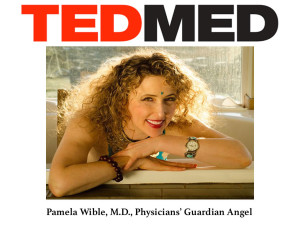



I’m a family physician in Eugene, Oregon—a sweet town where folks are pretty darn friendly. I still do house calls. Patients often surprise me with gifts. And nearly every appointment ends with a hug.
Kindness is contagious.
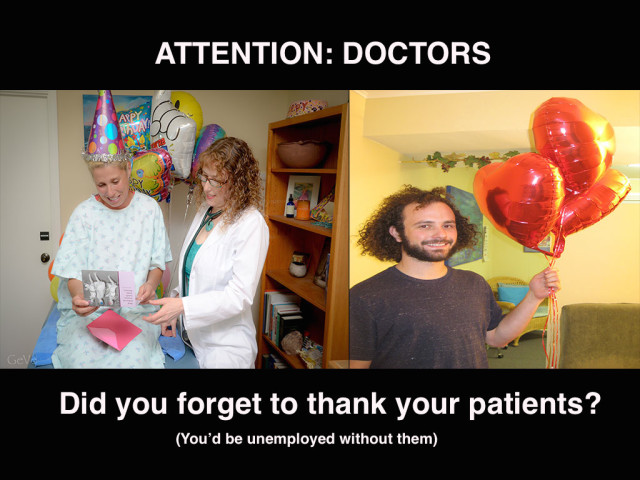
I like to return the favor. So every few weeks I celebrate “patient appreciation day.” I thank patients with balloons and chocolates. Why? For picking me as their doctor, of course. I figure I’d be pretty bored without any patients.
Patients are then inspired to share their appreciation with other doctors. What a great idea!
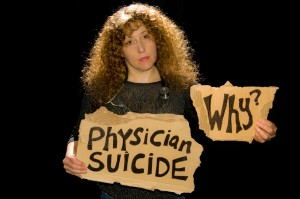
Physicians have a high rate of depression—and even suicide. Doctors treasure the cards and gifts they’ve received from patients over the years. Several docs have claimed that something as simple as a thank-you card has made their day—even saved their lives. Seriously.
Being thankful is good for your health. I keep a stash of thank-you cards with me so I’m always prepared. As a physician, I’ve learned that the best way to deliver health care is to care. In fact, I just delivered a keynote on the importance of caring to top health care leaders.
In St. Louis.
Thanks to my pilots.
P.S. The pilot wanted to know if I was going to be the one giving the massage. Nope.
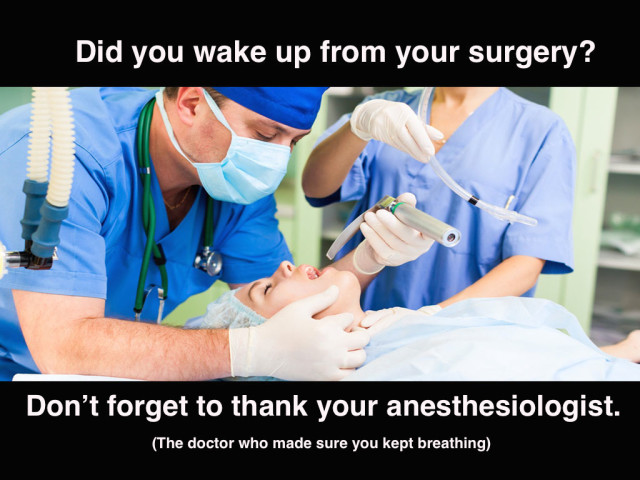
Pamela Wible., M.D., is the founder of the ideal medical care movement. To learn more about ideal care, watch her TEDx talk “How to get naked with your doctor.” Photo credits: Doctor office by Pamela Wible and GeVe. Anesthesiologist and pilots by Shutterstock.
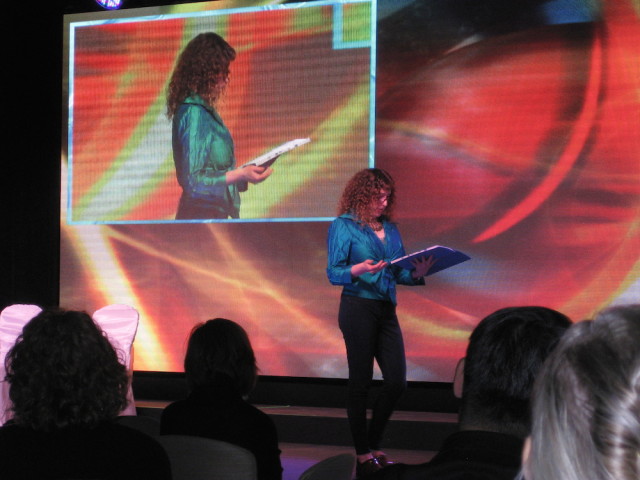
I just delivered a keynote in St. Louis to 600 health care leaders from a health system with 20 hospitals, 600 clinics, and 30,000 employees. They told me not to be afraid of the 12-foot-tall version of myself following me around stage. No problem. I’m one of the few people who has never been frightened by public speaking. The larger the audience the better.
Most people avoid public speaking. But it can be incredibly fun and fulfilling to inspire people from stage. Here are 7 secrets to wow the audience with your next speech—even if it’s not a keynote:
1. Inspire & motivate – The purpose of a keynote is to energize and engage the audience while delivering a profound message. Share your primary message in a way that excites the audience and makes them feel optimism and joy. Give simple and practical tips that can be implemented in their personal and/or professional lives.
2. Tell stories – People will remember how you make them feel and the best way to do that is with stories and anecdotes that teach your core message. Always use real-life adventures that the audience can relate to while guiding them on an emotional journey. Laughing one minute and crying the next is a good thing! And don’t be afraid to get a little edgy. People like the quirky and unexpected. So even though I was speaking at a Catholic health system with nuns in the front row, I told my erectile dysfunction story and even said a curse word or two. Yikes! I was a little nervous. But everyone laughed!
3. Be authentic – People today crave authenticity. Vulnerability is compelling so be raw and revealing. While speaking at a medical school on medical student suicide, I got real honest by reading excerpts from my med school diary that I had never shared with anyone. Guess what happened? I receive a standing ovation!
4. Love the audience – Know your audience. What they fear. What they love. Their greatest frustrations and desires. Arrive early and mingle with the guests. The more you understand your audience and their needs the better you will be received. Reference people in the room during your speech to bond with the group. This may sound really bizarre, but when I speak to medical students I feel very maternal. I’m so open-hearted, sometimes it feels like I’m breastfeeding. And I’ve never even had a baby!
5. Get active – To keep the audience engaged, get them up and out of their chairs. Ask them to do something. In the middle of my talk, I had everyone get up and hug someone. Then I taught them the right and wrong way to hug. Guess what happened afterwards? I saw people hugging up and down the hallway! And, of course, people wanted to hug me as I was leaving.
6. Call to action – Have one simple call to action. Challenge people to think and behave differently. Repeat your core message and the practical tips attendees can implement to improve their lives and careers. My basic call to action for the leaders of this Catholic health system: Love your patients. And don’t forget to hug them!
7. Have fun – A keynote is a performance. Get creative. Vary your volume, pacing, energy, and movement. Above all, enjoy yourself. Laugh. Be playful. Having fun is contagious! In retrospect, I would have liked to throw “FREE HUGS” T-shirts out to the crowd! Next time . . .
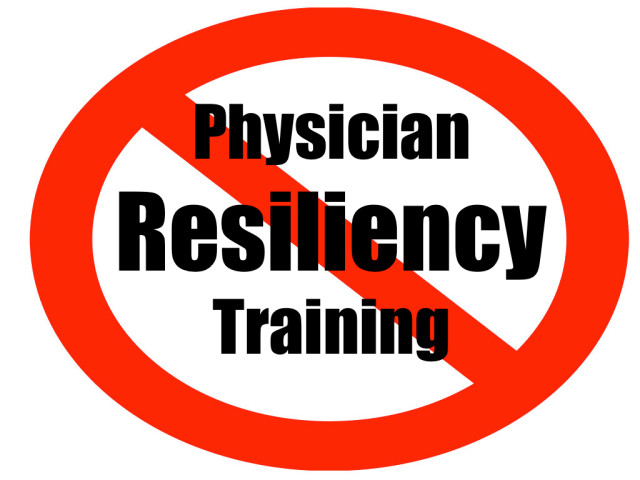
Here’s the latest medical fad: Physician resiliency training.
Huh?
Doctors are already the most resilient people on the planet.
Doctors can go days on call without eating. I know. I have.
Doctors can go 24 hours without a bathroom break. (yes, we even have the most resilient bladders!)
Doctors can work 168-hour shifts with little or no sleep as detailed in this whistleblower video.
Doctors can tell parents their child died in a car wreck and then immediately run a code in the next room—without shedding a tear.
Doctors can each amass up to 500K student loan debt for the honor or caring for other people’s families while delaying or giving up their own childbearing, their own family, their own life—and all the while being funneled directly from residency into assembly-line medical clinics where they are abused. Yes. Abused. For their entire careers!
By the way, none of the above leads to “work-life-balance.”
Resilient means flexible, strong, sturdy, tough, and quick to recover. That’s the definition of a doctor!
We’re already so tough, sturdy, and strong we spend our careers as the human equivalent of a punching bag. Doubt me?
According to the UN Declaration of Human Rights: Article 5. No one shall be subjected to torture or to cruel, inhuman or degrading treatment or punishment. Article 24. Everyone has the right to rest and leisure, including reasonable limitation of working hours and periodic holidays with pay.
Except doctors.
In my training, I assisted major surgeries with a full bladder, backed-up bowel, and a blood sugar of 24. My colleagues have worked hypoglycemic and sleep-deprived to the point of hallucinating and having seizures. There is absolutely NO organization that protects doctors who are routinely abused, mistreated, harassed, hazed, and humiliated.
Many of us have considered suicide, but we are so resilient that we smile and head back into the next room to see the next patient.
Please. Don’t train us to be more resilient. Train us to be more RESISTANT to abuse.
Hey doc, listen up. Have you been mistreated, injured, harmed, or damaged during medical school, residency, or by a health care employer?
Attention: Resiliency training will not help you. No amount of deep breathing will help you. No special yoga workshop for burned out doctors will be your salvation. You will never, ever, ever regain “work-life balance” while you continue to allow yourself to terrorized with fear tactics and trapped in an assembly-line clinic you hate.
Congratulations! You are already highly resilient.
Pamela Wible, M.D., is a pioneer is the ideal medical care movement and recipient of the 2015 Women Leader in Medicine Award. She leads physician retreats to help her colleagues overcome abuse and open their own ideal clinics.
My prescription: if a relationship isn’t working, end it. Now.
Recently an insurance plan told me they were sending a nurse to my office for a chart review that would take 3 hours. After 24 years of education, state licensure, board certification, and over 50 hours of continuing medical education each year, I’m not trusted to provide Pap smears or treat sinusitis without monitoring. OMG. I’m a solo doc. No staff. I can’t spend 3 hours being micromanaged by a nurse. I’m busy treating patients—and helping suicidal doctors struggling with the same insurance B.S. My solution: terminate contracts with all insurance companies.
Then—I gave my patients the option of terminating me. I even wrote the “Dear John” letter for them.
Love me? Love me not?
Dear Patient,
You may have received a letter from your insurance company indicating that I’m no longer an in-network provider with your health plan and that you will “need” to select a new participating provider in order to receive your plan’s benefits at the highest level. Is this true?
The truth is I will be out-of-network with all insurance companies as of June 1, 2015. This means that you may be responsible for a higher percentage of your office visit (call your plan for specifics). Ten years ago, I opened this clinic so that I could be a real doctor. Many insurance plans are making rather burdensome demands on in-network “preferred providers” so I’ve chosen to preserve my sanity—and still care for you. At this time, I will continue to submit your claims and expect nothing significant to change—other than your copay.
Let me assure you that I will continue to be your doctor regardless of your insurance plan—even if you have no insurance. I’m honored that you have chosen me to be your doctor and my commitment to you and to our relationship is lifelong. Since I never plan to retire, I will be here for you—until one of us dies. As in any relationship, it’s good to “renew our vows” with one another. I’m writing to find out if you wish to continue having me as your doctor—or not. If you value having a lifelong relationship with a doctor off the assembly line and believe my care is worth more than a $20 copay, I encourage you to say “yes.” 🙂
Please respond to this email with a “yes” or “no.”
Sincerely,
~ Pamela
P.S. If you’re uninsured, ignore the first two paragraphs. I welcome you, as always, with open arms. Please also indicate your intention to continue under my care.
And the results are in . . .
“YES! Abby and i have been down that road of Doctors that frankly wanna push pills and don’t care, we love you!”
“I am not interested and have asked to stop getting emails . . . I have had a new provider for over a year . . .”
“Uninsured, would still like to be under your care, please. I want to start having babies in the next few years, I need you! ~ Peace & love, Dakota”
“Yes! You betcha babycakes! U R my MD. XOXO”
“I don’t belong to a big insurane company plan—thank goodness. I get to see any doctor I want—and that’s you! ~ Blessings, Lynn”
“Hi Pam, I’m Yours. ~ Love, Roni”
“no”
“YES . . . till death do we part. I will always be your patient and you my doctor. Love, Sheri”
“Yes! THANKS for preserving your own sanity in a weird world!”
“Yes, yes, yes. One thousand times yes . . . I am so happy you are my doctor and proud of the work you are doing to improve the way medicine is practiced. Rock on, Dan”
“No.”
Honesty is the prerequisite to all successful relationships. When patients and physicians have the courage to be honest with one another, healing begins.
An investigation is underway after a Chicago-area doctor is found dead—a suicide according to the medical examiner. What demands investigation is the callousness with which the this doctor’s death was reported by the media—and received by neighbors, many healthcare professionals themselves.
I’m alerted to the death initially by a Facebook friend: “Pamela, check this out!” Headline: Police: Doctor found dead near hospital in Berwyn. (Interesting side note: on 4/21 ABC news changed this headline to “Man found dead near hospital in Berwyn.”)
The facts:
On Thursday, April 16, a maintenance worker calls the police to request a well-being check on a tenant, Dr. Jon Azkue, a 54-year-old physician employed at MacNeal Hospital.
Police discover his decomposed body with suicide note surrounded by helium tanks. Mistaken as propane tanks, police call the bomb squad and evacuate the 4-story building which primarily houses healthcare professionals and medical businesses. How do his neighbors and colleagues respond?
“I was actually going to get some baby food,” says Jemin George. “My daughter is in one of the vehicles and it’s been almost three hours since she’s had something to eat.”
“It’s an inconvenience for the patients,” claims Riz Ahmed, an employee at Chicagoland Retinal Consultants, a clinic located in the building.
Anna Futya, clinic manager at the retinal clinic, is also frustrated by the inconvenience. “All the calls that are coming here—whether from patients or doctors—nobody is able to answer . . . “
Wait, I thought this news story was about Dr. Jon Azkue. The headline clearly states: “Doctor found dead near hospital in Berwyn.” So why is the focus on inconvenience to patients? How did the dead doctor get scrubbed from the story?
Who is Dr. Jon Azkue?
My online research reveals that Jon Azkue is a foreign medical graduate from Central University of Venezuela who was a senior internal medicine resident at MacNeal Hospital at the time of his death. He was just a few months away from graduating.
In this news report, Dr. Azkue is treated as if he is guilty of a crime. There is no expression of sadness for the loss of this doctor—presumably a man who spent his entire career caring for patients in at least two countries. In the comment section—amid jokes about terrorist plots and remarks about the selfishness of suicide—Doc T writes:
Wow. I’m appalled by the lack of sensitivity for the loss of life here. I myself am in residency and unless you live through it, you cannot begin to imagine the stress and sacrifices that we and our families endure—far greater than missed eye appointments. My condolences to his family and colleagues. The journalist and editor should be ashamed of the slant through which they allowed this ‘news’ to be delivered.
Facebook comments continue throughout the afternoon where Cailean Dakota MacColl, a premedical student, is equally appalled. “Hi Patient X, your doctor is selfish and died by suicide so they cannot do your eye exam today.”
Heather Springfield, another premedical student, chimes in:
I had the same line of thoughts. What a sad situation that a fellow human being who dedicated their life serving/helping others, is considered an inconvenience. It’s pretty damn ridiculous that society cries for its physicians to have an open doctor-patient relationship—to not be robots—but the moment a doctor shows their shared humanity, either they’re sued/abused/or die by suicide because they can’t take it anymore… etc. etc. What the hell is wrong with people? I wish, as a populous, we’d stop acting as if we live on separate planets when in fact, we share one planet. How hard is it to take a moment, and realize we lost a precious life to something preventable? It’s a damn shame, and my heart mourns such a loss…. This shouldn’t have happened. Shame on those residents, clinicians, and those who don’t take pause for what this is.
Physician suicide: more questions than answers
With his suicide confirmed, the real investigation must begin. Why did he die by suicide?
And why do we lose more than 400 U.S. physicians each year to suicide? Why are these suicides not investigated?
Like most suicided doctors, Dr. Jon Azkue left a note. Why are we not analyzing these suicide notes for common themes to prevent future physician deaths?
Sadly, we are unlikely to hear any more about Dr. Jon Azkue. We will not hear about the many patients he cared for, the lives that he saved. This is his 5 minutes of fame.
Pamela Pappas, MD, a psychiatrist writes:
Rest in Peace, Dr. Azkue. Being a resident at age 54 is not easy, and I’m wondering about his life and what led to this kind of end. No mention of family being notified before releasing this news to public, etc. Our culture (both medical and non-medical) apparently regards doctors as dispensable. Yes, of course patients are ‘inconvenienced’ when a doctor dies! Houston, we have a PROBLEM here, and we need serious remediation.
Why is this news story so unsympathetic to this deceased doctor?
And why are clinics, hospitals, and medical schools so willing to sweep these deaths away—often with no debriefing for survivors. Why are physicians not receiving routine on-the-job mental health support for such a high-risk profession?
Georgia Jones, a Facebook friend, shares:
This is so sad. They [doctors] deserve to have therapy without being judged or the worry of losing their job. Schools need to start preparing students for what is to come, and have help in place if they become emotionally overwhelmed. It’s so sad that this is still happening. Doctors are human beings, like us. Start treating them as such. They’re not machines! They have emotions, and believe it or not, the death of their patients DOES affect them!! Give them a break! R.I.P. Dr. Azkue. I’m sorry it came to this.
Here’s the truth: until we investigate why this doctor died by suicide, we will continue to lose more doctors. Maybe if we took a sincere interest in Dr. Azkue’s death, we could prevent the next one.
Incidentally, Kim Aaronson, a chiropractor in Chicago, adds:
Here’s another note of interest, a local chef here in Chicago died by suicide on Tuesday of this week. It has remained in the news every day. (even covered in this NYT article) The doctor’s suicide has not even been mentioned. There is clearly uneven coverage going on here…. The FB comments show the kind of empathy the press should have shown…. You are so right on, a doctor dies and it seems that no one cares at all….