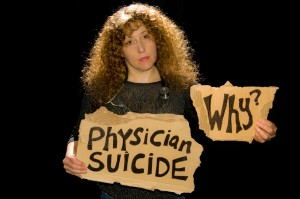
Medical school has killed my soul. What can I do? →

DearPamela

Hi Pamela,

I’m a medical student in the UK. Though I’ve only been in med school since September, it has already taken its toll on me. Before I started I was so in touch with my emotions, spirituality, and nature. Now I feel so empty and desensitized. I hate that when faced with the horrible circumstances of another person, I just don’t feel anything anymore. How can I overcome this? I so badly want to tap into the vibrant me from 6 months ago!

Before starting medical school, I was a curious and loving young man. My life hadn’t been plain-sailing: I had been through my parents’ divorce as a young teenager; I had suffered bullying in a hostile school environment, and I had come out of the closet as gay. All of these things sound quite monumental for a young person to go through, but nothing prepared me for the agony of medical school. You see, when my parents divorced, I was sad, I cried, I grieved for the family life I would no longer have, and I recovered. When I was bullied at school, I was hurt and upset, but knew they were wrong which gave me strength. And when I came out of the closet, I was bursting with emotion: of anticipation, excitement, terror. All of these experiences were by no means pleasurable, but I FELT them, and that’s what made me feel alive. They were painful, but they illuminated the happy times in my life and made me a stronger and more empathetic person as a result. I looked into people’s eyes and could sense their pain a little more because of my own personal experiences, and enjoyed feeling connected to their lives. I was spiritual. I would pray and meditate and marvel at the beauty of nature and humanity around me. I was genuinely excited for my life, the people I might help. I wanted to be intimate with people, rejoice in their success, and feel the pain of their sorrow.

Then I entered medicine.

From the first few days, I could tell something wasn’t right. I entered this profession with the intention of becoming a healer, yet, when I looked at my lecturers, I mainly saw didactic scientists, not healers. I looked around me and saw egotistical, power-hungry students. Many were concerned with status, competitive to the extent that they all wanted to outdrink each other on boozy nights out and have the most sex out of our whole group. They wanted to be the best at everything: in their exams, and in their personal lives. Yet no student has ever spoken with genuine concern and feeling for patients. When I organized a talk by two individuals suffering from HIV, hardly any of our class turned up—I’m talking about 2-3% of the students. When I asked some why they did not attend, many just didn’t care. “We don’t need to know it for our exams,” one said. “I don’t think I’d get anything from it,” smirked another. I was aghast by how little they cared. 

At this point, I really questioned the establishment of which I was becoming part. Even with the brightest soul and the best will in the world, it is hard to survive in an environment at complete odds with our own intentions. This soon took its toll on me. I felt like I was in a constant battle to retain my care, my love, my empathy. But I feel like I am losing. 

While the challenges in my life were at times very painful, medicine has caused me to feel something I never imagined could be so bleak—nothingness. It is quite astounding actually how little I feel nowadays. I have lost my libido (In fact, I have been convinced I was asexual for a time), and I feel numb on a daily basis, like a nurse has injected some local anesthetic into my heart which hasn’t worn off. Nothing seems to bother me anymore. After cadaveric dissection, nothing is gruesome, the boundaries by which I could operate on someone without feeling any hesitation are endless. There’s something about hammering a ribcage open with a chisel on a deceased old lady that breaks down those barriers for you, and they can never be built back up. In addition, disease and death are talked and laughed about in such matter-of-fact ways that they’ve become boringly dull to me. No longer am I heartbroken for the cancer patient, or devastated for the young mother who died in a car accident, because I feel nothingness. We are only ever taught about the scientific basis of afflictions, never the emotional or spiritual impact on both the patient—and ourselves.

My spiritual life has suffered too. No longer do I appreciate the world around me with the overflowing gratitude I used to hold. Instead, I just wallow. I am strongly considering dropping out of medical school to pursue another path, not because I detest the vocation, but because I am scared I am losing pieces of me that I will never get back. I am scared that after only 6 months, I am just a vessel with no life and that I will never feel what it feels like to feel ever again. I am scared I will never have another tear fall from my eye. Is really worth sacrificing my soul to this profession? I feel ripped apart.

Please let me know if there are any ways to cope with this torturous predicament.

With much love, even though it is so hard to gather from a numbed heart,

Luke

* * *

Luke,

Join our teleseminar this Sunday (scholarships available for med students)

You are not alone. Med students all across the world experience the dehumanizing effects of medical training. The basis of our education is a flawed reductionist medical model that views the human body as a machine—a bag of parts to be conquered. Reductionism (the opposite of holistic medicine) leads to mind-body-spirit disintegration. Consequently, you are losing connection with your heart and soul—the reason you went into medicine—the purpose of your very life. 

Loss of meaning, loss of self, leads to pain. Pain leads to self-medication with alcohol, drugs, sex—anything to numb oneself and distract from the loss of soul. Sustained numbing leads to permanent numbing and an inability to connect with oneself or others.

What can you do to overcome your loss of self? My best advice:

1) Keep a clear and unwavering focus on your dream—the original vision that led you to medicine. Read your personal statement daily. Hang it all around your house. Never allow anyone to steal your dream.

2) Surround yourself with inspiring mentors—other physicians who are living their dreams in medicine. They will guide you in the right direction. Avoid advice from cynics and naysayers for they are wounded too. I will totally get you into our mentorship group. Contact me here.

3) Maintain your physical health. Exercise, eat well, sleep. Balance your intellectual pursuits with time to relax and be INSIDE your body. I highly recommend weekly massage to help you remain present with yourself. The benefits are not just physical. To care for others, you must first care for yourself. Massage is a great way to learn how to receive care and to form a therapeutic relationship with a trusted healer who can help you through medical school.

4) Maintain your emotional health. I believe all medical students should receive weekly counseling with a professional (not a friend, not a spouse). If you feel sad, cry. Tears are cleansing. When humans bottle up their trauma with no outlet, they become numb, detached, sick.

5) Maintain your spiritual health. Whether you meet with your church pastor or meditate at an altar in your home, devote time at regular daily or weekly intervals to spiritual self-care or you will lose connection with your soul.

6) You must be well to guide others to health. By caring for yourself, you will not only help patients; you’ll help your classmates and teachers heal. They are wounded too. Be a beacon of hope for them. Even if triggered by your joy, they’ll be less likely to injure you with their pain. They need you.

7) When you are resourced and well, you will once again be able to look into people’s eyes and be a sacred witness to their suffering. You will experience true intimacy which means “in to me see.” For patients to see inside you, and for you to see inside them, you must be inside your body.

Blessings to you on your journey . . .

Love, 

Pamela

Want to heal your soul? Attend our next retreat!

* * *

Pamela Wible, M.D., was named one of the 2015 Women Leaders in Medicine by the American Medical Student Association. Dr. Wible is the author Physician Suicide Letters—Answered. Need a letter answered? Contact Dr. Wible

Tags: , , , ,
25 Comments

***

What do modern day shamans do? →

Pamela Wible Postcard

Dear Dr. Wible,

I wanted to pose a couple questions to you after reflecting on your TED talk and a couple of your stories. Also I wanted to say that I truly appreciate the awareness you’re bringing to the dysfunction in medical training, expectations for medical professionals, and the greed infiltrating one of the most tangible acts of empathy (medical insurance companies). You also recently spoke at an event on my med school campus. You made me feel as though I might not necessarily be walking into a bear trap as I become a physician—that perhaps medicine doesn’t equate with martyrdom if I take courage. Thank you.

If you happen to find a spare moment and think any of the following questions are worthwhile inquiries… What do you think med students leave out of their personal statements? What do modern day shamans do? What would the humanistic-doctor-personality do when/if the art of medicine is no longer necessary? Why do you take baths on the Internet?

Also this is a story I think you’d like if you haven’t already heard it. One of my classmates from Hawaii told me about a group of sea kayakers that honor their ancestors by traveling across the ocean every once in a while to their likely mainland of origin using traditional canoes. A few years ago their tiny boats were thrashed by storming waves leaving them lost and adrift. One of the members was a pro surfer, Eddie, and he knew the general direction of land and safety. He also knew he was strong and told the group he would swim for help. The group was found by search and rescue but the hero apparently was never seen again. Now when someone attempts a selfless act people say “Eddie would go” in memory of the young man in the prime of his life with a big heart.

Thanks for your insights and time. Also, I’m fairly certain if you replied it would be the highlight of my day. 

With Great Respect and Kind Regards,

Rusty Jones, OMS2

* * * 

Hey Rusty,

Here are my answers:

1) What do you think med students leave out of their personal statements? 

Words that might scare academic institutions that hold reductionist medicine as the only truth. Words like holistic, spiritual, transcendent, intuitive. Concepts that scare those who value only what can be measured, replicated, and billed to insurance companies. Medical students may leave out the most important part of themselves—their souls.

2)  What do the modern day shamans do?

Shamans heal through spiritual means and may consequently improve the human condition by bringing about restored health for all. The modern day shaman stands fearlessly against forces that erode our humanity and spirituality—even against modern medicine which has lost its way, lost its soul.

3) What would the humanistic-doctor-personality do when/if the art of medicine is no longer necessary? 

Search for the wounded. There will always be those who need help. Healing may not require potions, labs, and tests. The wounded may need time, attention, love. The humanistic doctor is adaptable and serves the needs of the world in the era in which he or she finds him/herself.

4)  Why do you take baths on the Internet?

To be real. To demonstrate how simple and fun and easy life can be when we don’t take ourselves so seriously. To show what doctors look like without the white coat. To break through the stereotypes that imprison us all. To break down the complex PowerPoints into simple rubber ducky routines. Maybe because I’m a cross between Lucille Ball, Patch Adams, and Marcus Welby. Maybe the modern day shaman doesn’t wear a white coat.

Love,

Pamela

* * *


Pamela Wible, M.D., is the founder of the Ideal Medical Care Movement. She was named one of the 2015 Women Leaders in Medicine by the American Medical Student Association for her pioneering contributions to medical student/physician suicide prevention. Dr. Wible is the author of the best seller, Physician Suicide Letters—Answered. Need a letter answered? Contact Dr. Wible.

Tags: , , , , ,
2 Comments

***

Tired after 200 patients? You need resiliency training. →

PamelaWible-R-U-Resilient?

Dear Pamela,

I just worked 36 hours in 3 days. Stick a fork in me. Must have seen close to 200 patients [in the emergency department] and picked up a nasty head cold from one of them. My throat feels like sandpaper and my mouth feels like the bottom of a birdcage. Last case was a 21-year-old asthmatic. All hands on deck—balls to the wall, IV, meds, monitors—the works in 10 minutes while trying to comfort her terrified mother at the foot of the gurney. Halfway into the epi and magnesium the gal sits bolt upright, screams with a high-pitched squeak, claps her hands 4 times over her head, goes out, bradys down to 30 and pukes all over her own face. Fuck me sideways. Direct laryngoscopy is a wash, as is Glidescope—too much shit, peas and potatoes pouring out of her mouth. Fuck, fuck, fuck. Cram an LMA in—nothing. Wait—let me wiggle it just a little—holy shit—the ETCO2 just turned a beautiful shade of egg yolk yellow. Sats improving, heart rate 38…42…50…66. I think it’s gonna be Ok. I’m not letting go of this fucking tube—anesthesia has to pry my fingers off it in order to work their bullshit with whatever magical fucking tools they use to swap out the LMA for an ET tube. I’m shaking and sweating and I think I might have peed myself a little. I’m weak and my ears are ringing and I’m not hearing anything anyone is saying. I see the mom sitting alone in a chair squeezing her bible and mouthing a prayer. I sit down next to her, hold her hand and thank her for her prayers. I tell her the honest truth—it was touch and go for a few minutes, but things are ok now and I honestly, truly believe it was her prayers that enabled us to do what we did. I thank her again. She thanks me. We hug for just a second and I leave before I start to cry. Came this-god-damn-close to a goddam dead 21 year old. Now she is going to live and hopefully have many, many more opportunities to eat dinner and laugh and love and pray with her mother. Don’t talk to me about fucking resilience. 

I’m so tired.

Jerry 

* * *

Poor Jerry. 

He’s so angry. 

How inappropriate. I hope he doesn’t get in trouble for being a “disruptive” physician.

Maybe he’s just burned out.  

Maybe Jerry needs to read a book on “work-life balance.”

Or take deep breaths.

Or sign up for a yoga class.

Or . . . 

Maybe Jerry isn’t the problem.

Maybe we should stop labeling, blaming, and shaming doctors like Jerry.

Jerry seems like a pretty fucking amazing doctor to me.

What do you think?

PamelaWibleBlaming

Pamela Wible, M.D., is a family physician who helps physicians recover from being overworked, shamed, and blamed. She offers biannual physician retreats and is the author of the best seller Physician Suicide Letters—Answered. Dr. Wible has been named the 2015 Woman Leader in Medicine for her pioneering contributions to medical student/physician suicide prevention.

Tags: , , , , , ,
24 Comments

***

Doctor explains insurance from bubble bath →

Hi! This is Dr. Pamela Wible and welcome to “Insurance 101” where I’m going to explain my philosophy about health insurance. So let’s just use the rubber duckies as kind of a teaching tool here. So this is you, the doctor, and here’s the patient. And so you all are sitting in the room doing your office visit. Maybe the patient came in with an ingrown toenail or bronchitis or something. And so you’re having your little session and everything’s hunky-dory. 

But you might kind of wonder why you feel like there’s so many other people in the room—other little ducks quacking at you. And here’s a group of little quacking ducks that might be passing by because in the average assembly-line medical clinic there’s five FTE staff per physician so, you know, here’s the coder, the biller, and all the people that you need to run that big assembly-line office. And you might feel like they’re kind of like traveling into your exam room with you. So now it’s no longer you and the patient. You’ve got like a bunch of quacking ducks in here.

And then you’ve got insurance companies, like these guys here are basically, look at this, like spitting on you, ya know. This one is spitting on your patient. And so the thing is if you feel like somebody is spitting and shitting on you it could be that you’ve got people in the room that really shouldn’t be there like maybe possibly insurance companies. Here’s another—maybe this is workers’ comp or something. There are some pretty massive insurance companies that could come right on through and disrupt what’s going on between you and your patient and have you filling out all sorts of the extra forms and paperwork that take like two, three, four times the amount of time that your office visit took.

And so I just want to encourage you to think clearly about what is best for you and for the patient. Is insurance serving you? I think for catastrophes, ya know, like lung transplants or things that are high ticket items obviously insurance may be necessary. But, ya know, for little ducky toenails and little ducky bronchitis is insurance necessary? So just give that some thought and in the next few videos I’ll share more about my philosophy on medical insurance.

Want to see more videos? Contact Dr. Wible here.

PamelaWibleTub4

PamelaWibleTub5

Pamela Wible, M.D., is a family physician and founder of the Ideal Medical Care Movement. She hosts physician retreats where she helps doctors and patients design ideal clinics and get back to healing. She is the author of Amazon’s #1 best selling Physician Suicide Letters—Answered and Pet Goats & Pap Smears. Please Contact Dr. Wible anytime. She returns calls from her bathtub perch above the Pacific Ocean. 🙂

Tags: , , , , , , , , , , , , , , , ,
41 Comments

***

I’m Dr. Wible and I speak for the victims →

DoNoHarm

On February 4, 2016, I delivered this speech to 250 citizens of Missouri at a fundraiser for a documentary on physician suicide.

I’m here to speak for the victims—medical students and physicians who’ve died by suicide and others on the edge now who have written to me. I simply ask that you open your heart to their words . . .

Dear Pamela ~ I definitely graduated from med school with PTSD. It has changed me forever. I will never be the same again.  We had two suicides and one murder, skull crushed with a bat, and one serving life in prison for murdering a classmate during a delusional episode after not sleeping for a month. Please change medical education. We were so beaten down. It takes a lot for me to cry, but I cried all the time along with everyone else. But we hid it from each other, of course. ~ Maria


Dear Dr. Wible ~ I’m not sure you read your [Facebook] messages but feel compelled to thank you. I was finishing term two of med school and had a bottle of Xanax in my hand. I was ready, as so many of us are. I took three then three more and came across your talk, “How to graduate medical school without killing yourself ” which I believe may have saved my life and a couple of close friends who are also suffering. [He was in the process of a suicide attempt and my lecture popped up on his Facebook feed] I’m near the top of my class and praying for death to escape the trap I’m locked into. I was in true delirium from lack of sleep and fear of failure. Studying in my sleep and waking up every hour in panic. Med school is doable but why must it be taught in this format? I read your stories and I’m just in shock how many others feel like I do or I feel like they do. Please keep sharing. You are saving lives, friend. ~ Chris 

For each person I help, there are thousands more on the edge.

Each year more than one million Americans lose their doctors to suicide.

PamelaWible-1Million copy

Across the country, our doctors are jumping from hospital rooftops, overdosing in call rooms, found hanging in hospital chapels. 

It’s medicine’s dirty secret. And it’s covered up by our hospitals, clinics, and medical schools. No medical school wants to be known as the suicide school. No hospital wants to be #1 for interns jumping from rooftops. No one wants to become a doctor—to kill themselves. 

So why? What the hell is going on? And why is this such a secret? And why am I piecing this together between patients?  I’m a solo family doc, yet somehow I’ve become an investigative reporter, a specialist in physician suicide. Why? Mostly because I can’t stop asking why. Why both doctors I dated in med school died by suicide. Why 8 doctors killed themselves—just in my sweet little town. So I keep talking and writing—and listening for the truth. And because I’m listening with my heart and soul 24/7, my cell phone has turned into a suicide hotline and I’ve received hundreds of letters from suicidal physicians.

Like this letter I just received from an intern: “While in the ICU I joked about jumping from the helipad and a nurse said ‘well it’s about time, we’re due for another one. It’s been a few years’ I worked 118 hours last week and was told I’m not committed enough. And being the only woman if I show any feeling or compassion or pain I’m ‘over emotional’ and when families hug me I’m told I should have been a social worker.”

PamelaWible-ICUquote copy

Suicide is never a joke. Students and doctors are crying out for help. And they are met with callousness—and even encouraged to kill themselves. These letters that I’ve published in my newest book, Physician Suicide Letters—Answered, reveal the pervasive and largely hidden medical culture of bullying, hazing, and abuse that claims the lives of countless medical students, doctors, and patients. Students who ask for help are often labeled (in evaluations and transcripts) as unprofessional, not a team player, inefficient, too sensitive, lazy, angry, idealistic. They are even told they have “inappropriate feelings.” Victim blaming and shaming creates desperate people and desperate people take desperate actions to end their pain.

So how does the system respond?

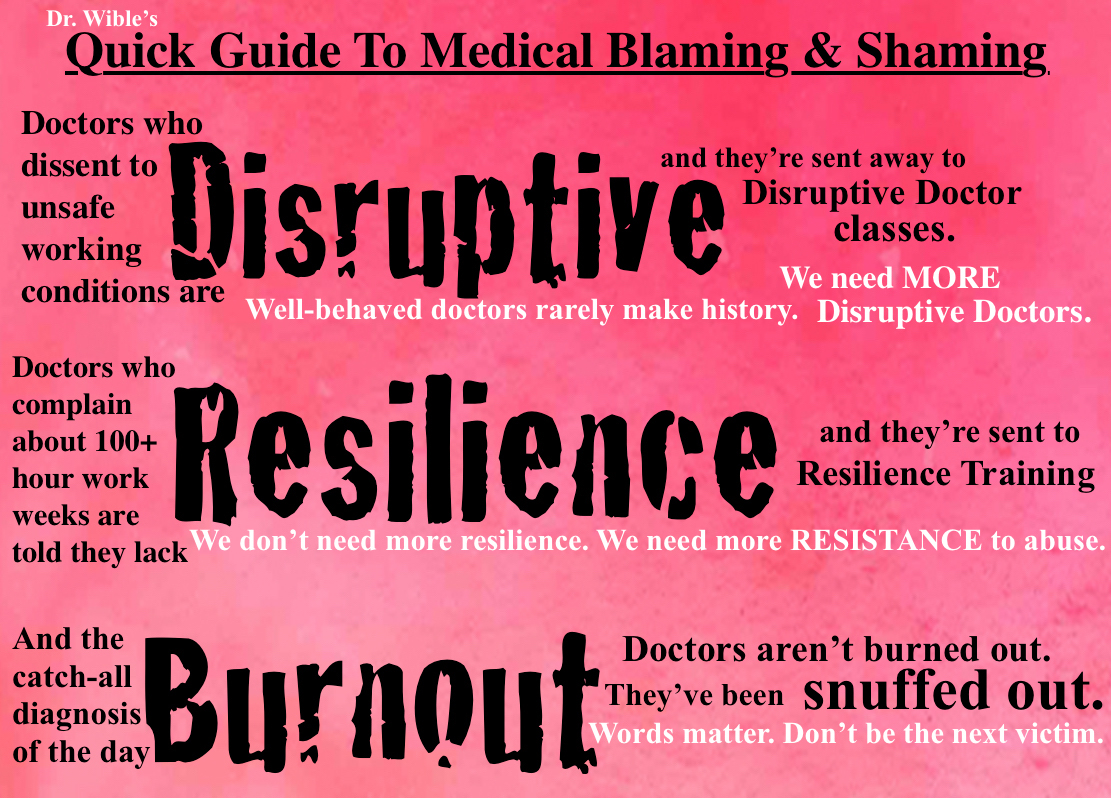
1) Doctors who dissent to working conditions are diagnosed as DISRUPTIVE (and are mandated to attend disruptive doctor classes). Well behaved doctors rarely make history. We need disruptive doctors.  

2) Doctors who complain about 100+-hour work weeks are told they lack RESILIENCE (and are sent to resiliency training). We don’t need more resilience. We need more resistance to abuse.

3) And the catch-all diagnosis of the day—BURNOUT. Doctors aren’t burned out, they’ve been snuffed out.

PamelaWibleBlaming

Like Dr. Greg Miday who sought help from the Missouri Physicians Health Program—an agency with no physician oversight that controlled his medical license. They told him NOT to follow his psychiatrist’s safety plan. Hours later he died after slicing the arteries in his wrists and ankles.

Like Dr. Kevin Dietl who couldn’t get the help he needed for occupationally induced depression. He killed himself just weeks before his graduation from a Missouri medical school. Michele and John Dietl were to be celebrating their son’s graduation, instead they attended his funeral.

Like the 3 medical students who died last week—a triple suicide. Three female medical students in India threw themselves into a well. In their suicide note they cite excessive fees, bullying, and abuse. This is a global phenomenon. And suicide pacts happen in the US too. Two female family medicine residents in Oklahoma died by overdose together (with a gun as backup).

Thankfully, MISSOURI is shining a spotlight on this crisis and blazing a trail for us all. Yes, the Show Me State is showing us what can be done.

Why Missouri ? 1) State Rep Dr. Keith Frederick is spearheading legislation to help depressed and suicidal medical students and  2) Dr. Stuart Slavin at St. Louis University is humanizing the medical school curriculum with excellent results for student mental health and 3) Families like the Dietls and Midays are speaking up about their physician children who have died in St. Louis for lack of the care they needed.

How can you support our efforts?

1) Read Physician Suicide Letters—Answered to grasp the current conditions of medical training. We can’t solve a problem nobody knows exists. **All book proceeds will be used to humanize our medical education system and help save the lives of suicidal medical students and doctors.**

2) Support the documentary Do No Harm so that the world can see the truth behind the white coat.

3) Keep talking and shining your light on this topic. “When we all shine our lights together, there is no darkness to fear.” 


Pamela Wible, M.D. is the founder of the Ideal Medical Care Movement and an activist in medical student and physician suicide prevention. She has been named one of the 2015 Women Leader in Medicine for her pioneering contributions to medicine.


5 Comments

***

ARCHIVES

WIBLE’S NPR AWARD

Copyright © 2011-2026 Pamela Wible MD     All rights reserved worldwide     site design by Pamela Wible MD and afinerweb.com