

Politics, Health Care, and Humanity

Welcome to the Ideal Medical Care Blog ~ where politics, health care, and humanity intersect ~ your home for intelligent, provocative commentary on the movement to achieve ideal care for all. Inspired? I welcome your comments.

Pamela Wible MD

Posted in Ideal Medical Care | 8 Comments

***

Physician, First Do No Harm—To Yourself

A psychiatrist in Seattle had picked out the bridge. At 3 a.m. he would swerve across his lane and plunge into the water. Everyone would assume he fell asleep.

A surgeon in Oregon was lying on the floor of her office with a scalpel. Nobody would find her until it was too late.

An internal medicine resident in Atlanta heard an anesthesiologist joking about the lethal dose of sodium thiopental. Alone in the call room, she would overdose that night.

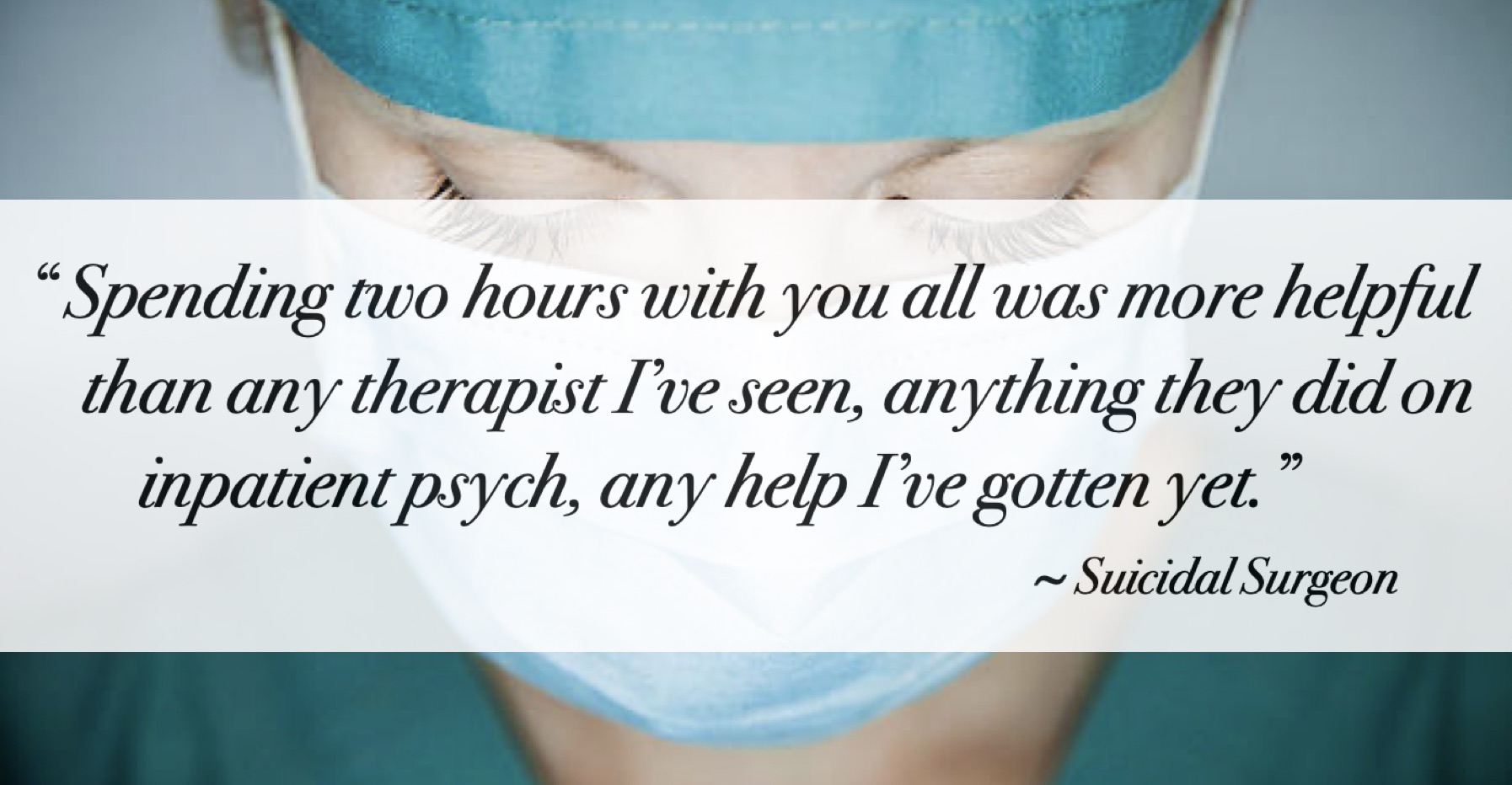
Three planned suicides. All three physicians survived. Why?

While preparing to overdose, the internist was interrupted by an endocrinologist calling to check on her. Before grabbing her scalpel, the surgeon called several physicians pleading for help—I responded immediately. Two days before he was to drive off the bridge, the psychiatrist spotted my ad for a physician retreat. He called me begging to attend.

One week later, I’m hiking through the Oregon Cascades. The scent of cedar envelops me as I approach the lodge where I’m welcoming physicians who have arrived from all over the United States and Canada, all of us on a pilgrimage for answers.

Tonight we begin a retreat for doctors who yearn to love medicine again. Studies confirm most doctors are overworked, exhausted, or depressed. The tragedy: few seek help.

I ask the group, “How many physicians have lost a colleague to suicide?” All hands are raised. “How many have considered suicide?” Except for one woman, all hands remain up—including mine.

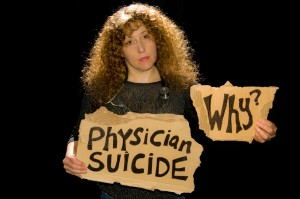
“Physicians have the highest suicide rate of any profession,” I explain. “In the United States we lose over 400 physicians per year to suicide. That’s the equivalent of an entire medical school. Even that’s an underestimate because many physician suicides are incorrectly identified as accidents.”

I tell them, “Both men I dated in med school are dead. Brilliant physicians. Loved by their families and patients. Both died young—by ‘accidental overdose.’ Really? How many physicians accidentally overdose?”

The room is quiet.

It’s easier to say accident than suicide. Doctors can say gonorrhea and carcinoma. Why not suicide? Maybe we can’t face our own wounds.

“I’m a family doc in Eugene, Oregon, where we’ve lost three physicians in eighteen months to suicide. I was suicidal once. Assembly-line medicine was killing me. Too many patients and not enough time sets us up for failure. Rather than kill myself, I invited my patients to help me design an ‘ideal clinic.’ It is possible to love medicine again.”

The Canadian doctor to my right wipes her eyes. “I’m feeling so discouraged. I want to give up and work at Starbucks. My head is exploding from banging it against the system.”

A bright-eyed, blonde woman reveals, “I just took a leave of absence from med school because it was ‘killing my soul.’ Three classmates attempted suicide.”

A newlywed couple join in. “I’m a nurse. My husband is an internist. He’s suffering, but I don’t know how to help him. Doctors don’t seek psychiatric care because mental illness is reportable to the medical board. He fears he’ll lose his license.” Her husband adds, “I was suicidal three months ago. On the edge. My wife and I are hoping to find answers here.”

Here, physicians, nurses, and medical students share their wounds and their wisdom—in community. We share new practice models, communication techniques, and strategies to care for ourselves—so we can care for our patients.

In four days, I witness more healing than in four years of med school. Once strangers, we’ve become family. Parting ways, the psychiatrist from Seattle thanks me again.

I didn’t know these doctors, but I know their despair. By speaking about my own pain, I validated their pain. By being vulnerable, I gave them the strength to be vulnerable too.

But mostly we healed each other by not being afraid to say the word suicide out loud.

Physician, First Do No Harm – To Yourself. Scalpel, syringe, needle, pain pills, car key.

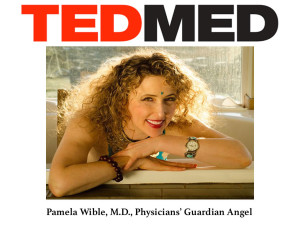
Pamela Wible, M.D., is a family physician, author, and expert in physician suicide prevention. She offers biannual retreats for physicians struggling with burnout and depression. Contact her at idealmedicalcare.org.

Posted in Ideal Medical Care | Tagged | 4 Comments

***

Why Health Care Lacks Love

I am a woman doctor, but I inherited a patriarchal medical model. A patriarchal medical model rewards male values.

MALE VALUES:

  • Speed
  • Volume
  • Bigness 
  • Toughness
  • Graphs
  • Charts
  • Algorithms
  • Proof
  • Strength
  • Fighting (war metaphors)

But I am a woman doctor. I have female values.

 FEMALE VALUES:

  • Relationships
  • Nurturing
  • Hugging
  • Joy
  • Laughing
  • Crying (feeling deeply)
  • Spirituality
  • Sharing
  • Caring
  • LOVE!

To be accepted in a man’s world, women adopt male values. A patriarchal medical model produces masculinized women doctors. I did not go into medicine to be a masculinized woman doctor. I went into medicine to be a healer—and a woman. And that’s what I am.

If you believe that love is health care please “like” and share with your friends!

Watch video: “I Love Men, But I’m a Woman Doctor.”

Pamela Wible, M.D. is a 100% woman doctor who practices family medicine in Eugene, Oregon. She is author of Pet Goats & Pap Smears: 101 Medical Adventures to Open Your Heart & Mind, a book that celebrates the love a woman doctor has for her patients.

Posted in Ideal Medical Care | 4 Comments

***

Preventing Physician Suicide, Depression, Burnout

Turn off your cell phone. Get off the grid. Take a deep breath and say, “Ah . . .”

You are invited to Live Your Dream: Revolutionize Your Medical Practice, a healing retreat for physicians at Breitenbush Hot Springs. Take refuge with like-minded colleagues who realize that healing health care begins within.

Reclaim your vision, and then liberate yourself to practice medicine in alignment with your values—and the values of your community. Rest, replenish, and retreat with kindred spirits while learning to engage community, thrill patients and staff—even slash overhead and increase your income!

Learn effective practice models, cures for common office irritants, medical marketing, media and more. Soak, sauna, and soothe your soul while mastering the business, leadership, and community organizing skills you never learned in medical school so you can launch your own ideal clinic (or love your current practice).

Breitenbush Retreat and Conference Center is a worker-owned cooperative and intentional community on 154 acres of wildlife sanctuary in the Willamette National Forest of the Oregon Cascades. The Breitenbush mission is to provide a safe and potent environment where people can renew and evolve in ways they never imagined.

Enjoy snow-capped mountain vistas overlooking the Breitenbush River while soaking in the hot springs with your new physician friends from all over the country (and Canada!). Hike ancient forest trails and walk the labyrinth. Savor three bountiful, organic vegetarian meals daily with vegan and gluten-free options. Sleep peacefully (and uninterrupted) in cozy, geothermally heated cabins.  Breitenbush is a healing vortex and sanctuary that allows busy clinicians to take a break from technology and focus on personal goals and dreams.

Live Your Dream: Revolutionize Your Practice is offered biannually. The next retreat will be April 23-26, 2013. Mark your calendar!  Plan to stay an extra day or two before or after the workshop if you like. Optional massage and bodywork is available onsite for an additional fee. The event is open to doctors, medical students, nurse practitioners, and other health care professionals. Scholarships are available to medical students and others in financial need.

Live Your Dream is offered by Pamela Wible, M.D., a Eugene-based physician who pioneered the first community-designed ideal clinic in America. Her model is now taught in medical schools. She trains physicians nationwide, has been interviewed by CNN, ABC, CBS, and is a frequent guest on NPR.  She has expertise in preventing physician suicide, depression, and burnout. Co-facilitator is Kassy Daggett, a highly skilled coach and therapist. Learn more: www.IdealMedicalCare.org.

For rapid registration: Please email Dr. Wible through her website with your contact information. Space is limited. Register now to secure your spot.

Posted in Ideal Medical Care | 2 Comments

***

My Love Affair with Medical Waste

I’m an obsessive-compulsive collector. So is my dad.

Raised in a morgue, I worked alongside Dad, the city medical examiner. Over fifty years, he amassed a huge collection of medical artifacts. My siblings don’t want any of it. So now I’m the curator of the collection.

Dad carefully ships the specimens to me. Today, I open my mailbox and discover a bag full of pacemakers and pessaries, a priority package of bullets—all retrieved from human bodies.

Physician family heirlooms. Some see only medical waste. But I see marvel and mystery, beauty and art, and mostly my love of medicine–a love I share with my dad.

I don’t believe in throwing away people or parts of people or parts of people’s stories. I can’t discard the device that saved a woman’s life or the bullet that took a man’s breath away.

And so my bedroom is a museum of medical art, a morgue of half-lived lives, of hopes and dreams, lost and found–all in a one-of-a-kind collection of pacemakers and pessaries, bullets and bones that live near my necklaces and nightgowns.

I’m a doctor and a storyteller. One day, I shall tell the untold stories of unnamed people I’ve never met. And I shall bring their medical waste back to life.

Posted in Ideal Medical Care | Leave a comment

***

Yes, Men Need Pap Smears Too!

Go ahead and laugh, but it’s true. Men get Pap smears too.

Not all men. Just high-risk men who have sex with men.

The female Pap smear is a screening test for cervical cancer, which is a sexually-induced cancer caused by the Human Papillomavirus. The Human Papillomavirus is also easily transmitted to the anus in men who have sex with men. Anal Pap smears screen for abnormal anal cells that may lead to anal cancer.

But don’t worry guys. You won’t need a large vaginal speculum for your exam. Just a small, friendly swab about the size of a Q-tip.

Now watch a LIVE Pap smear demo here:

Pamela Wible, M.D. is a family physician and author of Pet Goats & Pap Smears.

Posted in Ideal Medical Care | Leave a comment

***

Love Is Medicine

It’s Valentine’s Day 1997. I’m at Sacred Heart Hospital admitting a colleague’s patient—an elderly man dying of heart disease. On oxygen, gasping for life, he exchanges no words. His wife—unable to bear the pain of watching him die—leaves the room. So it’s just the two of us this Valentine’s Eve. A blind date. No champagne. No candlelit dinner. I could leave too, but it doesn’t seem right to let this guy die alone on this romantic day. So I sit with him, hold his hand, and cry.

A cardiologist looks in. Startled by my emotion, he says, “You must be a new doctor,” then disappears down the hall.

Maybe old doctors don’t cry, but I don’t want to close my heart to the wounded. I don’t believe in professional distance. I believe in professional closeness. And I believe in loving my patients.

During my pediatric rotation in medical school I used to stay up late at night in the hospital holding sick and dying children. I’d lift them from their cribs and sing to them, rocking them back and forth. One day the head of the department gave me a compliment I’ll never forget. He said that I was a doctor when my patients needed a doctor and a mother when they needed a mother.

A few years ago I visited the foster home where my nephew lived before he moved in with me. I spent the weekend with a dozen teenage boys, all on psychiatric medications. An autistic child had just moved into the home that day. As it got dark, he begged me to tuck him into bed. That night I tucked all 12 boys into bed and kissed them goodnight. When the foster mom found out she said, “You crazy. Them boys hasn’t been kissed in years!”

Some patients don’t need a pill. They need a kiss.

Photo by Spark Boemi

Pamela Wible, M.D., is a family physician in Eugene, Oregon. She is author of Pet Goats & Pap Smears: 101 Medical Adventures to Open Your Heart & Mind.


Posted in Ideal Medical Care | 8 Comments

***

Tribute to a Cowboy Doctor

After two decades of formal education, today I’m finally set loose with real patients. It’s the actual moment I’ve been waiting for my entire life.

We’re each assigned to a family doc for the month. I scroll down the list of third-year medical students, place my right index finger beside my name, slide it across the page, then read aloud: E. Sinks McLarty, Jr., M.D., III.

The next morning I find his office—a small nondescript building with his name on the side—and enter the waiting room, which features 1970s-style wood paneling, faded and covered with the grime of decades of cigarette smoke. Centrally located is a large oil portrait of E. Sinks McLarty, Sr., M.D., who opened the place nearly 100 years ago. I pass rows of empty chairs to the front desk, where I meet three bouncy women—all relatives of Dr. McLarty. I introduce myself to the friendly, frenzied group of chatty chart finders, then the garrulous gang scurries me down a narrow, smoke-filled hallway where I meet Dr. McLarty’s nurse, affectionately nicknamed “Olive Oyl.”

A friendly, slender, snappy-tongued woman with a gravelly voice, Olive Oyl chain-smokes at her desk. Her deep red lipstick and nail polish are the color of freshly clotted blood. She escorts me into a dimly lit room where I’m not at all sure I’m safe. There, on the couch, I meet Dr. McLarty—a seventy-year-old cowboy eating Metamucil wafers while puffing on a pipe. He wears Wrangler corduroys and sports a crew cut with some gray hairs shooting through. With his thick Texas twang, he slurs his words together around southern slangisms and medical anecdotes.

With pen, paper, and stethoscope, I follow Dr. McLarty around to see what I can glean from him. I’m immediately struck by his speech with patients. He calls all the men “pahdna” and all the women “shuga.” Isn’t that sexual harassment?

Dr. McLarty has no tolerance for big-government rules. When a patient needs a triplicate form signed, he snaps, “Well, now, shuga, that’s a bunch of horseshit!” or “I don’t give a ram dam or a rat’s butt!” While cursing, he signs the forms, gives one to the patient, and throws the other two across the room in a wad. “Hell, I’ll make toilet paper out of it one day,” he rambles as he tramps out of the room.

Dr. McLarty makes even the common cold an event to remember. “Okay, now, pahdna, let’s look in that there snoot. Ah, a little redness, nothing to say grace over. Let’s listen to your ticker while I gotcha here.” Slamming down the chart, he exclaims, “You’ve prob’ly got some of that damn crud we’ve seen going around!”

In the next room, an elderly woman complains of joint pain. His diagnosis: “You’ve got arthritis! Well, hell, you can see that. No need to pay for that, shuga. Now hold that cane in your left hand and tell Byron to give ya a damn golf ball to carry around in the right.” He didn’t cure her arthritis, but she looked like an avid golfer when she left.

After seeing a few patients in the morning, Dr. McLarty closes down for a two-hour lunch. We all squeeze into his office on the couch to watch soap operas. During a romantic interracial scene, they shake their heads in unison. “Oh, no! We don’t believe in that!”

So I offer the clan some of my chocolate soy ice cream and one gal gasps, “Oh, no! My husband wouldn’t like that!” Dr. McLarty puts down his Metamucil wafer and grabs a spoonful. “That’s pretty darn good!”

After lunch we’re getting ready to see a man named “Sunshine.” Before entering the exam room, Dr. McLarty pulls me aside and says, “This family’s been shot in the damn butt with bad luck!”

“What’s going on?” I ask.

“He got cancer. I’ve known a week, but gonna break it to him now.”

“Why didn’t you tell him last week?” I ask.

“If he lived by himself, I’d a told ’im right away this is how the cow ate the cabbage, but his wife, Lordy, ya couldn’t scrape her off the wall last night,” he rants as he trudges down the hall.

I gathered that Sunshine’s wife was extremely anxious.

We enter the room. Doc pats the old fellow on the shoulder and says, “Sunshine, now I ain’t gonna pull any punches by tellin’ ya we got a drug.” After a few cryptic sentences, he asks, “Ya get what I’m sayin’?”

Sunshine replies, “Yep! Lights out.”

That was the entire office visit.

Most of Doc McLarty’s patients are old white guys who have aged right alongside him. But this afternoon, we jump into Doc’s old pickup to see a young gal in the hospital. On exam, he notices her breast implants and asks, “Hey now, shuga, how long ya had these damn things blown up that way?” She answers politely and the interview continues without a hitch.

We only saw one kid that month. As the boy raced around the exam room, Dr. McLarty quickly warned, “Hey now, pahdna, get back up there on that there table. We don’t want ya to bust your gazoo!”

I’ll always savor my month with E. Sinks McLarty, Jr., M.D., III. I didn’t learn much about diagnosing or treating disease, but I learned a lot about human relationships and the art of medical practice.

I sure miss him.

So, after fifteen years, I track him down to thank him.

He answers on the first ring.

With my heart pounding, I ask, “Is this really Dr. McLarty?”

“Yep, this is Doctor McLarty. Who the hell is this?” he shouts.

“I’m a medical student you mentored long ago, and I just want to say thank you.”

“Well, thank you, sweetie, but I got cancer of the bladder and just had therapy today, and I’m bleedin’ like hell!” Before I can express my sympathy, he quickly blurts out, “What comes around goes around. Thanks for calling on me, but I gotta go pee again!”

He hangs up on me.

That’s it.

I never even tell him my name—not sure he would have remembered me—but I do get to thank him before lights out.


Chapter 66 from Pet Goats & Pap Smears,  Dr. Wible’s best 101 patient stories from 20 years of medical practice.

Posted in Ideal Medical Care | Leave a comment

***

A Tale of Two Testicles

Evan, a retired police officer, calls for an urgent appointment. I can hear the angst in his voice.

“Sure Evan, come right over.”

An hour later, he arrives in obvious distress. “I gotta show you something, Doc.” We proceed to the exam room. He pulls his pants down and points to his left testicle. I put on gloves, turn on the exam light, and l lean in real close.

“What’s the problem?” I ask.

“Look, Doc. Can’t you see?”

“What?”

“My left testicle is hanging real low.”

“That’s it? No pain?”

“No pain. But look how low it is!”

I stand up. “Evan, here’s the deal: most people hang lower on the left. In women, the left breast is slightly larger and hangs lower. For men, the left testicle generally hangs lower. So you’re in with the main crowd.”

“I’ve been this way my entire life?”

“Yep. You’re normal.”

Evan smiles. Relieved, he hands me his co-pay and a five-dollar tip. As he leaves, I add, “Just so ya know, most curvy penises also curve to the left.”

Chapter 52 from Pet Goats & Pap Smears,  Dr. Wible’s best 101 patient stories from 20 years of medical practice.


Posted in Ideal Medical Care | 2 Comments

***

Medical Aquarium Warning

Many busy clinics display a large fish tank in the waiting room. Staring at fish can help patients relax and lower blood pressure and anxiety before appointments. But how do fish feel about staring at miserable patients all day long?

In the fall of 1999, an exotic eel makes his feelings known. One morning he jumps out of the tank, flinging himself across the waiting room.

A kind older man picks up the eel; that’s when the eel attacks him.

When I arrive at work, the poor man is in the procedure room, with doctors pulling the eel off his finger while the clinic manager is on the phone with the malpractice carrier. I’m not sure whether we have liability coverage for eel attacks.


Chapter 70 from Pet Goats & Pap Smears: 101 Medical Adventures to Open Your Heart & Mind by Pamela Wible, M.D.

Posted in Ideal Medical Care | 2 Comments

***

Geckos, Goats & Stethoscopes

Residents in Salem, Oregon, are designing an ideal medical clinic. Slated to open by April 2013, the clinic may feature a dinosaur exam table, a cool gecko that greets patients at the front desk, and maybe even a pet goat. But the final design will be determined by citizens gathering at town hall meetings over the next few months.

Community-designed health care is nothing new. Citizens in Eugene, Oregon, pioneered the first community-designed ideal clinic back in 2005 (see video). Now, ideal clinics have opened all across America.

Dr. Lara Knudsen, a board-certified family physician, and her husband, Chris, are bringing ideal medical care to families in Salem at Happy Docs Neighbors’ Clinic. They imagine relaxed appointments; walking visits in a beautiful park; patients’ pictures on the walls; superhero gowns; weekend hours when the whole family comes in; an annual clinic picnic; and lots of laughter.

Now, Lara and Chris are turning their dream over to the community. They’re asking residents to design Salem’s ideal clinic. I spoke with them after their first town hall meeting to find out how things are going.

Pamela: “What are you specifically asking citizens to do?”

Lara:  “We want to know what patients would love to get out of seeing their doctor, what they imagine an ideal clinic would look, smell, sound, and feel like. We are asking citizens to attend one of our town hall meetings and share in writing, voice, song, prose, or dance their wildest ideas.”

Pamela: “Why open an ideal clinic?”

Lara: “In medical school and residency, I often questioned my choice to go into medicine. Pretty early on I realized that when I had TIME with people, to sit on their hospital bed and hear about their families and jobs and lives, then there were few things I loved more than medicine. It’s hard to have enough time with patients when working in a large system, so I quit my job and decided to ask the community to help me design an ideal clinic.”

Chris: “The big secret is that most of the things that patients hate about the system are exactly the things that doctors hate. Most of the things that patients want are what doctors want, too. So why not put our heads together and figure out a way to make our clinic what WE—patients, families, and doctors—want? Let’s build a beautiful healthful system, however small, that we can all be proud of, that reflects our values and encourages us to treat one another as neighbors.”

Pamela: “How did your first town hall meeting go tonight?”

Lara:  “We met for an hour and a half at the Salem library. We handed out paper, pens, markers, and asked folks to imagine their ideal clinic.  People were already brainstorming about ways they could help. They didn’t share everything on their sheets so when we got home and read the comments, it was really like Christmas as a kid. I should be headed off to bed, but I am still tingly and excited from it.”

Pamela: “What makes a doctor all tingly and excited?”

Chris: “It’s connection with patients. Folks had so many cool things to say. One man, a current patient, told me after the town hall that he and his wife believe that Lara’s approach to caring for him saved his life. Now he wants to give back to Lara and the community. And another patient hadn’t gone to a doctor for 67 years. He was literally shaking when he met Lara. A shut-in, scared and diabetic, he came and shared his love for Lara and his aim to help us create a clinic. It was really wonderful.”

Pamela: “So now patients are healing doctors?”

Lara: “Yes. Healing goes both ways. The current system is dehumanizing for patients—and doctors.”

Chris: “Doctors who don’t know you flipping through charts asking you the same questions over and over again is depersonalizing for everyone. A guy offered this analogy: ‘It’s like when you go to your public defender and you’re in court and he tells you, ‘Just say no, no, no, to everything.’ And you’re like, ‘But what about my case? What about my file?’ And he’s like, ‘You think I have time to read that stuff? I don’t have time to read anything.’”

Pamela: “Yeah, great analogy. So who came up with the idea for a dinosaur exam table?”

Chris: “A 20-something computer store employee said, ‘If the exam bed were in the shape of a dinosaur, I would go to the doctor then!’ So now we’re looking for carpenters to make our dino-exam table.”

Pamela: “And someone else wanted geckos?”

Chris: “As brainstorm fodder, I wrote words and questions on the white board. One word was animals? So a guy asked, ‘What did you mean by animals?’ I told him some clinics have cats, dogs, fish, and even therapy goats. He smiled and looked relieved, ‘Well then I would say geckos. We have a gecko and he is really cool and I would love to bring him.’”

Pamela: “What surprised you most from the evening?”

Lara: “People thought that we’d get overwhelmed, inundated by patients. ‘Everyone in town will want you!’ one guy said.  We told him that yes, at some point, we’d post a notice on the website: ‘Sorry, but we are not accepting new patients until our current ones get healthier. Keep checking back though!’ And one guy in the back (the same guy who talked about his public defender’s lack of personal attention) said, ‘You know? That makes me feel accountable to other patients. Like, knowing that other people won’t get to be in this clinic because I am still sick would actually motivate me to take better care of myself.’”

Chris: “Amazing! We hadn’t even thought about that, but it creates patient accountability. Patients will rise to the level of functionality we expect. And that guy blew us away with this immediate understanding of what we were getting at. He saw it before we did.”

Pamela: “So how can people get involved? What do you say to get folks to participate?”

Lara: “Attend the next town hall meeting! Would you and your in-laws like to have a dinner with me? Perhaps your church has members who would like to help design an ideal community clinic. What about your classroom of third graders? Your coworkers, softball team, economics class, motorcycle club? We want to build our meetings through the people we meet. More adventure that way. So send us your group, the number of people, and a proposed date and time. We’ll fit you in.”

Pamela: “Anything else?”

Chris: “Location! Think outside of the sterile, florescent-lit, paper-gowned box. Think of the coolest, most comfortable, most convenient place where you would want to visit your doctor. Then consider if you have friends who happen to have that place. Look for easy walking distance to a park, 250 square feet minimum, and rent between free or barter and $700/ month.”

Pamela: “How can people contact you?”

Lara: “Have a great idea? Go to our website and share it with us at Happy Docs Neighbors’ Clinic!”


A drawing of Chris and Lara planning an ideal clinic.


Pamela Wible, M.D. is a family physician in Eugene, Oregon and author of  Pet Goats & Pap Smears, a book that documents how Oregonians pioneered the first community-designed ideal medical clinic in the nation. She trains physicians (and other health care workers) to lead town hall meetings and open ideal clinics at her biannual retreats.

Posted in Ideal Medical Care | Leave a comment

***