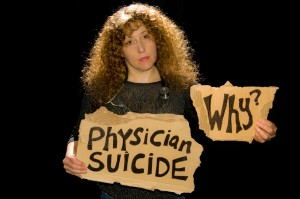
Can depressed doctors get emotional support without risking their license? Is confidential mental health care even possible?
I just got this email from a physician:
“Hi Pamela, Wondering if I could curbside you on the topic of seeking mental health services as a physician. I am not suicidal or impaired, but considering consultation with a psychiatrist for medication. Any chance you would be able to chat with me for a short bit to discuss tips for seeking consultation while avoiding stigma and labeling?”
Sadly, most medical professionals fear seeking mental health help due to stigma and labeling that can follow a physician for a lifetime.
I run a suicide helpline for physicians. So I’ve got a unique vantage point. I’ve spoken to thousands of medical students and doctors with anxiety, depression, and suicidal thoughts.
In fact, doctors seeking help may suffer lack of confidentiality, board punishment, and license repercussions. Punishing physicians for occupationally induced or exacerbated mental health conditions is cruel and all too common in medicine.
I have 13 tips to help depressed doctors get confidential mental health care. So keep reading (& take notes) . . .
Physicians have trouble asking for help. By the time doctors request help, they’re often in dire straits. By punishing the most vulnerable at their greatest moment of need, we increase the already-high suicide rate for doctors.
Even worse, when medical boards are involved, our private pain may be viewed publicly—in perpetuity—as one doctor shares:
“Do you know what really hurts? The fact that anyone can look me up on the Internet and read my dirty laundry. I’m publicly shamed [by my medical board], punished for being ill. I will only know peace when I am gone.”
So how can we prevent doctor suicides if we punish doctors who need help? How can medical professionals be assured their private suffering is not shared publicly?
My best advice comes from more than a decade of hearing worst-case-scenarios from med students and physicians who have faced persecution when seeking help. I’ve gleaned best workarounds and navigation strategies from victims—and their psychiatrists, many now adept at protecting physician patients.
13 proven strategies for confidential physician mental health care
1. Avoid care through your educational institution.
HIPAA’s privacy rule does not apply to “education records” or “treatment records” at educational institutions under the Family Educational Rights and Privacy Act (FERPA). I know trainees sent to school psychiatrists who breach their “perceived” confidentiality by sharing medical charts with deans and program directors. FERPA health records are HIPAA-exempt and courts have ruled students have no private right of action for a FERPA violation.
2. Beware of mandatory Physician Health Program (PHP) referrals.
Forced mental health care by an employer or medical board is never the best way to get confidential psychological support. Many medical institutions fund PHPs—a financial conflict of interest—plus PHPs charge medical professionals high fees not covered by health insurance. Doctors fear PHPs and some are left destitute after seeking help.
3. Bypass Employee Assistance Programs (EAPs).
If you suffer work-related mental health problems, seeking help from an employer-funded counselor presents a conflict of interest and risks a confidentiality breach. A surgical resident shares:
“I struggled with lack of sleep in a program which eventually was put on probation for duty-hour violations, though we were bullied into lying about our hours. Any violations were our fault, not the program’s. I was picked on by a more advanced resident, and the PD sent me to EAP because he thought I was the source of the problems. They sent me to a psychologist who diagnosed me with ADD. He sent me to a psychiatrist, who added bupropion and methylphenidate to my escitalopram. I ended up not having my contract renewed in the end.”
4. Confirm that your sessions are confidential.
Ask if your records and communications will be 100% confidential. Inquire about exceptions to your confidentiality. Health professionals may be mandatory reporters, legally bound by state laws to report abuse. HIPAA allows health professionals to breach your confidentiality if you are a threat to yourself or others.
5. Confirm that your private medical records are stored securely.
Physicians’ personal medical records have been accessed to discredit them and discriminate against them for disability insurance, licensing, hospital privileges, and medical liability cases (even during divorce and custody battles). Publicizing private medical records online is a form of extreme shaming and bullying. To protect physicians, some health professionals use biometric fingerprint safes to store handwritten paper charts with fake names. Psychiatrists may hospitalize docs under fake names and place VIPs (like high-profile athletes) in fake charts, never stored with other charts or in EMRs. An emergency doc reveals:
“I was sued. Overwhelmed with grief and fear, I took antidepressants and saw a psychiatrist. I paid cash and considered using a false name. I had already seen the Board send a physician to 6 weeks of inpatient alcohol treatment due to a complaint without any proof he was drinking. That saved his license but he owed an astronomical bill.”
6. Avoid having your mental health documented in an EMR.
From hackers and government agencies to prying eyes of peers, you are forever at risk of a confidentiality breach with electronic records. One physician wrote:
“Psychiatry has been weaponized against physicians . . . with libelous entries placed into the EHR by psychiatry sucking up to admin after a physician reported misconduct [and patient safety issues] at that hospital, the EHR becomes a battleground for a false narrative against YOU. If you complain to the board or any other agency, first thing they do is read your personal EHR, which is now ruined, falsely stating psychiatric diagnoses or substance abuse you don’t have! Reputational harm can be severe, and could cost you lots to defend yourself before a board, including hiring forensic psychiatrists to testify that you’re not nuts.”
7. Don’t use your insurance.
To keep the medical-regulatory complex out of your private matters, it’s best to avoid having psychiatric billing codes attached to you. A mental illness may be used against you by the board, in a malpractice case—even be grounds for denial of disability and life insurance policies. One psychiatrist reports:
“I deal with these issues all too often. Appalling that a patient should be afraid to utilize their expensive personal insurance to pay for mental health or be unable to ‘fully divulge’ the extent of their suffering to allow me to best help.”
8. Go out of town or go virtual.
Doctors in small towns don’t want to sit in a psychiatrist’s waiting room next to their own patients. High-profile physicians don’t want to be locked up on inpatient psych at their own hospital. To get confidential care, many choose telehealth services or travel out of town. A physician friend shares:
“After reading an article about one woman’s journey through hell after being honest on those [medical board] application questions, I sought care an hour away. I drove an hour in another direction to nervously fill prescriptions for antidepressants. I required several meds to stop thinking of suicide all day every day. My suicidal thoughts were 100% work-related.”
9. Consider pharmaceutical confidentiality.
To avoid picking up psych meds at the local pharmacy, doctors may fill scripts out of town. Medical boards and government agencies can access state pharmacy records so some doctors use Canadian mail-order pharmacies to avoid US mental-health persecution. Here’s one workaround a physician shares:
“I used samples of Paxil and had my spouse write me prescriptions for Lexapro, Buspar, Paxil, and sleeping pills over the years. I did not trust other doctors. I did not want any of this stuff in my records as I did not want to be seen as ‘crazy’ (this is how many doctors refer to psychiatric patients).”
10. Be familiar with your state board rules, statutes, and applications.
Most board applications ask mental health questions and threaten license revocation for lying. A physician shares:
“Applications also ask about gaps in education, training, or employment. Essentially they are fishing for more information. Responses like ‘leave of absence to get treatment for a chronic medical condition’ will be met with requests for medical records or other information. So even if you get past these first questions, applications are designed so you’ll have to disclose one way or another.”
Then, in tiny-font print before the signature line you will likely be waiving your HIPAA rights:
“The submission of an application to the Board shall constitute and operate as an authorization by the applicant to each physician or health care practitioner whom the applicant has consulted or seen for diagnosis or treatment—as a waiver by the applicant of any privilege or right of confidentiality.”
Physicians are terrified they may lose their livelihood—even if their job is killing them. One doctor reports:
“I’ve been in practice 20 years and have been on antidepressants and anxiolytics for all of that time. I drive 300 miles to seek care and always pay cash. I am forced to lie on my state relicensing every year. There is no way in hell I would ever disclose this to the medical board—they are not our friends.”
What happens when you declare your mental illness to the medical board?
Two doctors share their experiences:
“I was definitely subjected to discrimination, and it comes up EVERY TIME I apply for a new job, license, or malpractice. All I had was run-of-the-mill outpatient managed depression, and I probably should have chosen to just lie about it like 95% of applicants must, but I didn’t, and almost twenty years later it’s still hanging over my head.”
“By checking the ‘YES’ box: ‘Have/are you treated for depression?’ I was required to sign a five-year consent agreement, with stringent quarterly regimen; each quarter, the following had to be submitted to the state board: evaluation letters from multiple colleagues to affirm my fitness for practice and appropriate interactions with staff and patients, scheduled meetings with an assigned psychiatrist for validation of my fitness for practice, and a meeting with a board subcommittee, all completed prior to that month’s board meeting. All because I did not hide having been depressed and was (am) still taking an antidepressant. I’ve always wondered what would’ve happened if I’d just lied and said I’ve never been depressed.”
Of course, even if you lie, the board has the power to subpoena medical records.
Curious where your state medical board stands on mental health issues? Here’s my only peer-reviewed article that ranks every state—Physician-Friendly States for Mental Health: A Review of Medical Boards
11. Review hospital privilege and insurance applications.
Many hospitals ask similar invasive mental health questions. Check wording on applications for hospital staff, insurance credentialing, disability, and life insurance.
“I’ve seen good friends denied disability and life insurance policies tiered to same as 1-pack-per-day smokers because of history of depression (even well controlled with meds). Coercive and unnecessary referrals to PHPs. Sometimes boards take away the physician’s freedom, dignity, even license. Agencies and some boards don’t differentiate between illness and impairment. They apply policies of ADA and HIPAA differently to physicians in the name of ‘protecting public safety.’ Licensing agencies and corporate medicine can mandate release of information without any sign of impairment. Our physician ER colleague had to fight 10 years for her license due to disclosing feeling the ‘baby blues’ at work. Discrimination SHOULD NOT and DOES NOT only apply to a few listed categories of race, gender. Discrimination due to one’s profession is also a type of discrimination that is not addressed when it comes to physicians’ rights.”
12. Beware of sharing your mental health with colleagues (especially market competitors).
Sadly, physicians are highly competitive and they are encouraged to rat each other out by medical boards and hospitals as this woman explains:
“The only time my physician fiancé got into trouble with the boards of both Texas and Ohio was from a coworker. This other doctor believes that anybody and everybody who is medicated for mental illness is an immediate danger to his patients. So when he overheard my fiancé talking about being on antidepressants (chronic depression since 18 years old due to abuse in his childhood—a fact he always spoke openly about during college, residency, and career) he reported him to the Ohio board. They put him on probation for 5 years even though he never made a major mistake. Then the Texas board heard about it. He didn’t have money or time to run to Texas for the hearings, so he voluntarily gave up his Texas license. That blackballed him with Medicaid and several pharmacies. No wonder doctors are killing themselves.”
13. Consider curated and confidential peer support.
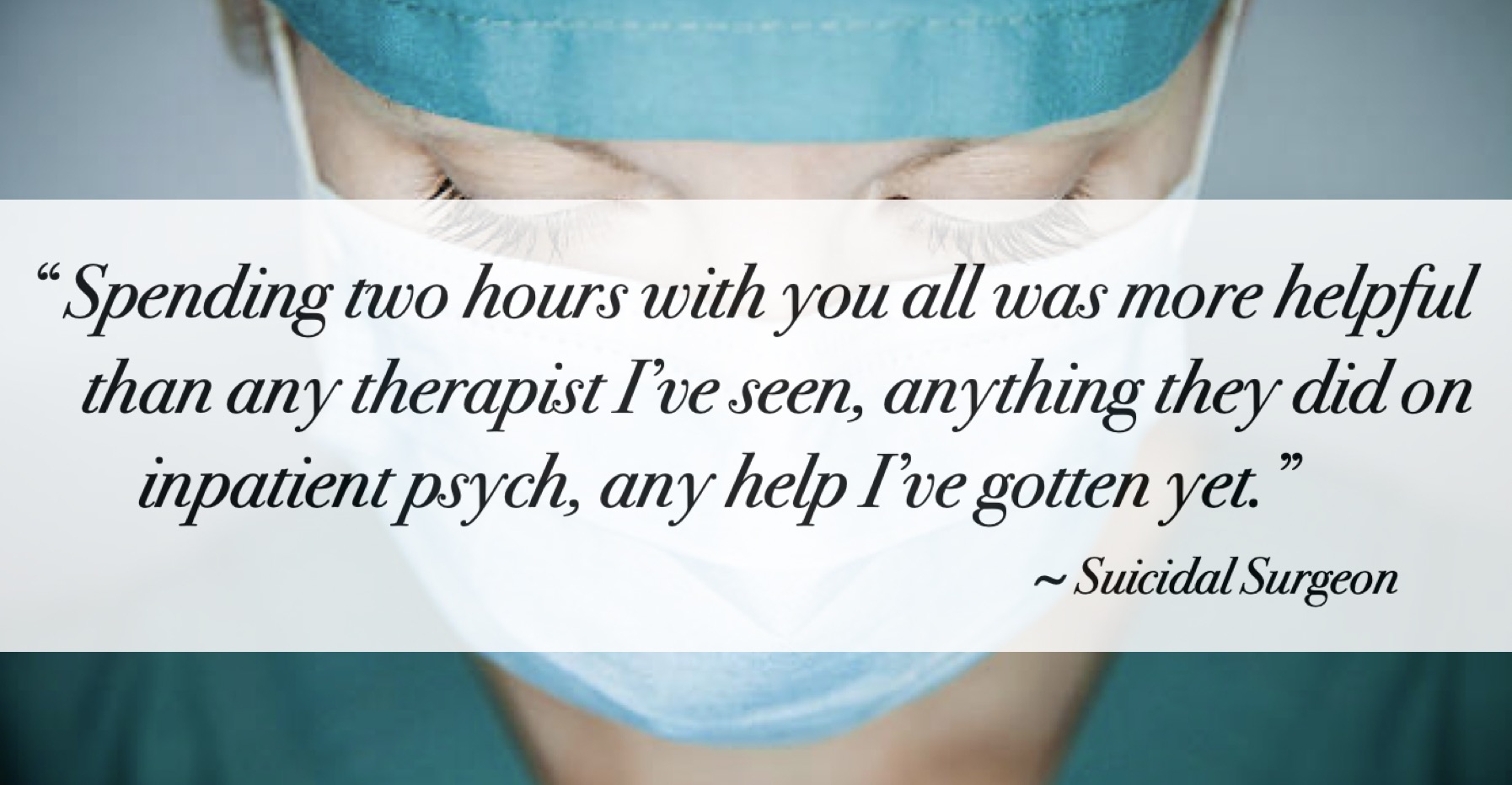
Often the most impactful first-line intervention for depressed doctors is peer support. Not with your coworkers or market competitors, but with an intimate group of up to 10 physicians who meet regularly to heal from suicidal thoughts, childhood or residency abuse, isolation, divorce, business problems, and more. No records. Nothing to subpoena. I’ve been curating physician peer support groups every Sunday for a decade. A suicidal surgeon shared, “Spending two hours with you all was more helpful than any therapist I’ve seen, anything they did on inpatient psych, any help I’ve gotten yet.”
No matter what—ALWAYS seek the care you need.
Despite the physician mental health witch hunt, YOUR LIFE IS PRECIOUS. Always choose your health first—no matter what the career repercussions—as this physician shares:
“Since being hospitalized with severe suicidal depression, I have lost my privileges, malpractice insurance, a current case (malpractice) now wishes to settle instead of defend my care (patient died of blood transfusion reaction not negligence on my part), my specialty society is failing to let me sit for MOC, and these events are all reported to the board so I will face an investigation soon. It breaks my heart that as a society and community of physicians we do not extend the same care and concern that we extend our own patients. I tried so hard to handle my own mood disorder without the help I desperately needed because of the repercussions I knew I would face. Going to the hospital was the very best thing I have ever done for myself. I am facing a total loss of my career and livelihood but I can now handle it and stay alive.”
So back to you—the physician who wrote me tonight for a curbside consult on seeking tips to avoid stigma and labeling when consulting with a psychiatrist for medication.
You wanted to chat with me. I called you twice this evening and got no answer. Then I texted you. Since I couldn’t reach you and I wouldn’t have been able to summarize my best advice in a quick call, I wrote this article just for you.
Bottom line—you are unlikely to be guaranteed 100% confidentiality unless you see a psychiatrist who keeps locked-in-safe paper charts (with a fake name) and claims no idea who you are if subpoenaed by Board. You’ll need to always pay cash, get meds filled at an out-of-state (or out-of-the-country) pharmacy. You’ll need to keep your mental health completely separate from your employer, med board, hospital, insurance plan, and anyone else who you do not trust 100%—and never agree to “mandatory” mental health care with “preferred” providers through your workplace or other medical institutions.
Of course, if you want 100% confidential peer support—join us Sunday. As always, if you need to talk—I’m available. Free. No chart notes. Nothing to subpoena. 😃 Yay! 🎉
Let me know if you have any more questions.
If you are a psychiatrist reading this, do let us know any other stealthy tips you use to keep docs safe.
Without help, here’s what depressed doctors do (when nobody’s looking)
Emergency Retreats for Physicians





 Do mental health issues caused by being a premedical student get better when accepted to medical school?